
 Worksheets
Electrical Fault Finding 6
Total questions: 31
Worksheet time: 16mins
To ensure any test instrument is fit for purpose, it should be
Calibrated every month
Tested every 6 months
Replaced every 12 months
Checked every time it is used
The instrument used to determine the ability of a protective device to function after a fault is
An approved continuity tester
A PFC tester
An insulation resistance tester
An EFLI tester
A 30mA RCD is tested and suspected of being faulty. When a current of 5 times IΔn is used to test it, the device should operate within
15 ms
30 ms
40 ms
300 ms
A fault has been reported on a piece of equipment. To assist with fault location, why is it worthwhile checking previous maintenance records?
They will explain how the equipment works
They may include up to date circuit diagrams
They will identify how often the equipment is maintained
They may identify a similar fault or gradual deterioration.
For fault diagnosis, collection and analysis of data may involve
Contacting the council
Contacting the Health and Safety Executive
Talking to users
Contacting building control
Which dangerous gas is emitted from lead acid cells?
Helium
Nitrogen
Oxygen
Hydrogen
When carrying out insulation resistance testing, to prevent damage to equipment the tester must ensure that
All incandescent bulbs must be removed
All electronic equipment is disconnected
All motor isolators are turned off
All heating elements are turned off
When working with fibre optic cables, a special precaution that must be taken is it
Never get them wet
Ensure total cleanliness of joints
Avoid touching the outer sheath of the fibre strands
Avoid exposure to sunlight
Which of these is a suitable test procedure to prove the operation of an RCD, when using an RCD tester?
Test between the line conductor of the protected circuit, and the associated CPC. The load should be disconnected during the test.
Test between the live conductor and the circuit protective conductor. The main switch should be off
Test between the line and neural conductors connected together, and earth at the consumer unit. The load should be disconnected during the test.
Test between live conductors. The test should be carried out with the main switch off, all fuses in place or MCB's turned on and any lamps removed.
Twin and earth, PVC cables are restricted to maximum operating temperatures of
80°C
50°C
70°C
60°C
A circuit breaker in a consumer unit keeps tripping. An electrician carries out an insulation resistance test between live and earth and gets a reading of 3Ω. What is the likely cause of the circuit breaker tripping?
Live conductor connected to earth
Overload
Open circuit
Circuit breaker rating too low
The neutral wire on a socket outlet has become disconnected from its termination. This fault would be detected as
A high resistance joint
An open circuit
A short circuit
Insulation resistance failure
A new 3 phase and neutral distribution board has been installed. Before powering up the boards, tests are carried out and a line to earth short circuit is found at the board. Which of these is a possible cause of the fault.
Two of the phase conductors have been reversed
A line conductor, and cpc conductor have been connected to the same point
The neutral has not been connected to earth
There is an open circuit on one of the phase conductors
Transient voltages are more usually caused by
Incorrect protective devices on the HV side
Switching on the LV side
Switching on the HV side
Circuit overload on the LV side
An inspection schedule shows that five years ago, the insulation resistance between live conductors and the cpc of a 400V welder connection point was 120MΩ. Now the reading is 50kΩ. A possible cause is
The cpc conductor is broken
A faulty RCD
An open circuit
Cable insulation damage
A socket outlet is damaged and badly discoloured. What is the likely cause?
High resistance connection
Fault switch
Incorrect size fuse fitted
Short circuit
Motor starters have overloads. These devices should be set to match the motor’s
Short circuit current
Earth fault current
Full load current
Tripping current
The setting of the overload is calibrated in
Coulombs
Amps
Bolts
Ohms
When a vacuum cleaner is plugged into a particular socket it intermittently stops working. What is the most likely cause?
A loose cable in the socket
The motor has burnt out
A broken wire in the plug
The plug contains the wrong size fuse
An electrician is called to a problem on a 3 phase motor. The operator reports there was a louder than usual humming from the motor and the motor shaft appeared to vibrate rather than rotate. What is the likely cause of the problems?
The cpc has become high resistance
One of the supply fuses has blown
Two of the motor phases are short circuited
The overload has tripped
The ends of a fluorescent lamp are constantly lit but the rest of that tube is dark. What is the likely fault?
The light switch is failing
The starter is permanently closed
The starter is permanently open
The room’s supply voltage is too low
A faulty socket is replaced in a bedroom. Which document should be issued to the person ordering the work?
Electrical installation certificate
Minor electrical installation works certificate
Electrical installation condition report
Schedule of testing
An engineer has just completed an Electrical Installation Condition Report. What action should the engineer now take?
The engineer should keep the original report, and send a copy to the National Inspection Council
The person ordering the report should be given the original report, and the engineer should keep a duplicate copy
The owner of the installation should be given the original report, with a copy going to the Local Authority, and the person who requested the report, if this is not the owner.
The Local Authority should be sent the original report, and a copy given to the person who ordered the report.
An electrician is working in a small high street shop and explains to the owner that it is necessary to isolate the electrical supply. In order to safeguard his customers what should the owner do?
Install temporary lighting
Close the shop until power is restored
Have staff escort any customers round the shop
Only allow a limited number of customers into the shop
An engineer is replacing some wiring and damaged overload trunking at a small furniture factory and production of one section has had to be stopped for the work to be done. Who does the engineer need to keep informed about the progress of the repair, and why?
The factory owner, so that a new profit forecast can be made
The health and safety representative at the factory, because work is being carried out overhead.
The electrical wholesaler, in case any more materials are needed at short notice
The production manager, to ensure that the most appropriate decisions can be made
HSE Guidance Note GS38 requires test probes to
Be the same colour
Be fitted with a 13A fuse
Have finger barriers to guard against accidental hand contact
Be insulated to leave an exposed metal tip not exceeding 10mm
An electrician working on a fault machine’s control panel in a large factory finds a fuse which has blown, and there are no spares for that size.
Fit the nearest larger fuse size
Report this to the stores
Fit the nearest smaller fuse size
Report to the maintenance supervisor for advice
The risk of electrical shock during fault diagnosis can be greatly reduced if
All employees have the same qualifications and experience
Only calibrated test equipment is used
All isolators and switches are correctly labelled
The supervisor keeps the keys to any lock off devices
Which of these pictures show the correct settings for using a multi meter to safely measure an a.c. voltage?
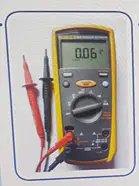
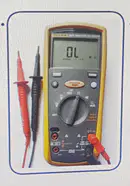



What test is being carried out in this diagram?
A continuity test of circuit protective conductors
A polarity test
An insulation resistance test between live conductors
An insulation resistance test to earth

The test instrument being used in this picture is
An earth fault loop impedance tester
A voltmeter
An ammeter
A low resistance ohmmeter

