
 Worksheets
Electrical Fault Finding 4
Total questions: 30
Worksheet time: 18mins
The risk of electric shock during fault finding can be greatly reduced if
The supervisor keeps the keys to any lock off devices
All employees have the same qualifications and experience
All isolators and switches are correctly labelled
Only calibrated test equipment is used
Which of these pictures shows the correct setting for using a multimeter to safely measure a.c voltage?


During the periodic inspection of an industrial installation, the engineer notes the absence of any main protective bonding. What action should the engineer take?
Identify on an Electrical Installation Condition Report, that there is a potentially dangerous situation and urgent remedial action is required
Isolate the installation and classify as C1 on a Periodic Inspection Report, to identify that there is danger present and immediate remedial action is needed
Tell the owner that having no protective bonding is classified as C3, and an improvement is recommended
Inform the person responsible for the installation, that it does not comply with BS 7671, but it is not unsafe
A safe system of work has been planned for a large installation. Which document will need to be produced?
Permission to operate
Secure system of operation
Building control notification
Permit to work
When should maintenance reports and records by fully completed for any repair work?
Within 3 months
When the repair is finished
Halfway through the job
Within 1 month
An electrician is working in a small high street shop and explains to the owner that it is necessary to isolate the electrical supply. In order to safeguard his customers what should the owner do?
Only allow a limited number of customers into the shop
Close the shop until power is restored
Have staff escort customers round the shop
Install temporary lighting
An engineer has just completed an Electrical Installation Condition Report. What action should the engineer now take?
The local Authority should be sent the original report, and a copy given to the person who ordered the report
The person ordering the report should be given the original report and the engineer should keep a duplicate copy
The owner of the installation should be given the original report, with a copy going to the Local Authority, and the person who requested the report, if this is not the owner.
The engineer should keep the original report, and send a copy to the National Inspection Council
An engineer is replacing some wiring and damaged overhead trunking at a small furniture factory and production of one section has had to be stopped for the work to be done. Who does the engineer need to keep informed about the progress of the repair and why?
The production manager, to ensure that the most appropriate decisions can be made
The electrical wholesaler, in case any more materials are needed at short notice
The factory owner, so that a new profit forecast can be made
The health and safety representative at the factory, because work is being carried out overhead
An electrician has been called to a fault on a control panel and finds there are no indication lights illuminated. What is the most likely cause of the problem?
Loss of supply
The emergency stop has been pressed
The indication light bulbs have all blown
The overload has tripped
When a vacuum cleaner is plugged into a particular socket it intermittently stops working. What is the most likely cause?
The plug contains the wrong size fuse
A broken earth wire in the plug
A loose cable in the socket
The motor has burnt out
Which of these is likely to result in arcing?
Loose connection
Overload
High resistance
Incorrect size fuse
What is the possible cause if a high resistance joint?
An uninsulated joint
A loose connection
Use of lead / tin solder
A tight connection
Transient voltages are more usually caused by
Incorrect protective devices on the HV side
Circuit overload on the LV side
Switching on the LV side
Switching on the HV side
An inspection schedule shows that five years ago, the insulation resistance between live conductors and the cpc of a 400V welder connection point was 130MΩ. Now the reading is 40kΩ. A possible cause is
Cable insulation damage
The cpc conductor is broken
A faulty RCD
An open circuit
When a 3 pin plug is fitted to a flexible cable, if all strands of the wires are not all firmly held in the screw conductor it is likely to cause
An overload fault
A short circuit fault
An open circuit fault
A transient fault
The neutral wire on a socket has become disconnected from its termination. This fault would be detected a
A short circuit
A high resistance joint
Insulation resistance failure
An open circuit
A circuit breaker in a consumer unit keeps tripping. An electrician carried out an insulation resistance test between live and earth and get a reading of 5Ω. What is the likely cause of this circuit breaker tripping?
Live conductor connected to earth
Overload
Circuit breaker rating too low
Open circuit
Twin and earth, PVC cables are restricted to maximum operating temperatures of
60°C
70°C
50°C
80°C
The ends of a fluorescent lamp are constantly lit but the rest of that tube is dark. What is the likely fault?
The rooms supply voltage is too low
The starter is permanently closed
The light switch is failing
The starter is permanently open
The following are all control measures required when working with what type of cable? - Safety glasses with side shields - Well ventilated and well-lit work area - A disposable container that can be tightly closed
SWA
Butyl rubber
Fibre optic
MICC
Special precautions should be taken to avoid or control electrostatic discharge when working with
Armoured cables
Auto transformers
Discharge luminaires
IT equipment
When connecting a large number of lead acid cells, such as on an electric vehicle or emergency power supply, extra care must be taken to prevent
Good ventilation of the working area
Spanners touching more than one terminal
Electrostatic discharge from mobile phones
Anyone under the age of 18 entering the area
Which document is the most valuable when a fault has been reported on a piece of equipment?
Electrical Installation Certificate
IET Wiring Regulations
Manufacturers trouble shooting guide
Safe working procedure
When called to find a fault on a machine, identify two good initial steps to take
A 30mA RCD is tested and suspected of being faulty. When a current of 5 times IΔn is used to test it, the device should operate within
15ms
300ms
40ms
30ms
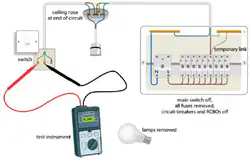
The test instrument being used in this picture is
A voltmeter
A low resistance ohmmeter
An earth fault loop impedance tester
An ammeter
The instrument used to determine the ability of a protective device to function after a fault is
An EFLI tester
An approved continuity tester
A PFC tester
An insulation resistance tester
When testing a circuit the instrument selected should be inspected
Every 12 months
Every time it is used
Every 6 months
Every month
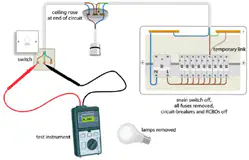
What test is being carried out in the diagram?
An insulation resistance test between live conductors
A polarity test
A continuity test of circuit protective conductors
An insulation resistance test to earth
What type of test is being described? ‘The instrument is connected to the live conductors within the consumers installation and will indicate rotation either clockwise or anti-clockwise’
Voltage drop
Polarity
Phase sequence
Insulation resistance

