
 Worksheets
g9 separation techniques by khayrattee yasser
Total questions: 25
Worksheet time: 1hrs 15mins
Which separation technique is used to obtain salt from seawater?
Simple distillation
Filtration
Chromatography
Evaporation


Name the separation technique
Filtration
Evaporation
Distillation
Separation
True or false: Magnets can be used to separate iron filings from sand
True
False
True or false: Decanting is a technique that can be used to separate a salt water solution
True
False
Filtration can be used to separate...
an insoluble solid from a solution
a soluble solid from a solution
a dissolved solid from a solution
The change of a liquid to a gas to remove solvent and collect solute is called
Decantation
Filtration
Evaporation
Centrifuge
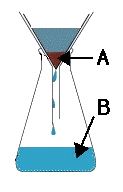
What is the method suitable to obtain pure water from seawater.
Simple distillation
Fractional distillation
Filtration
Evaporation to dryness

Name the separation technique
Distillation
Crystallisation
Magnetic Separation
Condensation
In a salt water solution ...
Salt is the solute and water is the solvent
Salt is the solvent and water is the solute
Name the separation technique
Simple distillation
Crystallisation
Magnetic Separation
Condensation
solute + solvent =
solution
equation
Distillation is used to separate ...................................
coloured substances in a mixture.
a pure liquid from a solution.
dissolved solids from a solution.
insoluble solids from liquids.
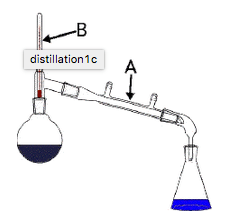
What does the boiling chips do?
Stop water from boiling
Maintain the temperature of the mixture
Smoothen the boiling
Condense the hot vapour

What process is occurring at the point labelled Y?
Evaporation
(from liquid to gas)
Condensation
(from gas to liquid)
Melting
(from solid to liquid)
Freezing
(from liquid to solid)
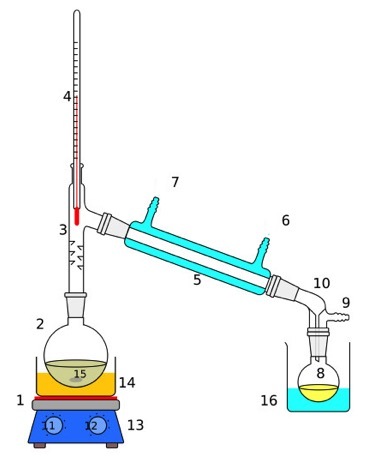
What is the flow of water in 6 and 7?
6 = water in;
7 = water out
6 = water out;
7 = water in
Sublimation is the process in which substance directly changes from
liquid state to gaseous state
solid state to gaseous state
solid state to liquid state
gaseous state to liquid state

8. Dry ice is an example of.....
Evaporation
Sublimation

The process of sublimation happened in number ....
1
2
3
4
Which of these is needed for filtration?
Wire gauze
Burner
Funnel
Round-bottom flask

This is called_______________________?
Connical Flask
Test Tube
Safety Gloves
Thermometer

