
 Worksheets
Section 09 HZMT Quiz
Total questions: 100
Worksheet time: 58mins
What does HAZMAT stand for?
Hazardous Materials
Hazardous Management
Hazardous Maintenance
Hazardous Manufacturing
Which of the following is NOT covered in Section 9 of the CDL manual?
Bulk Tank Loading, Unloading, and Marking
Driver Responsibilities
Vehicle Maintenance
Emergencies
What must you have before driving any size vehicle used to transport hazardous materials?
A commercial driver's license (CDL) with a hazardous materials endorsement
A special permit from the federal government
A certificate from a training course
A letter from your employer
What is the common reference for the Hazardous Materials Regulations (HMR)?
49 CFR 171 - 180
49 CFR 101 - 110
49 CFR 201 - 210
49 CFR 301 - 310
What must drivers be trained to recognize and respond to?
Possible security threats
Vehicle maintenance issues
Road signs
Weather conditions
How often must hazardous materials employees be trained and tested?
At least once every three years
At least once every year
At least once every five years
At least once every two years
What is the primary purpose of the regulations for transporting hazardous materials?
To increase the cost of transportation
To protect the shipper's profits
To protect people, the environment, and ensure safe transportation
To reduce the number of shipments
What must shippers do to communicate the risk of hazardous materials?
Increase the price of shipping
Provide hazard warning labels, shipping papers, and emergency response information
Reduce the size of shipments
Use only air transportation
What is required to get a hazardous materials endorsement on a CDL?
Pass a written test about transporting hazardous materials
Have a minimum of 5 years of driving experience
Complete a physical fitness test
Own a transportation company
Who is responsible for determining the product's identification number, proper shipping name, and hazard class?
The driver
The carrier
The shipper
The receiver
What is one of the responsibilities of the carrier in hazardous materials transportation?
To prepare shipping papers
To refuse improper shipments
To label the hazardous materials
To determine the hazard class
What must the driver do to ensure the safe transportation of hazardous materials?
Increase the speed of the vehicle
Refuse to transport any materials
Follow all special rules about transporting hazardous materials
Reduce the number of trips
What is the primary purpose of a material's hazard class?
To reflect the risks associated with it
To determine the cost of transportation
To identify the manufacturer
To indicate the weight of the material
Which of the following is an example of a material in the "Flammable Gases" hazard class?
Dynamite
Propane
Gasoline
Battery Fluid
What should shippers include on hazardous materials shipping papers?
The weight of the material
An emergency response telephone number
The cost of the material
The name of the driver
Where should drivers keep hazardous materials shipping papers while driving?
In a pouch on the driver's door
In the trunk of the vehicle
In the glove compartment
Under the seat
What type of label should shippers put on most hazardous materials packages?
Square-shaped labels
Diamond-shaped hazard warning labels
Circular warning labels
Rectangular information labels
What is the purpose of placards on vehicles and bulk packages?
To provide aesthetic appeal
To warn others of hazardous materials
To indicate the vehicle's speed
To show the vehicle's destination
Where must placards be placed on a vehicle?
Only on the front
Only on the back
On the front, rear, and both sides
Only on the sides
What is the minimum size for placards?
100mm
150mm
200mm
250mm
What does the symbol (+) indicate in Column 1 of the Hazardous Materials Table?
The material is hazardous when transported by air
The material is hazardous when transported by water
The proper shipping name, hazard class, and packing group must be used even if the material doesn't meet the hazard class definition
The material is a marine pollutant
What does the symbol (A) indicate in Column 1 of the Hazardous Materials Table?
The material is hazardous when transported by air
The material is hazardous when transported by water
The material is a marine pollutant
The material is a generic shipping name
What does the symbol (W) indicate in Column 1 of the Hazardous Materials Table?
The material is hazardous when transported by air
The material is hazardous when transported by water
The material is a marine pollutant
The material is a generic shipping name
What does the symbol (D) indicate in Column 1 of the Hazardous Materials Table?
The material is hazardous when transported by air
The material is hazardous when transported by water
The proper shipping name is appropriate for domestic transportation but may not be proper for international transportation
The material is a generic shipping name
What does the symbol (I) indicate in Column 1 of the Hazardous Materials Table?
The material is hazardous when transported by air
The material is hazardous when transported by water
The material is a marine pollutant
The proper shipping name is used for international transportation
What does the symbol (G) indicate in Column 1 of the Hazardous Materials Table?
The material is hazardous when transported by air
The material is hazardous when transported by water
The material is a generic shipping name
The material is a marine pollutant
What is listed in Column 2 of the Hazardous Materials Table?
Proper shipping names and descriptions of regulated materials
Hazard class definitions
Identification numbers
Packaging groups
What does Column 3 in the 49 CFR 172.101 Hazardous Materials Table show?
Hazardous materials description and proper shipping names
Identification numbers
Hazard class or division
Packing group
Which of the following hazardous substances has a reportable quantity (RQ) of 5,000 pounds (2270 kilograms)?
Phenyl mercaptan
Phosphoric acid
Phorate
Phosphine
What does Column 4 in the 49 CFR 172.101 Hazardous Materials Table list?
Hazardous materials description and proper shipping names
Identification numbers
Hazard class or division
Packing group
What is the reportable quantity (RQ) for Phorate in kilograms?
45.4
10
2270
100
What information does Column 6 in the 49 CFR 172.101 Hazardous Materials Table show?
Hazardous materials description and proper shipping names
Identification numbers
Hazard class or division
Hazard warning label(s)
What does Column 7 in the hazardous materials table list?
Packaging requirements
Special provisions
Reportable quantities
Marine pollutants
What must be included on the shipping paper for hazardous materials?
Only the name of the material
Page numbers if more than one page
The weight of the material only
The destination address only
What does Appendix A to 49 CFR 172.101 list?
Marine pollutants
Special provisions
Hazardous substances and reportable quantities
Packaging requirements
What marking must be displayed on bulk packages of Marine Pollutants?
A triangle with a fish and an "X" through the fish
A circle with a fish and an "X" through the fish
A square with a fish and an "X" through the fish
A diamond with a fish and an "X" through the fish
What is the proper shipping name for UN1076?
Phosgene
Poison
Inhalation Hazard
Hazard Zone A
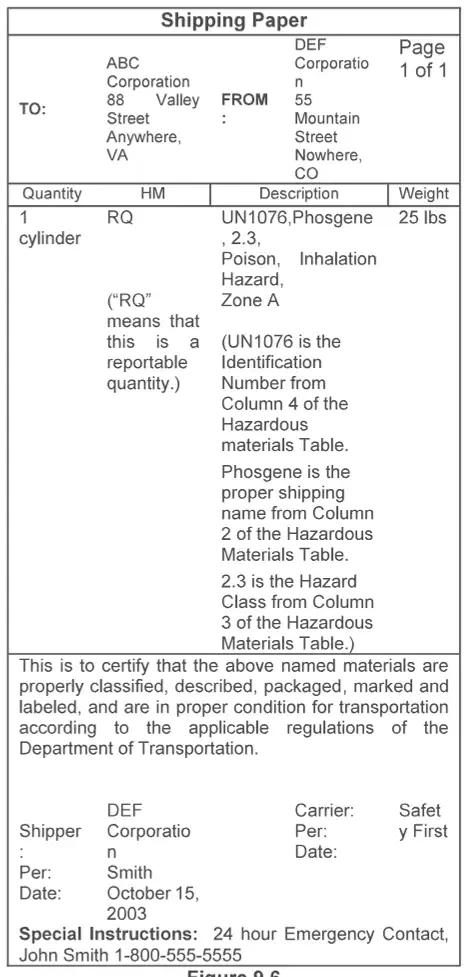
Shipping Paper
DEF Corporation, 88 Valley Street, Anywhere, VA
ABC Corporation, 88 Valley Street, Anywhere, VA
DEF Corporation, 55 Mountain Street, Nowhere, CO
ABC Corporation, 55 Mountain Street, Nowhere, CO
What must be entered first if a shipping paper describes both hazardous and non-hazardous products?
The non-hazardous materials
The hazardous materials
The total quantity and unit of measure
The emergency response telephone number
How should hazardous materials be highlighted on a shipping paper?
In bold letters
In a contrasting color
Underlined
In italics
What does the letter "RQ" indicate on a shipping paper?
The material is radioactive
The material is restricted
A reportable quantity needs to be identified
The material is recyclable
What must the basic description of hazardous materials include?
The total quantity and unit of measure
The emergency response telephone number
The identification number, proper shipping name, hazard class or division, and packing group
The name of the shipper
What information must shippers provide to the motor carrier for each hazardous material being shipped?
The name of the driver
The basic description and technical name, immediate hazards to health, risks of fire or explosion, immediate precautions, handling methods, and initial methods for handling spills or leaks
The total quantity and unit of measure
The name of the recipient
What must be listed on the shipping paper for hazardous wastes?
The word WASTE before the proper shipping name
The name of the driver
The total quantity and unit of measure
The emergency response telephone number
For how long must shippers keep a copy of shipping papers for hazardous waste?
1 year
2 years
3 years
5 years
What must appear on the original shipping paper when a shipper packages hazardous materials?
The shipper's certification
The receiver's certification
The driver's certification
The manufacturer's certification
What information must be included on the package when shipping hazardous materials?
The name and address of the receiver
The hazardous material's shipping name and identification number
The driver's license number
The manufacturer's address
What should you do if you are not familiar with the hazardous material being shipped?
Ignore the shipment
Ask the shipper to contact your office
Refuse to transport the shipment
Contact the receiver directly
What should you look for to recognize shipments of hazardous materials?
An entry with a proper shipping name, hazard class, and identification number
A highlighted entry in green
A special stamp on the package
A barcode on the package
What must you do when transporting hazardous wastes?
Sign by hand and carry a Uniform Hazardous Waste Manifest
Only carry a Uniform Hazardous Waste Manifest
Sign by hand and carry a regular shipping paper
Only sign by hand
Where must placards be placed on a vehicle transporting hazardous materials?
Only on the front of the vehicle
On both sides and both ends of the vehicle
Only on the back of the vehicle
Only on the driver's side of the vehicle
What is the minimum amount of hazardous materials required to use Table 1 placards?
Any amount
1,001 pounds or more
2,205 pounds or more
500 pounds or more
Which of the following is NOT a requirement for placarding hazardous materials?
Kept clean and undamaged
Be affixed to a background of contrasting color
Use of "Drive Safely" slogans
Kept clear of attachments or devices
When must you use a POISON GAS or POISON INHALATION placard?
When the words INHALATION HAZARD are on the shipping paper or package
When transporting any hazardous material
When the total weight of hazardous materials is over 1,000 pounds
When transporting flammable gases
What is the placard name for a material classified as 1.1 Mass Explosives?
Explosives 1.1
Explosives 1.2
Explosives 1.3
Explosives 1.4
Which of the following materials requires a placard when wet?
Organic Peroxide
Poison Gas
Dangerous When Wet
Radioactive
What is the placard name for a material classified as 2.1 Flammable Gases?
Flammable Gas
Non-Flammable Gas
Combustible Liquid
Flammable Solid
What is the requirement for using a DANGEROUS placard instead of separate placards for each Table 2 hazard class?
You have 1,001 pounds or more of two or more Table 2 hazard classes
You have 500 pounds or more of any Table 2 hazard class
You have 2,205 pounds or more of any Table 2 hazard class
You have 1,000 pounds or more of any Table 1 hazard class
Shippers package in order to (fill in the blank) the material.
(a)
Driver placard their vehicle to (fill in the blank) their risk.
(a)
What three things do you need to know to decide which placards (if any) you need?
A hazardous materials identification number must appear on the (fill in the blank) and on the (fill in the blank).
Where must you keep shipping papers describing hazardous materials?
What should you do before loading or unloading Class 1 (Explosives) Materials?
Use hooks or other metal tools.
Disable cargo heaters and disconnect heater power sources.
Load charged storage batteries.
Transport damaged packages of explosives.
Which materials must be completely enclosed in a vehicle or covered securely?
Class 1 and 2 materials
Class 3 and 4 materials
Class 4 and 5 materials
Class 6 and 7 materials
What should you never load corrosive liquids next to or above?
Division 1.4 (Explosives C)
Division 2.1 (Flammable Gas)
Division 3 (Flammable Liquid)
Division 4.1 (Flammable Solids)
How should cylinders containing Class 2 (Compressed Gases) be transported if the vehicle does not have racks to hold them?
Horizontally, with the relief valve in the vapor space
Vertically, with the relief valve in the liquid space
Flat, with the cylinders lying down
Upright, in racks attached to the vehicle or in boxes
What should you do if you need to transfer a Division 1.1, 1.2, or 1.3 from one vehicle to another on a public roadway?
Use extra care to protect explosives.
Set out red warning reflectors, flags, or electric lanterns.
Use a floor lining with Division 1.1, 1.2, or 1.3.
Load breakable containers of corrosive liquid one by one.
Which of the following is NOT a precaution for transporting Class 1 (Explosives) Materials?
Use a floor lining with Division 1.1, 1.2, or 1.3.
Use extra care to protect explosives.
Transport damaged packages of explosives.
Disable cargo heaters and disconnect heater power sources.
Which hazard classes must you never smoke around?
Class 1 (Explosives)
Class 2 (Gases)
Class 3 (Flammable Liquids)
Class 4 (Flammable Solids)
Which three hazard classes should not be loaded into a trailer that has a heater/air conditioner unit?
Class 1 (Explosives), Class 2 (Gases), Class 3 (Flammable Liquids)
Class 2 (Gases), Class 3 (Flammable Liquids), Class 4 (Flammable Solids)
Class 1 (Explosives), Class 3 (Flammable Liquids), Class 4 (Flammable Solids)
Class 2 (Gases), Class 4 (Flammable Solids), Class 5 (Oxidizers)
Should the floor liner required for Division 1.1 or 1.2 materials be stainless steel?
Yes
No
Only if specified
Depends on the material
At the shipper's dock you're given a paper for 100 cartons of battery acid. You already have 100 pounds of dry Silver Cyanide on board. What precautions do you have to take?
Load them together
Load them separately
Load them in the same compartment
No special precautions needed
Name a hazard class that uses transport indexes to determine the amount that can be loaded in a single vehicle.
Class 1 (Explosives)
Class 2 (Gases)
Class 3 (Flammable Liquids)
Class 7 (Radioactive Materials)
What is the maximum transport index allowed for packages in a single vehicle?
50
100
200
500
What must be displayed on the identification number of hazardous materials in portable tanks and cargo tanks?
Blue numbers on white background
Black numbers on orange panels
Red numbers on yellow background
Green numbers on black background
What is the common cargo tank number for liquids?
(a)
What is the common cargo tank number for gases?
(a)
What must be displayed on portable tanks?
The lessee or owner's name and the shipping name of the contents.
The lessee or owner's name and the tank's capacity.
The shipping name of the contents and the tank's weight.
The tank's capacity and the tank's weight.
What is required for a person in charge of loading and unloading a cargo tank?
A clear view of the cargo tank.
A qualified person always watching.
A knowledge of the materials involved.
A knowledge of the procedures to follow in an emergency.
What should you do before moving a tank of hazardous materials?
Close all manholes and valves.
Open all manholes and valves.
Check the tank's weight.
Check the tank's capacity.
What should you do when loading or unloading flammable liquids?
Turn off your engine before loading or unloading.
Keep your engine running during loading or unloading.
Turn off your engine only after loading or unloading.
Keep your engine running only after loading or unloading.
What should you do with liquid discharge valves on a compressed gas tank during loading and unloading?
Keep them open.
Keep them closed.
Open them only after loading.
Open them only before unloading.
Where should you not park with Division 1.1, 1.2, or 1.3 explosives?
Within five feet of the traveled part of the road.
Within 300 feet of a bridge, tunnel, or building.
Within 300 feet of an open fire.
Within 300 feet of a place where people gather.
What is a safe haven in the context of transporting hazardous materials?
A place for parking unattended vehicles loaded with explosives
A place for refueling vehicles
A place for loading and unloading cargo
A place for vehicle maintenance
How close can you park a placarded vehicle (not laden with explosives) to the traveled part of the road?
Within 5 feet
Within 10 feet
Within 15 feet
Within 20 feet
What must a person attending a placarded vehicle do?
Be in the vehicle, awake, and not in the sleeper berth
Be in the vehicle, asleep, and in the sleeper berth
Be within 200 feet of the vehicle
Be in the vehicle, awake, and in the sleeper berth
What should you not use if you break down and have to use stopped vehicle signals?
Burning signals, such as flares or fuses
Reflective triangles
Red electric lights
Hazard lights
What must you do if transporting Division 1.1, 1.2, or 1.3 explosives?
Have a written route plan and follow that plan
Drive without stopping
Park the vehicle in a residential area
Use burning signals for stopped vehicle signals
What should you do before fueling a motor vehicle containing hazardous materials?
Turn off your engine
Leave the engine running
Park near a residential area
Use burning signals
What is the minimum UL rating for a fire extinguisher in a placarded vehicle?
10 B:C
5 B:C
15 B:C
20 B:C
How often should you examine each tire on a motor vehicle?
At the beginning of each trip and each time the vehicle is parked
Once a week
Once a month
Only when the tire pressure is low
What is the only acceptable way to check tire pressure?
By kicking the tire
By using a tire pressure gauge
By visually inspecting the tire
By driving the vehicle
Where should shipping papers for hazardous materials be kept when the driver is behind the wheel?
In the glove compartment
In the trunk
Within reach, such as on the driver's seat or in the driver's door pouch
In the back seat
What must a driver transporting Division 1.1, 1.2, or 1.3 explosives provide according to FMCSR, Part 397?
A copy of the vehicle's registration
A copy of FMCSR, Part 397
A copy of the driver's license
A copy of the vehicle's insurance
What equipment must a driver transporting chlorine in cargo tanks have in the vehicle?
A fire extinguisher
An approved gas mask and an emergency kit
A first aid kit
A spare tire
What should you do if your vehicle is placarded and you are approaching a railroad crossing?
Speed up to cross before the train arrives
Stop 15 to 50 feet before the nearest rail
Stop directly on the tracks
Ignore the crossing and proceed
What is the purpose of the Emergency Response Guidebook (ERG)?
To provide driving tips for hazardous materials transport
To protect the public and emergency personnel from hazardous materials
To list all hazardous materials
To provide a map of hazardous materials routes
What should a professional driver do at the scene of a crash or incident involving hazardous materials?
Leave the scene immediately
Communicate the danger to emergency response personnel
Try to clean up the hazardous materials
Ignore the incident and continue driving
What should you do if you discover a fire in your vehicle carrying hazardous materials?
Try to extinguish the fire yourself.
Call for help and keep the shipping papers with you.
Open the doors to let air in.
Drive to the nearest fire station.

