
 Worksheets
Google Professional Architect 2 - 21 to 40
Total questions: 20
Worksheet time: 20mins
Name
Class
Date
1.
Your company's user-feedback portal comprises a standard LAMP stack replicated across two zones. It is deployed in the us-central1 region and uses autoscaled managed instance groups on all layers, except the database. Currently, only a small group of select customers have access to the portal. The portal meets a
99,99% availability SLA under these conditions. However next quarter, your company will be making the portal available to all users, including unauthenticated users. You need to develop a resiliency testing strategy to ensure the system maintains the SLA once they introduce additional user load.
What should you do?
a)
Capture existing users input, and replay captured user load until autoscale is triggered on all layers. At the same time, terminate all resources in one of the zones
b)
Create synthetic random user input, replay synthetic load until autoscale logic is triggered on at least one layer, and introduce "chaos" to the system by terminating random resources on both zones
c)
Expose the new system to a larger group of users, and increase group size each day until autoscale logic is triggered on all layers. At the same time, terminate random resources on both zones
d)
Capture existing users input, and replay captured user load until resource utilization crosses 80%. Also, derive estimated number of users based on existing user's usage of the app, and deploy enough resources to handle 200% of expected load
2.
Your solution is producing performance bugs in production that you did not see in staging and test environments. You want to adjust your test and deployment procedures to avoid this problem in the future.
What should you do?
a)
Deploy fewer changes to production
b)
Deploy smaller changes to production
c)
Increase the load on your test and staging environments
d)
Deploy changes to a small subset of users before rolling out to production
3.
A small number of API requests to your microservices-based application take a very long time. You know that each request to the API can traverse many services.
You want to know which service takes the longest in those cases.
What should you do?
a)
Set timeouts on your application so that you can fail requests faster
b)
Send custom metrics for each of your requests to Stackdriver Monitoring
c)
Use Stackdriver Monitoring to look for insights that show when your API latencies are high
d)
Instrument your application with Stackdriver Trace in order to break down the request latencies at each microservice
4.
During a high traffic portion of the day, one of your relational databases crashes, but the replica is never promoted to a master. You want to avoid this in the future.
What should you do?
a)
Use a different database
b)
Choose larger instances for your database
c)
Create snapshots of your database more regularly
d)
Implement routinely scheduled failovers of your databases
5.

One of the developers on your team deployed their application in Google Container Engine with the Dockerfile below. They report that their application deployments are taking too long.
You want to optimize this Dockerfile for faster deployment times without adversely affecting the app's functionality.
Which two actions should you take? (Choose two.)
a)
Remove Python after running pip
b)
Remove dependencies from requirements.txt
c)
Use a slimmed-down base image like Alpine Linux
d)
Use larger machine types for your Google Container Engine node pools
e)
Copy the source after he package dependencies (Python and pip) are installed
6.
Your organization requires that metrics from all applications be retained for 5 years for future analysis in possible legal proceedings.
Which approach should you use?
a)
Grant the security team access to the logs in each Project
b)
Configure Stackdriver Monitoring for all Projects, and export to BigQuery
c)
Configure Stackdriver Monitoring for all Projects with the default retention policies
d)
Configure Stackdriver Monitoring for all Projects, and export to Google Cloud Storage
7.
Your company has decided to build a backup replica of their on-premises user authentication PostgreSQL database on Google Cloud Platform. The database is 4
TB, and large updates are frequent. Replication requires private address space communication.
Which networking approach should you use?
a)
Google Cloud Dedicated Interconnect
b)
Google Cloud VPN connected to the data center network
c)
A NAT and TLS translation gateway installed on-premises
d)
A Google Compute Engine instance with a VPN server installed connected to the data center network
8.
Auditors visit your teams every 12 months and ask to review all the Google Cloud Identity and Access Management (Cloud IAM) policy changes in the previous 12 months. You want to streamline and expedite the analysis and audit process.
What should you do?
a)
Create custom Google Stackdriver alerts and send them to the auditor
b)
Enable Logging export to Google BigQuery and use ACLs and views to scope the data shared with the auditor
c)
Use cloud functions to transfer log entries to Google Cloud SQL and use ACLs and views to limit an auditor's view
d)
Enable Google Cloud Storage (GCS) log export to audit logs into a GCS bucket and delegate access to the bucket
9.
You are designing a large distributed application with 30 microservices. Each of your distributed microservices needs to connect to a database back-end. You want to store the credentials securely.
Where should you store the credentials?
a)
In a secret management system
b)
In an environment variable
c)
In the source code
d)
In a config file that has restricted access through ACLs
10.
A lead engineer wrote a custom tool that deploys virtual machines in the legacy data center. He wants to migrate the custom tool to the new cloud environment.
You want to advocate for the adoption of Google Cloud Deployment Manager.
What are two business risks of migrating to Cloud Deployment Manager? (Choose two.)
a)
Cloud Deployment Manager APIs could be deprecated in the future
b)
Cloud Deployment Manager is unfamiliar to the company's engineers
c)
Cloud Deployment Manager requires a Google APIs service account to run
d)
Cloud Deployment Manager can be used to permanently delete cloud resources
e)
Cloud Deployment Manager only supports automation of Google Cloud resources
11.
A development manager is building a new application. He asks you to review his requirements and identify what cloud technologies he can use to meet them. The application must:
1. Be based on open-source technology for cloud portability
2. Dynamically scale compute capacity based on demand
3. Support continuous software delivery
4. Run multiple segregated copies of the same application stack
5. Deploy application bundles using dynamic templates
6. Route network traffic to specific services based on URL
Which combination of technologies will meet all of his requirements?
a)
Google Kubernetes Engine, Jenkins, and Helm
b)
Google Kubernetes Engine and Cloud Load Balancing
c)
Google Kubernetes Engine and Cloud Deployment Manager
d)
Google Kubernetes Engine, Jenkins, and Cloud Load Balancing
12.
You have created several pre-emptible Linux virtual machine instances using Google Compute Engine. You want to properly shut down your application before the virtual machines are preempted.
What should you do?
a)
Create a shutdown script named k99.shutdown in the /etc/rc.6.d/ directory
b)
Create a shutdown script registered as a xinetd service in Linux and configure a Stackdriver endpoint check to call the service
c)
Create a shutdown script and use it as the value for a new metadata entry with the key shutdown-script in the Cloud Platform Console when you create the new virtual machine instance
d)
Create a shutdown script, registered as a xinetd service in Linux, and use the gcloud compute instances add-metadata command to specify the service URL as the value for a new metadata entry with the key shutdown-script-url
13.
Your organization has a 3-tier web application deployed in the same network on Google Cloud Platform. Each tier (web, API, and database) scales independently of the others. Network traffic should flow through the web to the API tier and then on to the database tier. Traffic should not flow between the web and the database tier.
How should you configure the network?
a)
Add each tier to a different subnetwork
b)
Set up software based firewalls on individual VMs
c)
Add tags to each tier and set up routes to allow the desired traffic flow
d)
Add tags to each tier and set up firewall rules to allow the desired traffic flow
14.
Your development team has installed a new Linux kernel module on the batch servers in Google Compute Engine (GCE) virtual machines (VMs) to speed up the nightly batch process. Two days after the installation, 50% of the batch servers failed the nightly batch run. You want to collect details on the failure to pass back to the development team.
Which three actions should you take? (Choose three.)
a)
Use Stackdriver Logging to search for the module log entries
b)
Read the debug GCE Activity log using the API or Cloud Console
c)
Use gcloud or Cloud Console to connect to the serial console and observe the logs
d)
Identify whether a live migration event of the failed server occurred, using in the activity log
e)
Adjust the Google Stackdriver timeline to match the failure time, and observe the batch server metrics
15.
Your company wants to try out the cloud with low risk. They want to archive approximately 100 TB of their log data to the cloud and test the analytics features available to them there, while also retaining that data as a long-term disaster recovery backup.
Which two steps should you take? (Choose two.)
a)
Load logs into Google BigQuery
b)
Load logs into Google Cloud SQL
c)
Import logs into Google Stackdriver
d)
Insert logs into Google Cloud Bigtable
e)
Upload log files into Google Cloud Storage
16.
You created a pipeline that can deploy your source code changes to your infrastructure in instance groups for self-healing. One of the changes negatively affects your key performance indicator. You are not sure how to fix it, and investigation could take up to a week.
What should you do?
a)
Log in to a server, and iterate on the fox locally
b)
Revert the source code change, and rerun the deployment pipeline
c)
Log into the servers with the bad code change, and swap in the previous code
d)
Change the instance group template to the previous one, and delete all instances
17.
Your organization wants to control IAM policies for different departments independently, but centrally.
Which approach should you take?
a)
Multiple Organizations with multiple Folders
b)
Multiple Organizations, one for each department
c)
A single Organization with Folders for each department
d)
A single Organization with multiple projects, each with a central owner
18.
You are designing a mobile chat application. You want to ensure people cannot spoof chat messages, by providing a message were sent by a specific user.
What should you do?
a)
Tag messages client side with the originating user identifier and the destination user.
b)
Encrypt the message client side using block-based encryption with a shared key.
c)
Use public key infrastructure (PKI) to encrypt the message client side using the originating user's private key.
d)
Use a trusted certificate authority to enable SSL connectivity between the client application and the server.
19.
As part of implementing their disaster recovery plan, your company is trying to replicate their production MySQL database from their private data center to their
GCP project using a Google Cloud VPN connection. They are experiencing latency issues and a small amount of packet loss that is disrupting the replication.
What should they do?
a)
Configure their replication to use UDP.
b)
Configure a Google Cloud Dedicated Interconnect.
c)
Restore their database daily using Google Cloud SQL.
d)
Add additional VPN connections and load balance them.
e)
Send the replicated transaction to Google Cloud Pub/Sub.
20.
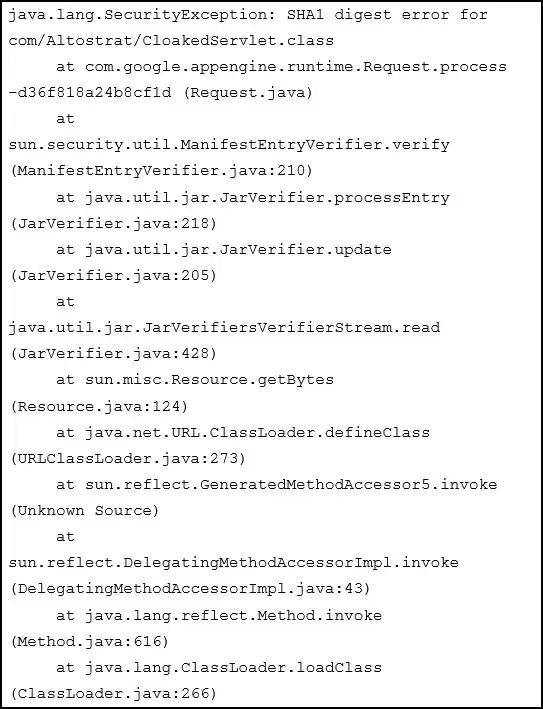
You deploy your custom Java application to Google App Engine. It fails to deploy and gives you the following stack trace.
What should you do?
a)
Upload missing JAR files and redeploy your application.
b)
Digitally sign all of your JAR files and redeploy your application
c)
Recompile the CLoakedServlet class using and MD5 hash instead of SHA1
100 %

