
 Worksheets
M3 quiz Kempy
Total questions: 62
Worksheet time: 1hrs 19mins
When capacitors is arrange in series (3 capacitors), the equivalent capacitance C is
C = C1 + C2 + C3
1/C = 1/C1 + 1/C2 + 1/C3
C = QV1 + QV2 + QV3
C = CR1 + CR2 + CR3
Connecting capacitors in parallel effectively causes the _____ ________
distance between the plates , increase
distance between the plates , decrease
plate area increase
plate area decrease

Which of the graphs below shows the characteristics for the circuit shown?


Which of these circuit symbols represents a band pass filter


Which of these circuit symbols represents a high pass filter
The critical frequency is defined as the point at which the response drops ________ from the passband.
- 3 db
-20 db
-6 db
- 40 db
A ________ filter significantly attenuates all frequencies below fc and passes all frequencies above fc.
Low pass
High Pass
Band Pass
Band Stop

What kind of filter is shown in the figure ?
Low Pass Filter
High Pass Filter
Band pass filter
-------------------- is a circuit which can be designed to modify , reshape or reject all undesired frequencies .
Filter
oscillator
Amplifier
Rectifier
which of these circuits matches its equivalent schematic symbol?


The force exerted by a magnetic field depends on 3 things. What is the 3rd?
1) Magnetic flux density 2) Current 3) ...
(a)
What is the unit of magnetic flux density?
(a)
What is the unit of magnetic flux density?
(a)
What happens if you cut a magnet in half?
Nothing
The magnets repel
There will be two magnets

A magnet is dropped through a coil connected to a millivoltmeter as shown. The voltmeter needle moves to the right showing a positive reading.
Which of these will make the voltmeter move to the left?
Drop the south pole through first
Add more turns to the coil
Move the magnet slowly through the coil
Use a stronger magnet

A magnet is dropped through a coil connected to a millivoltmeter as shown. The voltmeter needle moves to the right showing a positive reading.
Which of these will make the voltmeter reading smaller but still positive?
Drop the south pole through first
Add more turns to the coil
Move the magnet slowly through the coil
Use a stronger magnet
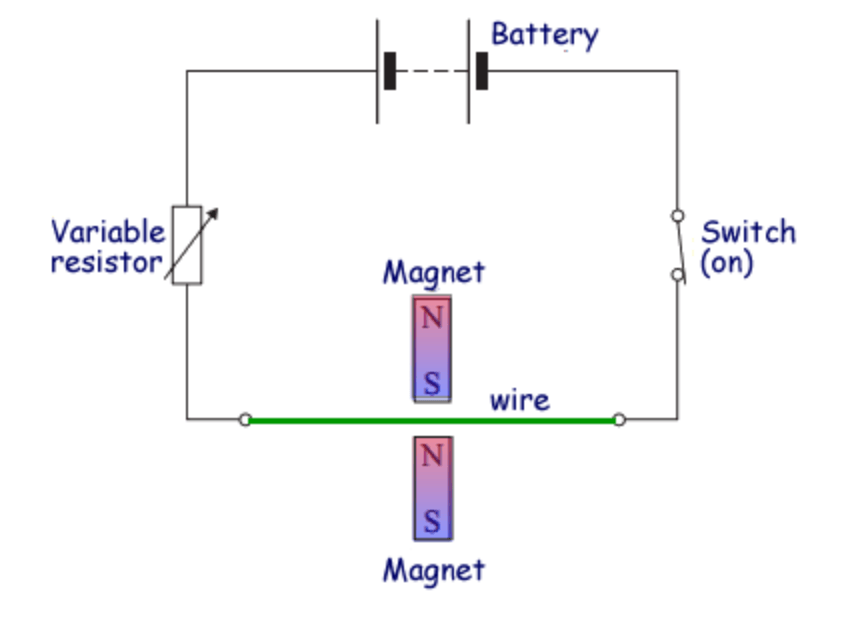
The force on a wire can be made stronger in several ways. Which one of these will not work?
Increase the current
Use stronger magnets
Use a coil with many turns
Make the wire thicker

The diagram shows a coil of wire with a current flowing through it in the direction shown by the arrows. The coil is between 2 magnets as shown.
Using Fleming's Left hand Rule, which way will the coil move?
upwards
downwards
rotate clockwise
rotate anticlockwise
Some magnets are easily magnetised when placed in a magnetic field, and then quickly lose their magnetism once the field is removed. These materials are used in electromagnets, and are called...
soft magnetic materials
hard magnetic materials
temporary magnets
partial magnets
Which of these is not a magnetic material?
aluminium
steel
nickel
iron

Within the armature windings
Poor contact of the bushes with the commutator
Impact of the resistive force of the load on the armature angle with reference tot he main field
Series-parallel
The rotating rectifying diode pack.
By increasing the frequency of the supply voltage
To generate a Rotating Magnetic Field (RMF) in the stator

With reference to Torque in a dc machine:
The magnitude of the force is proportional to
The strength of the magnetic field, Flux Density,
The current in the conductor,
The length of the conductor influenced by the magnetic field.
The value of back emf,
The current in the conductor,
The length of the conductor influenced by the magnetic field.
The value of back emf,
The current in the field windings,
The length of the conductor influenced by the magnetic field.
The value of back emf,
The current in the conductor,
The number of poles on the stator.

How can Back emf be calculated
Eb=Vs−IaRa
Eb=Vs+IaRa
Eb=IaRaVs
Vs=IaRaEb
Which of these statements are true regarding the laminated iron core in a Rotor?
Select 1 or more answers.
It holds the armature winding in slots
It forms part of the magnetic circuit
It increases the eddy currents in the armature, therefore increases the magnetic flux
It forms part of the electric circuit
It forms the return path for the magnetic field

What component is represented by label K
Armature Windings
Commutator
Pole Piece
Drive shaft
Yoke
What is the purpose of the commutator?
To reverse the current in the armature
To reverse the current in the field windings
To protect the slip ring from damage
To allow constant motion of the rotor
To allow the motor to be used as a generator
What is the advantage of a series field motor?
What is the advantage of a shunt field motor?
It maintains constant speed even when the load changes.
What type of motor is best suited as a starter motor?
Shunt field motor
Series field motor
Compound motor
How is the direction of rotation in a dc machine changed?
what is the purpose of the excitation winding in a dc machine?
Why are interpoles fitted to main poles of DC machines?
Which component in a dc machine machine provides the power supply for the armature?
Transformer and rotating diode pack
Excitation winding
Field winding
What effect would increasing the armature current have on the armature cross field?
What does a commutator do in a dc machine?
What does a commutator do in a dc machine?
What does a commutator do in a dc machine?
If the frequency of the ac supply is increased what would happen to the value of the inductive reactance (XL) within a series LR circuit
XL would increase
XL would decrease
XL would remain the same
If the frequency of the ac supply is increased what would happen to the value of the capacitive reactance (XC) within a series LR circuit
XC would increase
XC would decrease
XC would remain the same
What is the relationship between the peak voltage (Vp) and the root mean square voltage (Vrms) in a sinusoidal wave?
Vp = √2 * Vrms
Vp = 2 * Vrms
Vp = 0.5 * Vrms
Vp = Vrms

on the graph showing a sinusoidal wave, what is being represented by the letter a?
Vp-p
Vp
Vmean
Vrms
What is the main characteristic that distinguishes AC from DC?
In AC the amount (size) of voltage remains constant.
In AC the direction (polarity) of current remains constant.
In AC the amount (size) of both voltage and current changes with time.
In AC the direction (polarity) of both voltage and current changes with time.
Which statement accurately describes common AC?
The changes in voltage and current never repeat.
The average voltage and current are always positive.
The voltage and current vary sinusoidally with time.
The current remains constant over time.
What is the unit of frequency?
Volt (V)
Watt (W)
Seconds (s)
What is the amplitude of an AC waveform?
The average value of voltage or current over a full cycle.
The peak value of voltage or current.
The instantaneous value of voltage or current.
The root mean square value of voltage or current.
What defines a square waveform?
It rises quickly to a particular amplitude, remains constant for a time period, and drops fast at the end.
It is a waveform with a symmetrical shape and equal rise and fall times.
It oscillates between positive and negative peak values.
It has a steady rate of change of voltage over each half cycle.

