wayground logo

Free Printable Worksheets

Font size

S
M
L
XL
Worksheets

QB | MCQ | French Revolution

Total questions: 111

Worksheet time: 56mins

Name
Class
Date
1.

On which of the following day did 'Storming of the Bastille' occur?

a)

14th July, 1789

b)

14th July, 1798

c)

14th June, 1789

d)

14th June, 1798

2.

What did Bastille symbolise?

a)

Benevolence of the king

b)

Despotic power of the king

c)

Armed might of France

d)

Prestige and power

3.

The Bastille was hated by all in France because:

a)

It stood for the despotic power of the King

b)

It was a fortress prison

c)

prison in charge tortured inmates

d)

It housed dreaded criminals

4.

Which of the following statements is not true?

a)

Bastille was a symbol of despotic power of the king

b)

In the morning of 14th July, 1789, the city of Paris was in a state of alarm

c)

Most people were protesting against the high prices of the bread

d)

There were only 17 prisoners when Bastille was stormed

5.

How many men and women gathered in front of the townhall on 14th July, 1789 in Paris?

a)

5000

b)

7000

c)

8000

d)

6000

6.

In armed fight who was killed in the 'Fortress of Bastille'?

a)

The King

b)

The Minister

c)

The Commander

d)

The Prisoner

7.

On 17th July, 1789 the city of Paris was in a state of alarm because:

a)

The King had ordered the army to open fire upon the citizens in reality.

b)

Rumours spread that the King would soon order the army to open fire upon the citizens

c)

There was a foreign attack on the citizens

d)

The earthquake struck Paris that moment

8.

For whom the stone fragments of the demolished fortress of Bastille sold in the markets?

a)

Those who wished to sell them further to earn profit

b)

Those who wished to keep a souvenir of its destruction

c)

Those who wanted to keep them as toys for the children

d)

Those who wanted to show it to the king

9.

What do you understand by the word 'Revolution'?

a)

A gradual change

b)

A momentous change in any situation

c)

Social contract

d)

Political conflict

10.

What did historians looked back upon as the beginning of a chain of events that ultimately led to the execution of the king in France?

a)

Gathering of people

b)

High price of bread

c)

Wedding of King Louis XVI

d)

All of the above

11.

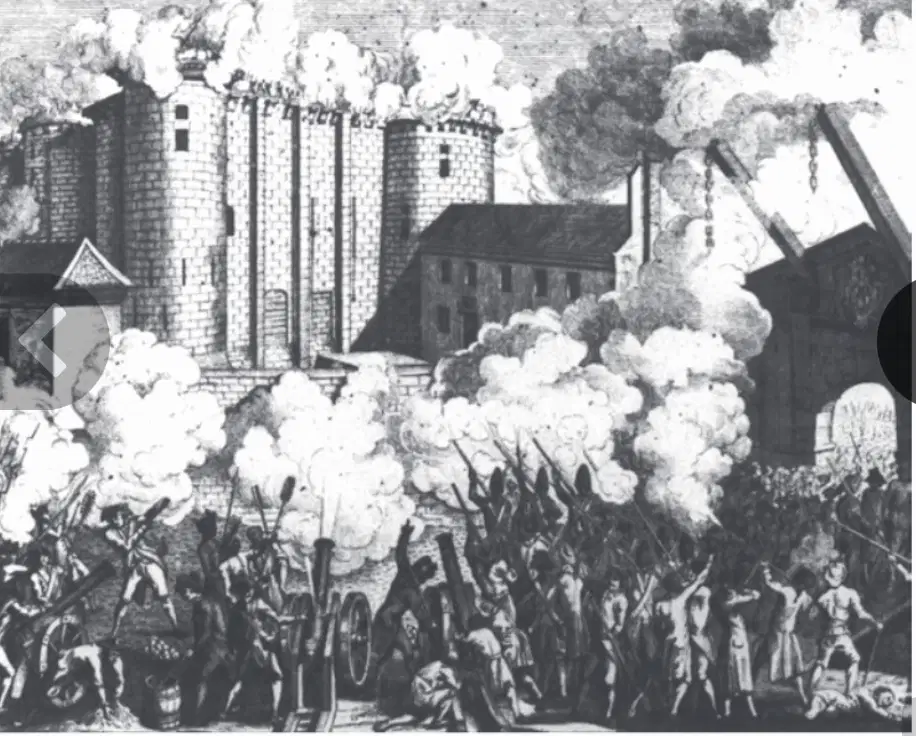
Identify the following picture.

a)

attack on Tuileries

b)

Storming of Bastille

c)

Conquest of Louis XVI

d)

None of the above

12.

In the question given below, there are two statements marked as an Assertion(A) and Reason (R). Mark your answer as per the codes provided below: Assertion(A): On the morning of 14th July, 1789, the city of Paris was in a state alarm. Reasoning(R): Rumours spread that the King would soon order the army to open fire

a)

Both A and R are true and R is the correct explanation of A

b)

Both A and R are true but R is not the correct explanation of A

c)

A is true but R is false

d)

Both A and R are false

13.

18th-century French society was divided into

a)

(a) Castes

b)

(b) Four Estates

c)

(c) Three Estates

d)

(d) Two Estates

14.

Which of the following constituted the privileged class?

a)

(a) Clergy and peasants

b)

(b) Peasants and nobility

c)

(c) First and Third Estate

d)

(d) Clergy and nobility

15.

The most important of the privileges enjoyed by the clergy and nobility

a)

(a) Right to collect dues

b)

(b) Ownership of land

c)

(c) Participate in wars

d)

(d) Exemption from taxes to the state

16.

Which of the following statements is untrue about the Third Estate

a)

(a) The Third Estate was made of the poor only

b)

(b) Within the Third Estate some were rich and some were poor

c)

(c) Richer members of the Third Estate owned lands

d)

(d) Peasants were obliged to serve in the army, or build roads

17.

Louis XVI was associated with:

a)

Tuluva dynasty

b)

Bourbon dynasty

c)

Gluckburg dynasty

d)

Sorbonne dynasty

18.

A group of persons invested with special function in the church are called____________.

a)

Priest

b)

Clergy

c)

Nobility

d)

Feudal Lords

19.

Who enjoyed feudal privileges by birth?

a)

The First Estate

b)

The Second Estate

c)

Third Estate

d)

The First Estate and the Second Estate

20.

The_________ that existed in the French Society in the Old Regime became the cause of the French Revolution.

a)

inequality

b)

equality

c)

partiality

d)

discrimination

21.

Who ascended the throne of France in 1774?

a)

Louis XVII

b)

Louis XVI

c)

Louis XIV

d)

Louis XV

22.

Who helped the thirteen American colonies to to gain their independence from the common enemy, Britain?

a)

Louis XV

b)

Louis XVI

c)

Louis Philip

d)

Maximilien Robbespierre

23.

What is referred to as 'Old Regime'?

a)

British society in the 20th century

b)

French society before 1789

c)

French society in the 20th century

d)

None of the above

24.

What was the percentage of the population of peasants during old regime?

a)

70

b)

80

c)

90

d)

85

25.

Since when the society of France was part of feudal system?

a)

Ancient ages

b)

Middle ages

c)

Paleolithic ages

d)

Mesolithic ages

26.

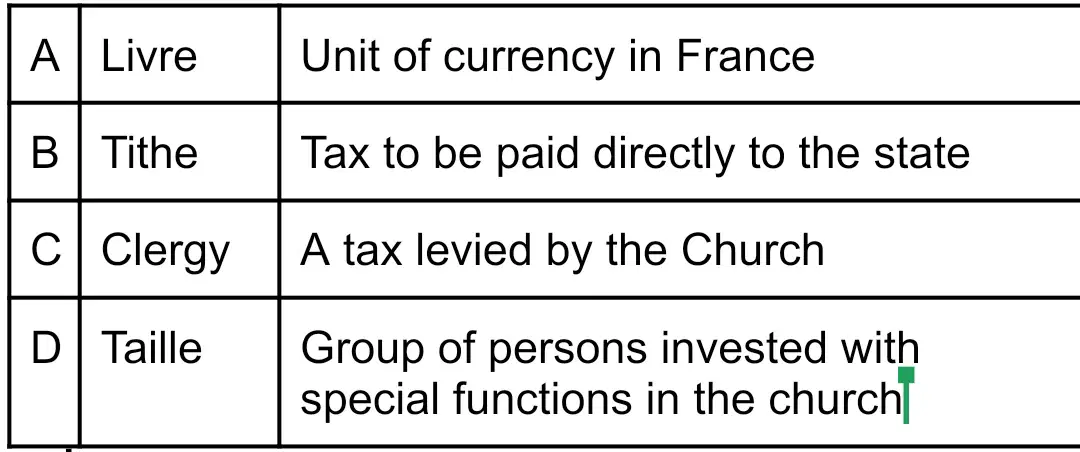
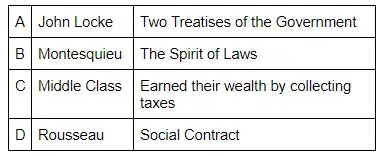
Choose the correctly matched pair:

a)

A

b)

B

c)

C

d)

D

27.

How many years old Louis XVI was when he ascended the throne in 1774?

a)

18 years old

b)

50 years old

c)

20 years old

d)

25 years old

28.

Which of the following king found an empty treasury upon his accession to the throne?

a)

Duke Metternich

b)

King Canton

c)

Louis XVI

d)

Louis XIV

29.

Whom did Louis XVI marry?

a)

British princess Elizabeth

b)

Austrian princess Marie Antoinette

c)

French princess Marie Antoinette

d)

All of the above

30.

Who owned 60 percent of the land in Old Regime?

a)

Nobles

b)

Church

c)

Other richer members of the Third Estate

d)

All of the above

31.

Austrian Princess Marie Antoinette was the queen of which of the following French rulers?

a)

King Louis XVI of France

b)

King Louis XVII of France

c)

King Louis XVIII of France

d)

King Louis XIV of France

32.

Which of the following is not correct?

a)

Marie Antoinette was the Austrian Princess

b)

France helped the thirteen American colonies to gain their independence from Britain

c)

Lenders who gave credit to France began to charge 5 per cent interest on loans

d)

All of the above

33.

Who were obliged to render services to the nobility?

a)

Peasants

b)

Clergy

c)

Craftsmen

d)

Samantas

34.

How much debt was added on France by war against Britain to help the independence of thirteen American colonies?

a)

One billion livres

b)

Two billion livres

c)

Three billion livres

d)

Five billion livres

35.

How does a ‘Subsistence Crisis’ happen?

a)

(a) Bad harvest leads to scarcity of grains

b)

(b) Food prices rise and the poorest cannot buy bread

c)

(c) Leads to weaker bodies, diseases, deaths and even food riots

d)

(d) All the above

36.

Given below are two statements, one labelled as Assertion(A) and the other labelled as Reason(R).Assertion(A): Subsistence crisis is an extreme situation where the basic means of livelihood are endangered Reason(R): The population of France rose from about 23 million in 1715 to 28 million in 1789. Choose from the following:

a)

Both A and R are true and R is the correct explanation of A.

b)

Both A and R are true but R is not the correct explanation of A.

c)

A is true but R is false

d)

A is false but R is true.

37.

Which of the following taxes is a direct tax paid to the state?

a)

Tithe

b)

Taille

c)

Livre

d)

Clergy

38.

Which of the following is not a reason for subsistence crisis?

a)

Population of France rose from 23 million to 28 million

b)

Rapid increase in the demand for grains

c)

wages increased along with prices

d)

Bad Harvest

39.

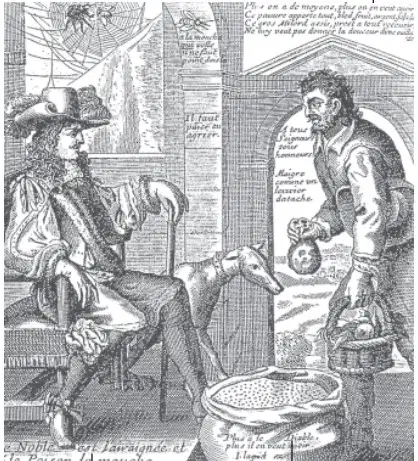
Identify the following figure:

a)

The Spider and the Insect

b)

The Spider and the Fly

c)

The Spider and the tiger

d)

All of the above

40.

Which of the following currencies discontinued in 1794?

a)

Franc

b)

Livres

c)

Tithe

d)

Bitcoin

41.

What occurred frequently in France during the old regime?

a)

Pandemic

b)

Epidemic

c)

Subsistence crisis

d)

Plague

42.

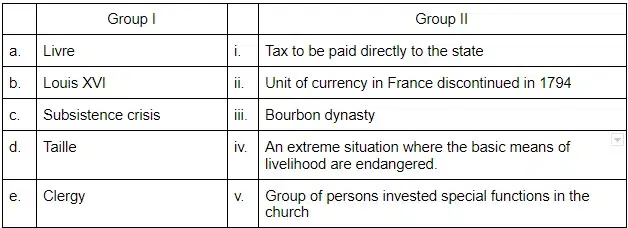
Match the following and choose the correct option

a)

a-i, b-ii, c-iii, d-iv, e-v

b)

a-ii, b-iii, c-iv, d-i, e-v

c)

a-iii, b-iv, c-ii, d-v, e-i

d)

a-v, b-iv, c- iii, d-ii, e-i

43.

Which of the following tax was paid by the peasants of France? (i) Taille (ii) Tithe (iii) Indirect taxes (iv) No tax was given

a)

(i) and (ii)

b)

(ii) and (iii)

c)

(iv)

d)

(i), (ii) and (iii)

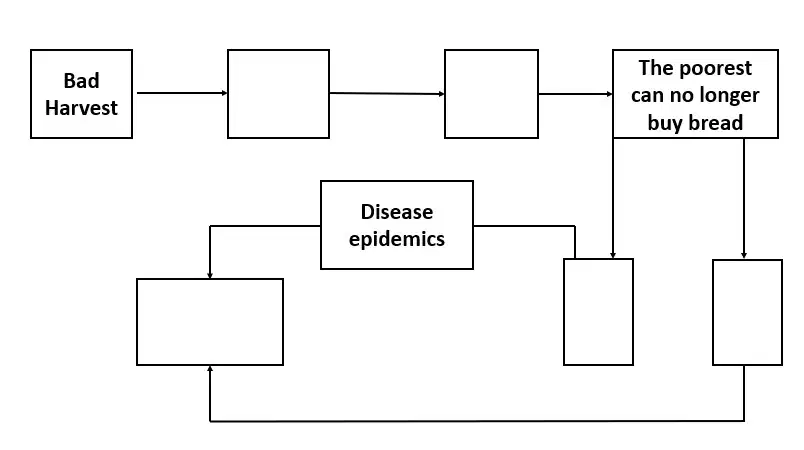
44.
The following diagram shows the course of subsistence crisis with few blank boxes. Choose the diagram that correctly shows the course with filled boxes:
a)
Option 1
b)
Option 2
45.

Name the French philosopher who said that the people are real masters of the rule and king rules with their consent.

a)

Voltaire

b)

Rousseau

c)

Locke

d)

Montesuieu

46.

The spirit of laws was written by:

a)

Montesquieu

b)

Rousseau

c)

Voltaire

d)

Locke

47.

Which of the following believed that social position must depend on merit?

a)

Middle class

b)

Nobility

c)

Workers

d)

Peasants

48.

Society based on freedom, equal laws and opportunities was advocated by

a)

Middle class and people of the third estate

b)

Clergy and nobility

c)

Philosophers such as John Locke and Rousseau

d)

Englishmen Georges Danton and Artur Young

49.

Which of the following refuted the doctrine of divine and absolute rights?

a)

John Locke

b)

Rousseau

c)

Montesquieu

d)

Voltaire

50.

Who advocated government based on Social Contract

a)

Darwin

b)

Spencer

c)

Rousseau

d)

Montesquieu

51.

Division of power within the government was put forth in

a)

Two Treatises of Government

b)

The Spirit of the Laws

c)

Le Montieur Universal

d)

The social contract

52.
The model of the government proposed by Montesquieu was at first implemented in
a)
China
b)
USA
c)
UK
d)
France
53.
Which of the following is not correctly matched?
a)
A
b)
B
c)
C
d)
D
54.
Which of the following statements is not true?
a)
The American constitution and guarantee of individual rights was an important sample for political thinkers in France
b)
The ideas of the philosophers were discussed intensively in salons and coffee houses
c)
Rousseau refuted the doctrine of divine and absolute rights in his book 'The Social Contract'
d)
The middle class earned their wealth through an expanding overseas trade.
55.
Which of the following refers to the political body representing the three estates of pre-revolutionary France?
a)
Parliament of France
b)
National Assembly
c)
Estates General
d)
Estates Committee
56.
The Estates General was last convened in
a)
1604
b)
1614
c)
1416
d)
1641
57.
After how many years, the meeting of Estates general was called in France in 1789?
a)
165
b)
175
c)
189
d)
25
58.
Voting in the Estates General was conducted on the principle of
a)
Each member one vote
b)
Male adult Franchise
c)
Universal Adult Franchise
d)
Each Estate had one vote
59.
On___________, Louis XVI called together an assembly of the Estates General to pass proposals for new taxes.
a)
5 May 1789
b)
5 June 1789
c)
5 July 1789
d)
5 August 1789
60.
Which of the following statements is/are true regarding the Assembly of the Estates General on 5 May 1789?
a)
It was called to pass proposals for new taxes
b)
The first and second estates sent 300 representatives each
c)
The third estate was represented by its more prosperous and educated members
d)
All of the above
61.
Where did the Third Estate form and announce the National Assembly?
a)
Indoor Tennis Court
b)
Hall of Mirrors
c)
Gandhi Maidan
d)
Winter Palace
62.
Members of the Third Estate were led by
a)
Louis XVI and Marie Antoinette
b)
Lenin and Kerensky
c)
Mirabeau and Abbe Siyes
d)
Rousseau and Voltaire
63.
Who was Mirabeau?
a)
a noble
b)
a clergy
c)
a merchant
d)
a priest
64.
Who wrote an influential pamphlet called 'What is the Third Estate'?
a)
Mirabeau
b)
Abbé Emmanuel Joseph Sieyès
c)
Rousseau
d)
Karl Marx
65.
Give one word for the following: Castle or stately residence belonging to a king or a nobleman
a)
Manor
b)
chateau
c)
Fortress
d)
Palace
66.
Which of the following is not an effect of the French revolution of 1789?
a)
Louis XVI accorded recognition to the National Assembly
b)
National assembly passed a decree abolishing the feudal system of obligations and taxes
c)
Louis XVI was executed
d)
Tithes were abolished and lands owned by the Church were confiscated
67.
Which of the following is/are the epicentre of main panic movements?
a)
Alsace
b)
Nantes
c)
Marseilles
d)
All of the above
68.
Give one word for the following: An estate consisting of the lord's lands and his mansion
a)
manor
b)
chateau
c)
Versailles
d)
Palace
69.
Which important historical event has been shown in the given picture?
a)
Storming of Bastille
b)
The Tennis Court Oath
c)
Voting in the Estates General
d)
None of the above
70.
Which of these provisions were passed by the assembly on night of 4th August 1789?
a)
Abolition of Feudal system
b)
Clergy had to give up its privileges
c)
Tithes were abolished
d)
All of the above
71.
Which of the following was the main objective of the constitution of 1791?
a)
To limit the powers of the King
b)
Do away with feudal privileges
c)
Give equal rights to women
d)
Establish a constitutional monarchy
72.
Which type of government adopted according to the constitution of 1791 in France?
a)
Monarchy
b)
Dictatorship
c)
Constitutional Monarchy
d)
None of the above
73.
Who got the voting rights as per the constitution of 1791 in France?
a)
Active Citizens
b)
Passive Citizens
c)
Educated Citizens
d)
Nobility
74.
Who were not considered passive citizens?
a)
Women
b)
Children
c)
Non propertied men
d)
Wealthy people
75.
How many elected members were there in the National Assembly?
a)
645
b)
845
c)
754
d)
745
76.
Which of the following was/were not passive citizens?
a)
Women
b)
Men above 25 years who did not pay taxes equal to three days labourers wage
c)
Men above 25 years who paid taxes equal to three days labourer's wage
d)
Children
77.
The French constitution of 1791 began with
a)
Declaration of the Rights of Man and Citizen
b)
Declaration of the Rights of Woman and Citizens
c)
Preamble to the constitution
d)
National Anthem
78.
How the Judiciary under the political system of France in 1791 was formed?
a)
elected by the electors
b)
appointed by the King
c)
elected by the National assembly
d)
All of the above
79.
According to the new constitution 1791, the National Assembly was to be __________
a)
Elected directly
b)
Appointed by the King
c)
Elected indirectly
d)
A hereditary body
80.
The Constitution of 1791 vested the power to make laws in the_____________.
a)
the National Assembly
b)
Estates General
c)
the Kig
d)
the Clergy
81.
A broken chain symbolised
a)
chains used to fetter slaves
b)
Strength lies in unity
c)
Royal Power
d)
Act of becoming free
82.
The winged woman personified
a)
National colours of France
b)
Act of becoming free
c)
Personification of law
d)
Rays of the Sun
83.
Bundle of rods or fasces symbolized
a)
Royal Power
b)
Equality before law
c)
law is same for all
d)
Strength lies in unity
84.
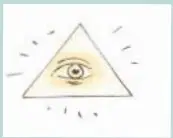
Which of the following symbolized Eternity?
a)
Sceptre
b)
Snake biting its tail to form a ring
c)
The law tablet
d)
eye within a triangle
85.
Which of the following were the national colours of France during the revolution?
a)
Blue-green-yellow
b)
Red-Blue-Green
c)
Blue-Red-Yellow
d)
Blue-White-Red
86.
What does the following image signifies?
a)
Eternity
b)
Knowledge
c)
Unity
d)
Fraternity
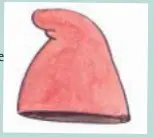
87.
identify the picture shown below.
a)
Red American Cap
b)
Red Phrygian cap
c)
Rec French cap
d)
Red Slave cap
88.
Who entered into secret negotiations with the King of Prussia despite signing the constitution?
a)
King Louis XVI
b)
Tsar Nicholas II
c)
KIng Edward
d)
Marie Antoinette
89.
France on 21st September 1792 was declared a
a)
Socialist state
b)
Oligarchy
c)
Communist state
d)
Republic
90.
Which of the following is the national anthem of France?
a)
Marseillaise
b)
Marseilles
c)
Mariellaise
d)
Marie Antoinette
91.
Members of the Jacobin club were also known as
a)
Sans-cullottes
b)
Conservatives
c)
Liberalists
d)
Terrorists
92.
Who composed the national anthem of France?
a)
Walter de la marie
b)
Roget de L' Isle
c)
William Wordsworth
d)
Louis XVI
93.
What did National Assembly vote for in April 1792?
a)
to form a new constitution
b)
to declare France a Republic
c)
to declare war against Prussia and Austria
d)
to declare war against Britain
94.
Give one word for the following: Building belonging to a community devoted to a religious life.
a)
School
b)
Fortress
c)
Convent
d)
Clergy
95.
Which patriotic song was sung by the army in the war against Prussia and Austria?
a)
'Liberty' written by Olympe de Gouges
b)
'Marseillaise' written by the poet Roget de L' Isle
c)
'Viva France' written by a French peasant
d)
None of the above
96.
On what charges was Louis XVI guillotined?
a)
Cruelty
b)
Treason
c)
Absolute rule
d)
Misgovernance
97.
On 21 January 1793, Louis XVI was executed publicly at the ____________________.
a)
Place de la Concorde
b)
Place de la guillotine
c)
Place de la Bastille
d)
None of the above
98.
Who was the leader of Jacobin clubs?
a)
Maximilien Robespierre
b)
Rousseau
c)
Dr Guillotine
d)
Marie Perry
99.
What was the new name of the National Assembly after the insurrection of 1792?
a)
Estates General
b)
Convention
c)
Legislative council
d)
French Assembly
100.
_______________gave political rights only to the richer sections of society.
a)
The Constitution of 1791
b)
The Constitution of 1792
c)
The Constitution of 1793
d)
The Constitution of 1794
101.
Which of the following groups were not the members of the Jacobin Clubs?
a)
Small shopkeepers
b)
Priests
c)
daily wage workers
d)
dock workers
102.
What was the prime reason of discontentment with the constitution of 1791, among a large section of population in France?
a)
It did not give right to property
b)
It established Constitutional Monarchy
c)
It gave political rights only to richer sections of society
d)
None of the above
103.
Who got the voting rights in France after the insurrection in 1792?
a)
All men above 25 years
b)
All men above 21 years, regardless of wealth
c)
All men and women above 21 years
d)
Only men above 18 years
104.
Which palace was stormed in France on the morning of August 10, 1792?
a)
Tuileries Palace
b)
Bastille
c)
Palace of Versailles
d)
Hall of Mirrors
105.
Which of the following events took place as a result of Jacobins in 1792?
a)
The revolutionaries stormed the palace of Tuileries
b)
Massacred the King's guards
c)
held the king hostage for several hours
d)
All of the above
106.
Which of the following decisions was taken by the convention?
a)
It declared France a constitutional monarchy
b)
Abolished the Monarchy and declared France a Republic
c)
All men and women above 21 got the voting rights
d)
All of the above
107.
Which period is referred as the reign of terror?
a)
1792 to 1793
b)
1793 to 1795
c)
1793 to 1794
d)
1804 to 1814
108.
The word 'Guillotine' during the French revolution era refers to
a)
Beheading a person
b)
Awarding a person
c)
Taxing a person
d)
Threatening a person
109.
What was a Guillotine?
a)
A device consisted of two poles and a blade to behead people
b)
A fine sword to behead people
c)
A special noose to hang people
d)
None of the above
110.
Instead of the traditional Monsieur(Sir) and Madame (madam), all French men and women were henceforth addressed as:
a)
Citoyen
b)
Citoyenne
c)
Both Citoyen and Citoyenne
d)
None of the above
111.
Why is the period from 1793 to 1794 referred to as the 'Reign of Terror'?
a)
Louis XVI's successor became a tyrant
b)
Robespierre followed a policy od severe control and punishment
c)
Jacobins opted loot and plunder
d)
None of the above