
 Worksheets
Y8 Mega Quiz 23/24
Total questions: 217
Worksheet time: 2hrs 16mins

According to the Law of reflection, a light ray striking a mirror will?
bounces off the mirror toward the direction it came from
bounces off the mirror at the same angle it hits.


Given that the angle of incidence = 30 degrees
a. Draw a ray diagram, labelling clearly the normal, incident ray, angle of incidence, reflected ray and angle of reflection accurately.
Which is the correct diagram?

A student placed a pencil in a cup of water. The pencil appears broken because light
always travels in a straight line.
bends when it passes through water.
makes the water in the glass evaporate.
reflects the pencil on the water's surface.

Swimming pools and the ocean look shallower than they really are due to?
refraction
reflection

Which of the following shows the principle of light refraction? Tick the correct answers.
A
B
D
E
F


A ray of light in air is incident at an angle on one side of a rectangular glass block, as shown. Which ray diagram correctly describes the complete path of the ray of light?
(Determine if light bends towards or away from normal at each boundary)


Which of the following is NOT a primary color of light?
Red
Blue
Yellow
Green
How many components of white light?
5
6
7
8

Why is the spectrum of light seperated into its components of colour when white light is directed to a prism?
The different colours in the white light bend away from the normal line at different angles when entering prism
The different colours in the white light bend towards the normal line at different angles when entering prism
The different colours in the white light bend away from the normal at same speed to each other when entering prism
The different colours in the white light bend towards the normal at same speed to each other when entering prism
these are examples of phenomenon of scattering of light except
Sky appears blue at midday
Sky appears reddish in the evening
Rainbow after rain
Which of the following correctly places these in order from LARGEST to SMALLEST?
galaxy -- local group/cluster -- planet -- solar system -- universe
universe -- local group/cluster -- galaxy -- solar system -- planet
planet -- solar system -- galaxy -- local group/cluster -- universe
universe -- galaxy -- solar system -- local group/cluster -- planet
A Group of stars, and or star systems, star clusters, dust and gas held together by gravity is known as:
Universe
Galaxy
Solar System
Planet
What Galaxy is Earth located?
Andromeda
Milky Way
Sagittarius
Snickers
How many main sequence stars is in our solar system?
2
8
1
None

I am located between Mars and Jupiter.
Comet belt
Asteroid belt
Meteor belt
Stars
What unit is used to measure distances in space?
Light year
Kilometer
Miles
Solar unit
Which object would have a stronger force of gravity?
The moon
The Earth
A person
A mouse
What is the force that pulls objects together called?
Rotation
Revolution
Orbit
Gravity
How many planets are in our solar system?
9
8
7
6
The Earth is the ______ planet from the sun.
8th
5th
4th
3rd
Which of the following is part of a solar system?
Star
Planets
Moons
All of the above
The sun is a star.
True
False
A star reflects light.
True
False
How long is one full revolution on Earth?
1 day
1 year
24 hours
24 years
How long is one full rotation on Earth?
24 minutes
24 days
1 day
1 hour
One year is the same as ___________ days
300
365
563
24
1 day is the same as __________ hours.
1
12
24
48
In what direction does the sun rise?
North
East
South
West
The sun appears to move across the sky each day because ______.
the Earth is rotating on its axis
the Earth is revolving around the sun.
the sun moves across the sky


Light travels through air, water, glass and many other materials. What path does it travel to get from one place to another?
sideways
back and forth
straight
up and down


Metals are found on the ______________ side of the periodic table.
nonmetals
left
right
metals


Elements in the same group have : (2 correct answers)
Similar chemical properties
Similar names
Same number of outer (valence) electrons)
The same number of protons
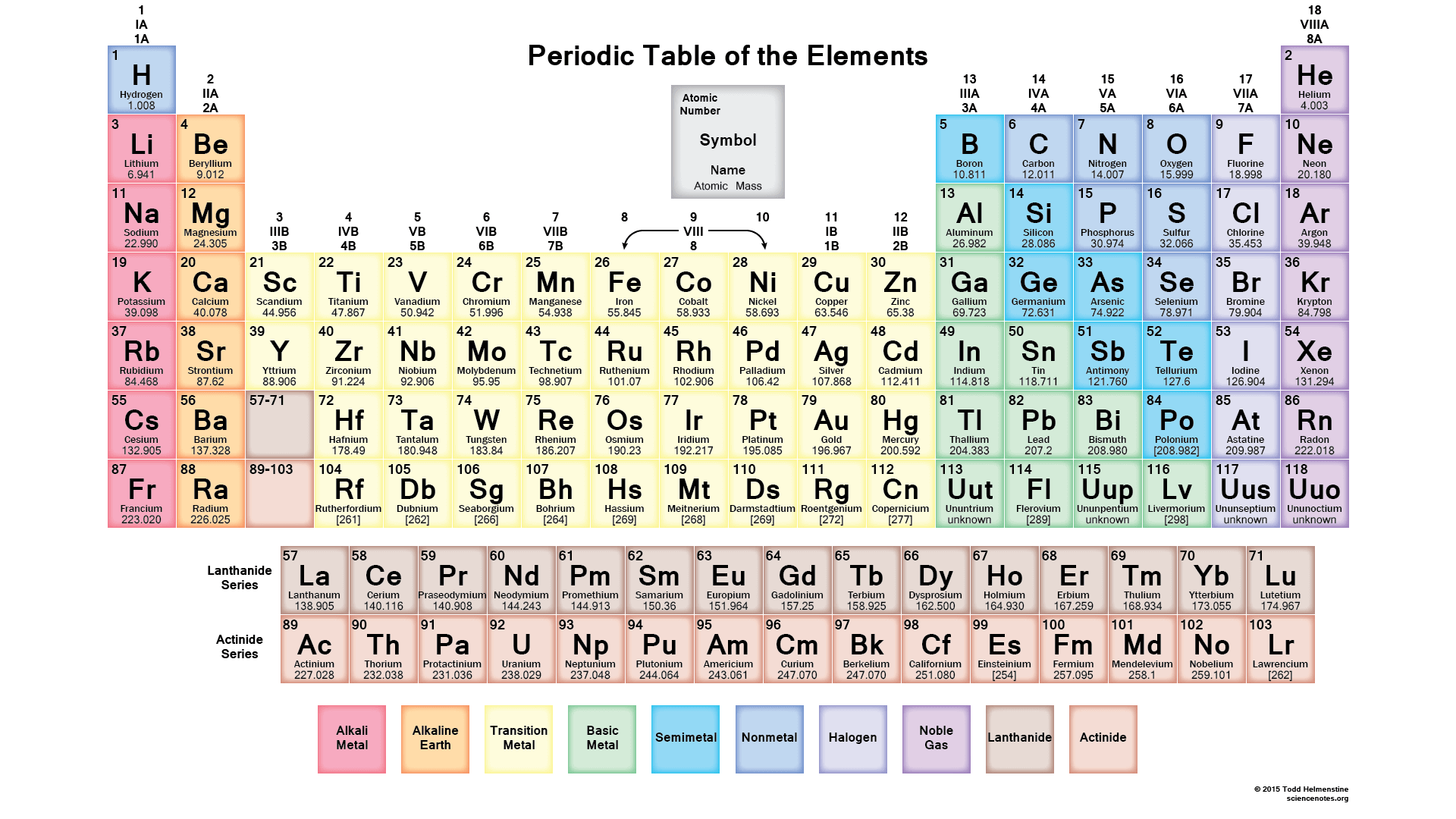
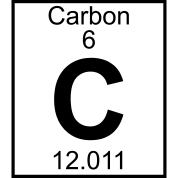
one or two letters that represent the name of an element
element name
element symbol
atomic number
atomic mass
Which group of the periodic table is composed of inert (not reactive) gases?
answer choices
alkali metals
alkaline earth metals
halogens
noble gases
Which is an alkali metal?
Magnesium
Iron
Sodium
Europium
Which is a halogen?
Helium
Chlorine
Oxygen
Neptune
Elements in a .................. have similar chemical properties.
period
group
row
Name this group: These metals are the most reactive.


Choose all the items that are elements.
NaCl (table salt)
Sulfur
O2
Water
Air
Choose all of the items that are compounds.
NaCl (table salt)
Sulfur
O2
Water
Air
Choose all of the items that are mixtures
NaCl (table salt)
Sulfur
O2
water
Air
Students in Mrs. Clark's science class are investigating a substance that has the following properties
-shiny
-bends easily
-hard, not easily broken
Based on these properties how would you classify the substance?
metal
nonmetal
metalloid
neutron
A subatomic particle that has a positive charge and that is found in the nucleus of an atom
not able to conduct heat or electricity, little to no metallic luster
A subatomic particle that has a negative charge
A small particle in the nucleus of the atom, with no electrical charge
A subatomic particle that has a positive charge and that is found in the nucleus of an atom
Proton
elecrtron
groups
neutrons
A subatomic particle that has a negative charge
nobles gases
protons
electrons
neutrons
What is the first part of the digestive system that your food travels though?
stomach
mouth
small intestine
esophagus
What is the second part of the digestive system that your food travels though?
stomach
mouth
small intestine
esophagus
What is the third part of the digestive system that your food travels though?
stomach
mouth
small intestine
exophagus
What is the fourth part of the digestive system that your food travels though?
stomach
mouth
small intestine
esophagus
What are the three parts of the mouth that help with digestion?
saliva
taste buds
teeth
gums
tongue
Which of the following is NOT an example of dairy?
yogurt
milk
cheese
Cheerios
Which of the following is TRUE about fiber?
It is a nutrient that comes in two forms: natural and added. The natural form is much better for you than the added form.
a mineral that our body needs in small amounts to
help muscles relax and contract. This nutrient also helps move blood throughout your body (blood pressure)
a nutrient that helps digest and pass foods that
we eat and makes our bodies absorb sugar more slower
Which of these is a good source of fiber?
a hamburger
cheese
bacon
whole grain bread
Where does digestion start?
Feet
Throat
Stomach
Mouth
Chewing is which kind of digestion?
physical
chemical
What is the function of the small intestine?
most chemical digestion and nutrient absorption
waste exits body
chews food
What is the function of your excretory system?
Absorb nutrients
Fight infection
Get rid of waste
Nothing
What is the function of the stomach?
chew food
store food temporarily and aid chemical digestion
physically breakdown food
the stomach has no function
Which of these is NOT one of the 7 food groups?
Carbohydrates
Proteins
Dairy
Lipids
Which of these are types of carbohydrate?
Starch
Sugar
Amino acids
Fatty acids
"Meat, eggs, cheese, beans, nuts and seeds." These foods are all good sources of which nutrient?
Simple carbohydrates
Fats (lipids)
Complex carbohydrates
Protein
What is the major function of lipids (fats) in the body?
Growth and repair
Energy; make up part of cell membranes so essential for normal growth
Why does starch need to be digested (broken down)?
It is too big to be absorbed in the small intestine
It is too small to be absorbed in the small intestine
Proteins are broken down into _____ _____.
(a)
Starch is broken down into (a) .
Which chemical reagent is used to test for sugars?
Benedict's
Biuret
Iodine
Which chemical reagent is used to test for proteins?
Benedict's
Biuret
Iodine
Which chemical reagent is used to test for starch?
Benedict's
Biuret
Iodine
What colour is iodine in the presence of starch?
Red
Orangey-brown
Green
Blue-black

What is the name for the finger-like projections in the small intestine that provide a large surface area for the absorption of food?
(a)
Soft bones and teeth may be caused by a diet that lacks
zinc
protein
calcium
vitamin A
Scurvy is caused by a deficiency in ______
Protein
Sunlight
Vitamin C
Iron
Saliva begins the chemical digestion of
proteins
starches
fats
nutrients
Your body needs proteins for
malnourishment
insulation
energy
growth and repair
Bile is produced in the liver
TRUE
FALSE
The pancreas releases digestive juices into the small intestine
TRUE
FALSE

Which digestive substance, produced by the liver and stored in the gall bladder, is critical for digestion and absorption of fats and fat-soluble vitamins?
Amylase
Lipase
Bile
Pepsin

Name the pictured organ
stomach
small intestine
liver
Pancreas

Which digestive organ is where most chemical digestion and absorption of nutrients takes place?
pancreas
small intestine
liver
Mouth

Which organ absorbs water into the bloodstream before excretion?
gall bladder
large intestine
liver
Lungs

Which is the oesophagus?
A
B
C
D
E

Name this organ
small intestines
large intestines
esophagus
stomach
What is the function of the gall bladder?
Stores bile
Produces bile
Filters blood
Secretes insulin
How are magnets oriented when they attract each other?
North pole to North pole
South pole to South pole
North pole to South Pole
How are magnets oriented when they repel each other?
Like poles next to each other
Opposite poles next to each other
What does it mean when objects repel each other?
Move closer together
Move farther apart
They explode
In order for electricity to flow, the circuit must be
open
closed
This material allows electrons to flow easily
Conductor
Insulator
Grounding
This material does not allow electrons to flow easily.
Conductor
Insulator
Grounding
Metal is a good conductor
True
False
How do objects become positively charged?
They gain electrons
They lose electrons
Rubbing or Friction
How do objects become negatively charged?
They gain electrons
They lose electrons
Rubbing or Friction
This is a measure of electrical resistance
Current
Volt
Ohms
Ampere
Force resulting from interaction between electrically charged particles
Magnetic Force
Electromagnetic Force
Electric Force
Current
As the distance between magnets increases-the attraction between them will
Decrease
Stay the Same
Increase
How can the strength of an electromagnet increase?
Remove the battery
Remove loops (coils) of wire from around the iron nail
Add more loops (coils) of wire around the iron nail
Remove the iron nail, leaving only the coils of wire
What is magnetic force?
Attraction or repulsion that arises between electrically charged particles because of their motion
How strong a magnet is
Force resulting from interaction between electrically charged particles
The size or quantity of something

What type of circuit is shown in the picture?
Series circuit
Parallel circuit
Open circuit
When an electric current can travel along more than one path, it is traveling in a—
Open circuit
Series circuit
Closed circuit
Parallel circuit

The magnetic field is strongest at
the north pole only
in the middle
at both poles
at the south pole only
Which direction will the electricity travel?
Neutral to positive
Positive to negative
Negative to positive
Neutral to negative
The buildup of charges on an object is called
Current electricity
Static electricity
Electromagnetism
Magnetic field

What type of circuit is shown in the picture?
parallel circuit
open circuit
series circuit
What is a circuit?
The buildup of electric charges
A complete, closed path through which electric charges flow
Opposition to the flow of charge
Electric potential
An iron nail wrapped with copper wire and attached to a battery makes —
Permanent magnet
Electromagnet
Compass
Metal magnet
A coiled current carrying wire is called
an electromagnet
a solenoid
a compass
a ferromagnet
Electromagnets can be
turned on and off
made stronger
made from iron
made weaker

What type of event will occur at this boundary?
Earthquake
Volcano Eruption
Tornado
Mountain Building

Which of these events can ONLY happen on a DIVERGENT BOUNDARY?
Rift Valley
Mountain
A peninsula
An Insanely complex, long answer that you will click out of instinct.


The process by which metamorphic rock changes to igneous rock begins with
melting
erosion
deposition
crystallization
The process by which igneous rocks are formed...
heat and pressure
melting and solidification
weathering and erosion


The two main causes of variation within a species are:
Genetics
Diet
Environment
Personality
Some characteristics are caused by both genetics and environmental influences, select all those that only genetic.
Weight
Scar
Sporting ability
Eye colour
Blood group
Name the main 2 scientists who discovered the structure of DNA
Watson and Crick
Franklin and Crick
Watson and Mendel
Creese and Bareham
Select all the statements about the structure of DNA that are TRUE.
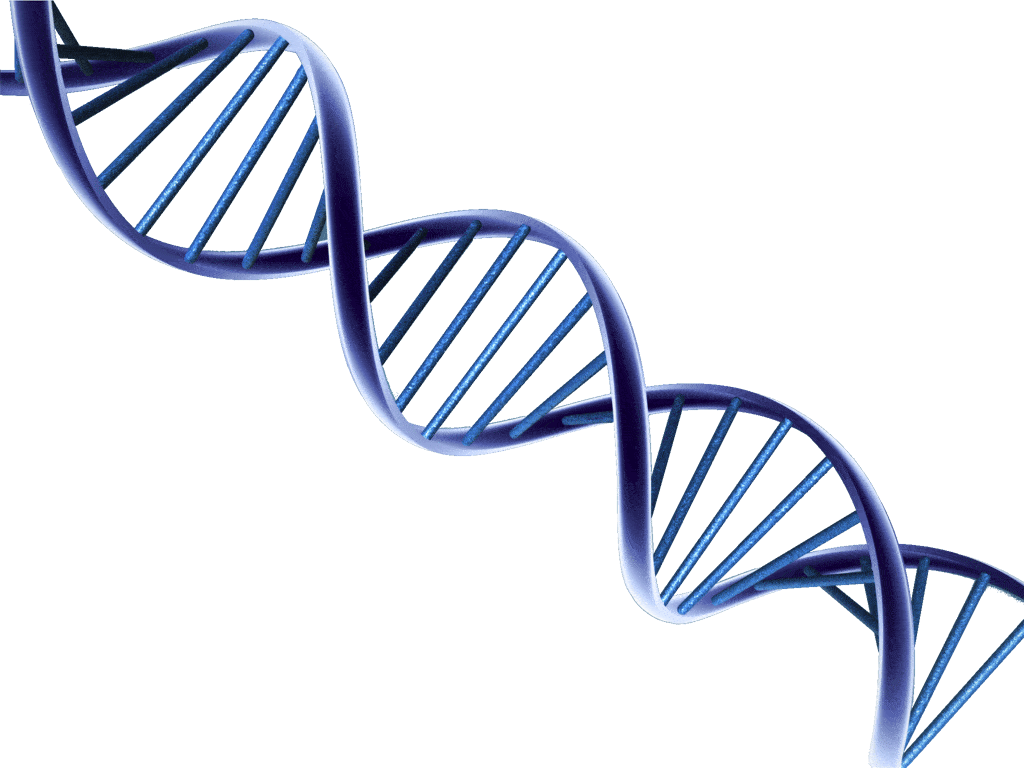
The structure is described as a double helix
A pairs with C
C pairs with G
The bases are held together with hydrogen bonds
The bases are: Argon, Thymine, Cyan, Ghana
Where is DNA found?
Nucleus
Cell Wall
Cell Membrane
Anywhere in the cell.
(a) is a short length of DNA found on a chromosome that codes for a particular characteristic.
An alternative form of a gene is called an (a) .
The genetic make up of an organism is known as their (a)
The physical characteristics of an organism are known as their (a)
Which of these would be correct for an organism that was described as being homozygous recessive.
bb
BB
Bb
Bbb
Which of the following bone are found in your arm?
Clavicle
Radius
Femur
Ribs
Which of the following tissue connects bone to bone?
Ligament
Tendon
Cartilage
Joint capsule


Latissmus Dorsi
Erectors
Deltoids
Abdominal


What is this muscle?
Biceps
Triceps
Lats
Deltoids

What muscle is the arrow pointing to?
Pectoralis (Pecs)
Biceps
Triceps
Lats


Muscles in your body move in _________.
points
their own way
pairs
What are the products of aerobic respiration?
Carbon Dioxide and Energy
Lactic Acid
Water and Carbon Dioxide
Glycogen and Carbon Dioxide
What are the products of anaerobic respiration in a human cell?
Energy and Lactic Acid
Lactic Acid
Lactic Acid and Carbon Dioxide
Carbon Dioxide and Water
What are the products of anaerobic respiration in plants and yeast?
Lactic Acid and Carbon Dioxide
Carbon Dioxide and Energy
Ethanol and Energy
Ethanol and Carbon Dioxide
Which type of respiration releases more energy per gram of glucose?
Aerobic
Anaerobic
They both release the same amount
What is the chemical formula for glucose?
C6H12O6
C12H6O12
C6O12H6
6CH2O
Where is lactic acid principally broken down in the human body?
Muscles
Liver
Kidneys
Blood
What is the equation for aerobic respiration?
C6H12O6 + 6O2 --> 6CO2 + 6H2O
C6H12O6 + O2 --> CO2 + H2O
C6H12O6 + 6O2 --> CO2 + 6H2O
6C6H12O6 + 6O2 --> 6CO2 + 6H2O
Where in the body does respiration take place? Select the best answer.
The lungs
The muscles
All cells
The blood
What is the purpose of respiration? Select the best answer.
To release the chemical energy stored in glucose
To generate heat
To produce energy
To absorb oxygen by diffusion

What is structure A?
Mouth
Trachea
Alveoli
Air pipe
What is structure B?
Alveoli
Trachea
Air pipe
Diaphragm
What is structure B?
Alveoli
Diaphragm
Mouth
Trachea
Where does oxygen go after the lungs?
Out of the body
To the brain
Into the bloodstream
stays in the lungs
What happens to breathing and heart rate when we exercise?
They decrease
They increase
They stay the same
They go up and down randomly
Why does breathing rate and heart rate increase when we exercise?
We need more water so we can respire more
We need more oxygen so we can respire more
Trick question! We don't
Because we get hotter

