
 Worksheets
Design and Technology 70 question full curriculum
Total questions: 70
Worksheet time: 38mins
What should pupils do if they notice any defects in tools or machines?
Ignore the defects
Report the defects immediately
Try to fix the defects themselves
Continue using the tools or machines
What does the Health and Safety at Work Act 1974 require employers to do?
Ignore the safety of their employees
Take all reasonable care to ensure the safety of their employees
Allow employees to work without any safety measures
Encourage employees to take risks
Which of the following is a correct safety rule for pupils in the workshop?
Run in the workshop
Wear loose clothing
Wear sensible shoes
Leave tools lying around
What colour are the safety signs that show things that must be done?
Red
Blue
Yellow
Green
What does the word ‘automatic’, when referring to a product, mean to you?
Requires manual operation
Operates without human intervention
Needs constant supervision
Works only with a remote control
What are the three parts that can represent a system?
Input, Process, Output
Start, Middle, End
Sensor, Controller, Actuator
Signal, Response, Feedback
Describe the term ‘feedback’.
Information sent to the input of a system
A signal that stops the system
A process that speeds up the system
A method to start the system
What is the difference between an open loop and a closed loop control system?
Open loop has feedback, closed loop does not
Closed loop has feedback, open loop does not
Both have feedback
Neither has feedback
Make a list of the things that sensors can sense and measure.
Light, Heat, Sound, Pressure, Tension, Position, Movement, Vibration, Speed
Color, Taste, Smell, Texture, Weight, Volume, Density, Mass
Length, Width, Height, Depth, Area, Perimeter, Volume, Surface Area
Time, Date, Year, Month, Week, Day, Hour, Minute, Second
Describe a sub-system.
A smaller system within a larger system
A system that operates independently
A system that does not require feedback
A system that is always malfunctioning
What are the three parts that every mechanism can be split into?
Input, Output, Process
Input, Process, Output
Input, Process, Energy
Input, Energy, Output
Which type of movement is described as circular forwards and backwards movement?
Rotary
Reciprocating
Oscillating
Linear
What is the function of a lever?
To increase speed
To lift or move objects heavier than you could deal with on your own
To decrease friction
To change the direction of movement
What are the three parts of a lever system?
Effort, Load, Fulcrum
Input, Process, Output
Energy, Movement, Pivot
Force, Weight, Balance
Which type of movement is described as straight line, forwards and backwards movement?
Rotary
Reciprocating
Oscillating
Linear
What is the rhyme to remember the classes of levers?
1 2 3 – F L E
1 2 3 – E L F
1 2 3 – L F E
1 2 3 – F E L
What is the formula for Mechanical Advantage (MA)?
MA = LOAD × EFFORT
MA = LOAD ÷ EFFORT
MA = EFFORT ÷ LOAD
MA = EFFORT × LOAD
If an effort of 4 newtons is used to move a load of 8 newtons, what is the Mechanical Advantage (MA)?
MA = LOAD ÷ EFFORT
1
2
4
8
What is the formula for Velocity Ratio?
Velocity Ratio = Distance load moves ÷ Distance effort moves
Velocity Ratio = Distance effort moves ÷ Distance load moves
Velocity Ratio = Distance load moves × Distance effort moves
Velocity Ratio = Distance effort moves × Distance load moves
What is the formula for Torque?
Torque = Effort ÷ Distance
Torque = Effort × Distance
Torque = Distance ÷ Effort
Torque = Distance × Effort ÷ 2
If a mechanism's effort moves 6 meters and the load moves 2 meters, what is the velocity ratio?
Velocity Ratio = Distance effort moves ÷ Distance load moves
1
2
3
4
What is the torque when an effort of 8 newtons is made by using a spanner with a handle of 250mm (0.25m) in length?
Torque = Effort × Distance
1 Nm
2 Nm
4 Nm
8 Nm
What is the primary use of a pulley?
To lift a heavy object by pulling down on a rope
To push a heavy object up a slope
To rotate a wheel
To balance a load
What is the Mechanical Advantage (MA) of a pulley system with two wheels?
1
2
3
4
What happens if the pulley system is overloaded?
The belt tightens
The belt slips
The pulley breaks
The load increases
What is the formula for the speed ratio of pulleys?
Diameter of driven pulley ÷ Diameter of driver pulley
Diameter of driver pulley ÷ Diameter of driven pulley
Number of teeth on driver gear ÷ Number of teeth on driven gear
Number of teeth on driven gear ÷ Number of teeth on driver gear
What must be done to change the direction of rotation in a pulley system?
Increase the load
Decrease the load
Cross the belt over
Use a larger pulley
What is the function of gears in a machine?
To transfer linear motion
To transfer rotary motion
To balance the load
To increase the load
What is the formula for the gear ratio?
Number of teeth on driven gear ÷ Number of teeth on driver gear
Diameter of driven pulley ÷ Diameter of driver pulley
Number of teeth on driver gear ÷ Number of teeth on driven gear
Diameter of driver pulley ÷ Diameter of driven pulley
What is the gear ratio between gears A and B if gear A has 80 teeth and gear B has 40 teeth?
Number of teeth on driver gear ÷ Number of teeth on driven gear
1:1
2:1
4:1
1:2
What is the effect of the number of teeth on the idler gear on the gear ratio formula?
It doubles the gear ratio.
It halves the gear ratio.
It has no effect on the gear ratio.
It reverses the gear ratio.
Why is a change of more than 10:1 or 1:10 unlikely with two meshing gears?
Because the gears will break.
Because the teeth on each gear have to be the same size to mesh.
Because the gears will turn in the same direction.
Because the gears will not fit on the same shaft.
What is the purpose of an idler gear in a gear system?
To increase the speed of the driven gear.
To decrease the speed of the driven gear.
To make the driver and driven gears turn in the same direction.
To change the size of the gears.
When using a single pulley system, if the effort is moved 2 metres, how far does the load move?
1 metre
2 metres
3 metres
4 metres
What is the purpose of an idler gear?
To increase speed
To change the direction of rotation
To reduce speed
To increase torque
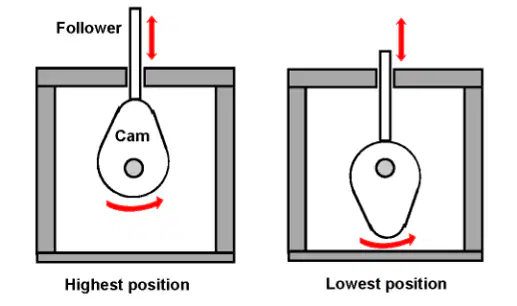
Cams are used in mechanisms to change rotary motion to what type of motion?
Linear motion
Reciprocating motion
Circular motion
Oscillating motion
Which type of cam follower stays at the lowest position for half a turn and then rises and falls steadily?
Pear shaped
Eccentric
Ratchet
Circular
What is the main use of a worm gear?
To increase speed
To reduce the speed of a motor
To change the direction of rotation
To increase torque
What type of motion is caused by using a cam?
Rotary to linear motion
Linear to rotary motion
Rotary to rotary motion
Linear to linear motion
What force is described as a pushing force that tries to squash?
Tension
Compression
Bending
Torsion
What is the mechanical advantage of a screw thread?
It changes linear motion to rotary motion.
It changes rotary motion to linear motion.
It reduces the distance moved when turning the head.
It increases the distance moved when turning the head.
What type of force tries to stretch a structure?
Compression
Bending
Tension
Shear
What type of force tries to twist a structure?
Tension
Compression
Bending
Torsion
What type of force tries to curve a structure?
Tension
Compression
Bending
Shear
What happens to the top and bottom surfaces of a beam when it is being bent by a force?
Both surfaces are compressed.
The top surface is compressed and the bottom surface is stretched.
Both surfaces are stretched.
The top surface is stretched and the bottom surface is compressed.
What is the term used to describe the amount of matter (mass) in a material?
Fusibility
Density
Thermal Conductivity
Insulating
Which material has a high melting point?
Zinc
Lead
Copper
Tungsten
What is the measure of how fast heat can travel through a material?
Density
Fusibility
Thermal Conductivity
Insulating
What is the purpose of understanding the various properties of materials when designing a product?
To choose materials based on their appearance.
To make a sensible choice of which materials to use.
To avoid using any materials.
To ensure the product is expensive.
Which of the following materials is known for having low thermal conductivity?
Copper
Steel
Woods
Tungsten
What is the term used to describe how easy it is to melt a material?
Density
Fusibility
Thermal Conductivity
Insulating
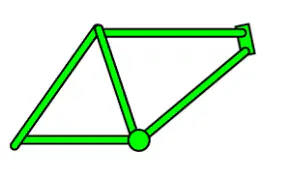
What is the effect of adding an extra member to a square frame structure?
It makes the structure heavier.
It makes the structure less rigid.
It makes the structure more rigid.
It makes the structure more flexible.
What is electrical conductivity a measure of?
How fast heat travels through a material
How fast electricity travels through a material
How much a material expands when heated
How much light passes through a material
Which of the following materials has a high melting point?
Woods
Nylon
Steel
Gold
What happens to a high expansion material when it is heated?
It becomes smaller
It becomes noticeably larger
It becomes transparent
It becomes opaque
What are materials called that do not let any light pass through them?
Transparent
Translucent
Opaque
Elastic
What is the term for materials that let some light through but do not allow details to be seen?
Transparent
Translucent
Opaque
Plastic
What is the term for a material that returns to its original state after deformation?
Plastic
Elastic
Opaque
Transparent
What type of strength resists being crushed?
Shear strength
Torsional strength
Tensile strength
Malleability
What is malleability a measure of?
How well a material can withstand force without breaking
How easily a material can be permanently deformed by compressive forces
How much a material expands when heated
How fast electricity travels through a material
Define the term 'density' and give two examples of a dense material.
Density is a measure of how easily a material can be permanently deformed; examples: copper, gold.
Density is a measure of how well a material resists scratching; examples: diamond, chromium.
Density is a measure of mass per unit volume; examples: lead, iron.
Density is a measure of how well a material stands up to weathering; examples: tin, bronze.
How would you describe a fusible material? Give two examples of easily fused materials.
A fusible material is one that can be easily bent; examples: polypropylene, copper.
A fusible material is one that can be easily melted; examples: gold, tin.
A fusible material is one that can resist high temperatures; examples: diamond, chromium.
A fusible material is one that can be easily scratched; examples: woods, thermoplastics.
Give two examples of materials that are good heat insulators.
Polypropylene, copper
Mild steel, bronze
Glass, polyester resin
Diamond, chromium
If I wish to make switch contacts that will conduct electricity well, which materials might I use?
Polypropylene, copper
Diamond, chromium
Gold, tin
Mild steel, soft woods
What do you understand by the term 'translucent'?
A material that allows light to pass through but not detailed shapes.
A material that is completely opaque.
A material that is completely transparent.
A material that can be easily melted.
Explain what an elastic material is.
With the aid of diagrams, explain the terms 'tensile strength', 'shear strength' and 'bending strength'.
Tensile strength is the resistance to being pulled apart; shear strength is the resistance to sliding forces; bending strength is the resistance to bending.
Tensile strength is the resistance to being compressed; shear strength is the resistance to bending; bending strength is the resistance to sliding forces.
Tensile strength is the resistance to bending; shear strength is the resistance to being pulled apart; bending strength is the resistance to sliding forces.
Tensile strength is the resistance to sliding forces; shear strength is the resistance to being compressed; bending strength is the resistance to being pulled apart.
What property allows a material to be stretched until it becomes a long thin wire or fibre?
Hardness
Toughness
Ductility
Durability
What is the property that makes a material a malleable material?
The ability to be easily melted.
The ability to be easily scratched.
The ability to be permanently deformed without cracking.
The ability to resist weathering.
Explain what is meant by a 'tough' material. Describe the sort of materials that are the opposite of tough.
A tough material can resist sudden forces without cracking; opposite materials are brittle.
A tough material can be easily melted; opposite materials are fusible.
A tough material can be easily scratched; opposite materials are hard.
A tough material can conduct electricity well; opposite materials are insulators.

