
 Worksheets
Physics Waves
Total questions: 144
Worksheet time: 4hrs 1mins
Which 3 key features of water waves will the ripple tank practical allow you to find?
Wavelength, speed and frequency
Depth, height and width
Wavelength, distance and time
Speed, frequency and depth
A still image of the waves on the piece of paper can be used to find the wavelength. What instrument will be used for this measurement?
Mobile Phone
Metre Rule
Toaster
Oscilloscope
In order to find the frequency of the waves, what do we need to know?
The speed of the waves
The number of waves passing a point each second
The time taken for a wave to travel across the tank
The time taken for a wave to reflect from the far side of the tank.
The highest point of a wave
Crest
Trough
Amplitude
Wavelength
The lowest point of a wave
Crest
Trough
Amplitude
Wavelength
A wave in which the motion of the wave is parallel to the direction of the wave.
Crest
longitudinal
transverse
Wavelength
The number of waves in given time
Crest
frequency
period
Wavelength
The time it takes for one wavelength
Crest
frequency
period
Wavelength
A wave in which the motion of the wave is perpendicular to the direction of the wave
Crest
transverse
longitudinal
Wavelength

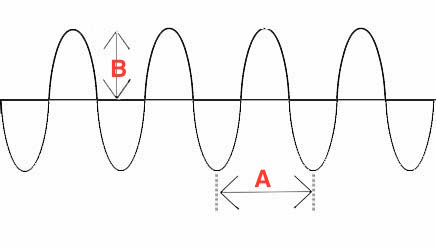
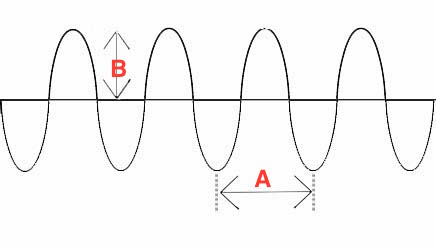
What is A pointing to?
Amplitude
Crest
Wavelength
Trough
Waves transfer (a)
Which waves require a medium (matter) to travel?
x-ray
microwave
sound
water

Which letter represents amplitude? (a)

2. What property of a wave is represented by letter B? (a)
6. Which of the following can act as media for a wave? (a)
8. The lowest part of a transverse wave is known as a (a) .
9. The frequency of a wave is measured in (a) .
16. The highest part of a transverse wave is known as a (a) .

What does point C represent? (a)
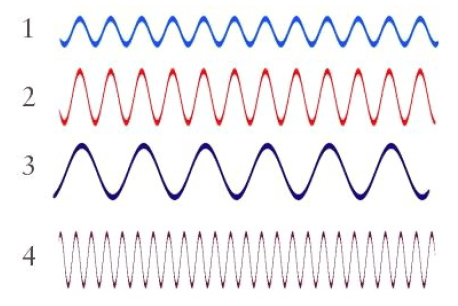
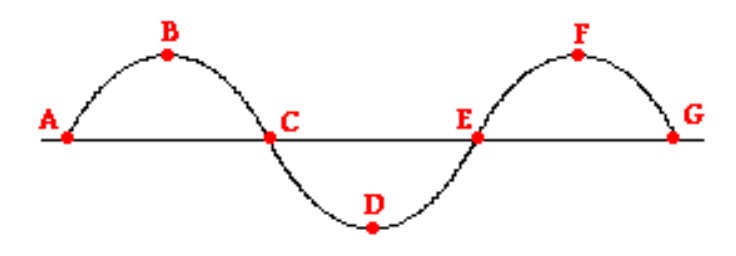
Which letter(s) represent the trough of the wave? (a)
What types of waves carry energy at a right angle or perpendicular to the direction of the energy flow? (a)
What are the parts of a longitudinal wave? (a)
How fast the wave is moving through a medium (a)
When a wave bounces off of something and moves in a different direction (a)

Which wave is pictured? (a)
What types of waves can travel through empty space AND mediums? (a)
A wave has frequency of 50 Hz and a wavelength of 10 m. What is the speed of the wave? (a)
Light bending as it passes through a raindrop is an example of (a)

What is the name of this piece of equipment?
Ripple tank
Wave machine
Frequency calculator
Wave speed apparatus

Why should you measure the distance covered by 10 waves and then divide by 10 to find the wavelength?
Because dividing by 10 is easy
To make it a fair test
To get a more accurate result

Between which two letters is one wavelength?
A and C
B and D
A and D
A and E
What would happen to the wavelength if the frequency was doubled?
the wavelength would be halved
the wavelength would be doubled
the wavelength would stay the same
frequency does not affect wavelength
What would happen to the frequency is the wavelength was tripled?
the frequency would be a third of what it was
the frequency would be 3 times larger
the frequency would stay the same
the wavelength does not affect the frequency of a wave

Which image represents a longitudinal wave?
A
B
Sound waves are which type of waves?
transverse
seismic
longitudinal
frequency
What does a wave carry from place to place?
energy
matter
people
What is the name of this piece of equipment?
Ripple tank
Wave machine
Frequency calculator
Wave speed apparatus
Why should you measure the distance covered by 10 waves and then divide by 10 to find the wavelength?
Because dividing by 10 is easy
To make it a fair test
To get a more accurate result
Between which two letters is one wavelength?
A and C
B and D
A and D
A and E
What would happen to the wavelength if the frequency was doubled?
the wavelength would be halved
the wavelength would be doubled
the wavelength would stay the same
frequency does not affect wavelength
What would happen to the frequency is the wavelength was tripled?
the frequency would be a third of what it was
the frequency would be 3 times larger
the frequency would stay the same
the wavelength does not affect the frequency of a wave
Which image represents a longitudinal wave?
A
B
Sound waves are which type of waves?
transverse
seismic
longitudinal
frequency
What does a wave carry from place to place?
energy
matter
people
51-60.
Answer the questions below after watching the video
What is the purpose of the vibrating bar in a ripple tank?
To measure the clarity of the water
To heat the water
To create waves across the water surface
To measure the depth of the water
What is used to visualize the waves in a ripple tank?
A thermal camera
A colored dye
A sheet of white paper
A UV light
How is the wavelength of water waves measured in a ripple tank?
Using a ruler
Using a thermometer
Using a stopwatch
Using a pH meter
What does measuring 10 wavelengths help in calculating?
The acidity of the water
The wavelength of a single wave
The temperature of the water
The depth of the water
How is the frequency of the waves determined?
By calculating the wave height
By observing the color change
By measuring the temperature change
By counting waves for 10 seconds and dividing by 10
What does the frequency of a wave indicate?
The speed of the wave
The depth of the water
The number of waves passing a point per second
The height of the wave
Which equation is used to calculate the speed of water waves?
Speed = Distance / Time
Speed = Frequency x Wavelength
Speed = Wavelength / Frequency
Speed = Depth x Width
What alternative method can be used to determine wave speed?
Measuring the tank's width
Observing the wave color
Calculating the wave height
Measuring the time it takes for a wave to travel the length of the tank
Why might different methods of measuring wave speed yield different results?
Due to errors in wave height
Due to water temperature
Due to the type of ruler used
Due to measurement errors
What does the ripple tank experiment help students understand?
The biology of aquatic life
The chemical properties of water
The physical properties of wave motion
The geological features of the seabed
Light and water waves are examples of what?
Transverse waves
Longitudinal waves
The speed of light in a vacuum is:
3 x 10⁹ m/s
3 x 10⁸ m/s
3 x 10⁸ km/s
3 x 108 cm/s

What word describes the distance between the middle line and the highest part of the wave?
Wavelength
Superposition
Amplitude
Frequency
The law of reflection says that the:
angle of incidence is greater than the angle of reflection
angle of incidence is equal to the angle of refraction
angle of incidence is equal to the angle of reflection
angle of incidence is less than the angle of reflection
When light goes from a less dense medium to a more dense medium, light bends in what direction?
Away from the normal
towards the normal
continues at the same angle
When light moves from glass into air, the light will bend in what direction?
Away from the normal
Towards the normal
Continues at the same angle
What is the part of the eye that is coloured?
Cornea
Lens
Iris
Retina
What is the the photo-sensitive part of the eye called?
Lens
Iris
Cornea
Retina
White light is a mixture of colours that can be seen when the light hits a prism. The correct order the colours come out in is:
Red yellow orange green blue indigo violet
Red orange yellow green indigo blue violet
Red orange yellow green blue indigo violet
Red orange green yellow blue indigo violet
Blue jeans appear blue because:
they absorb blue light and reflect all of the other colours
they reflect blue light and absorb all of the other colours
they reflect all of the colours
Black objects:
Reflect all of the colours
Absorb all of the colours
What type of wave does sound travel as?
Transverse
Longitudinal
A high pitched sound has a:
high frequency
low frequency
What units is frequency measured in?
Meters
Newton
Hertz
Seconds
Frequency measures:
the number of vibrations per hour
the number of vibrations per minute
the number of vibrations per second
the number of vibrations per millisecond
Longitudinal waves must have a __________ to transfer energy
Medium
Formula
Balanced Force
oscillation
All waves carry ______________.
Sound
Light
Matter
Energy
The vibrations in a longitudinal wave are __________ to the direction of energy transfer.
parallel
perpendicular
Up and Down
Backwards
Sound waves can travel through a vacuum because they don't require particles.
True
False

In longitudinal waves, the parts where the coils are spread apart (B) are called what?
rarefactions
compressions
wavelengths
longitudes

In a longitudinal wave, the parts where the coils are close together (A) are called what?
longitudes
rarefactions
compressions
wavelengths


Water waves and light waves are both examples to ___
Longitudinal Wave
Transverse Wave
Frequency wave
Sound Wave
As the wavelength increases, the frequency ____
increases
decreases
remain same
none of the above
The highest point of the transverse wave is called _____
trough
amplitude
crest
wavelength
The lowest point on the transverse wave is called_______
trough
crest
wavelength
frequency

This is the distance from the equilibrium position to the crest or to the trough.
crest
trough
wavelength
amplitude
In a transverse wave, particles vibrate perpendicular to the direction that the wave is traveling
True
False
none of the above
What do all waves transmit
energy
matter
frequency
water

The wavelength can be measured from ( check all that apply)
crest to crest
crest to trough
trough to crest
trough to trough
Examples of transverse wave ( check all that apply)
Vibration in guitar strings
a Mexican wave in sports stadium
ultrasound waves
micro waves
The material through which a wave travels
Mechanical Wave
Medium
Crest
Trough


What kind of wave is pictured below?
compressional wave
transverse wave
sound wave
mechanical wave
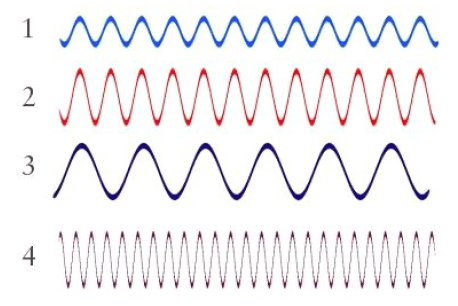

What is frequency measured in?
Milliseconds
Miles
Hertz
Kilograms

What is the number of complete waves passing a fixed point in a given amount of time?
Amplitude
Intensity
Wavelength
Frequency
What kind of wave is pictured below?
compressional wave
transverse wave
sound wave
mechanical wave
What kind of wave is pictured below?
compressional wave
transverse wave
sound wave
mechanical wave
∎ Progressive waves are travelling along the string in both directions.
∎ The standing wave is an example of superposition.
∎ The wavelength of the standing wave is d.

Which one of these statements is true?


Standing waves are created by
Two identical waves reflecting off each other
Two identical waves being diffracted together
Two identical waves move through each other in opposite directions
Two identical waves are diffracted from two identical sources
In the diagram which letters represent the nodes
A B C
A C E
B D
B D E
A C D

A violin string of length 0.54 m and wave speed of 565 m/s along it. Calculate the frequency of the 5th harmonic.
1046.3 HZ
282.5 Hz
3138.89 Hz
1546 Hz
The second harmonic on a string fixed at both ends shows
A wavelength
Half a wavelength
Two wavelengths
Which one of these statements is true?

The diagram below shows the mode of vibration in a closed pipe. The air displacements, nodes (N) and antinodes (A) are as indicated below.


The diagram below shows three modes of vibration in a closed pipe. If the length of the pipe is 10 m, and the speed of sound is 320 m/s, find the frequency of the harmonic shown.


The figure below shows a string vibrating in the sixth harmonic. The length of the string is 1.0 m. What is the wavelength of the wave on the string?
0.33𝑚
1.00m
0.66m
3.00m
A pipe that is open at both ends has a fundamental frequency of 150 Hz when the speed of sound in air is 300 m/s. How long is the pipe?
2.0𝑚
1.0𝑚
1.5𝑚

