
 Worksheets
Movement of Molecules
Total questions: 27
Worksheet time: 16mins
Diffusion is the movement of molecules from :
A lower concentration to a higher concentration
A higher concentration to a lower concentration
Osmosis is a form of :
Energy
Force
Diffusion
Active transport
Diffusion occurs in :
Solids
Liquids
Gases
Active transport requires a membrane
True
False
One difference between active transport and diffusion is that molecules move (a) (against/down) a concentration gradient in active transport.
Which of these processes require energy?
Osmosis
Active transport
Diffusion
Give an example of active transport.

The movement of particles is __________, resulting in the particles being spread throughout the container
Structured
In a straight line
Random
In curved, way motions
An increase in temperature does what to diffusion?
Speeds it up
Slows it down
Nothing
Stops it all together
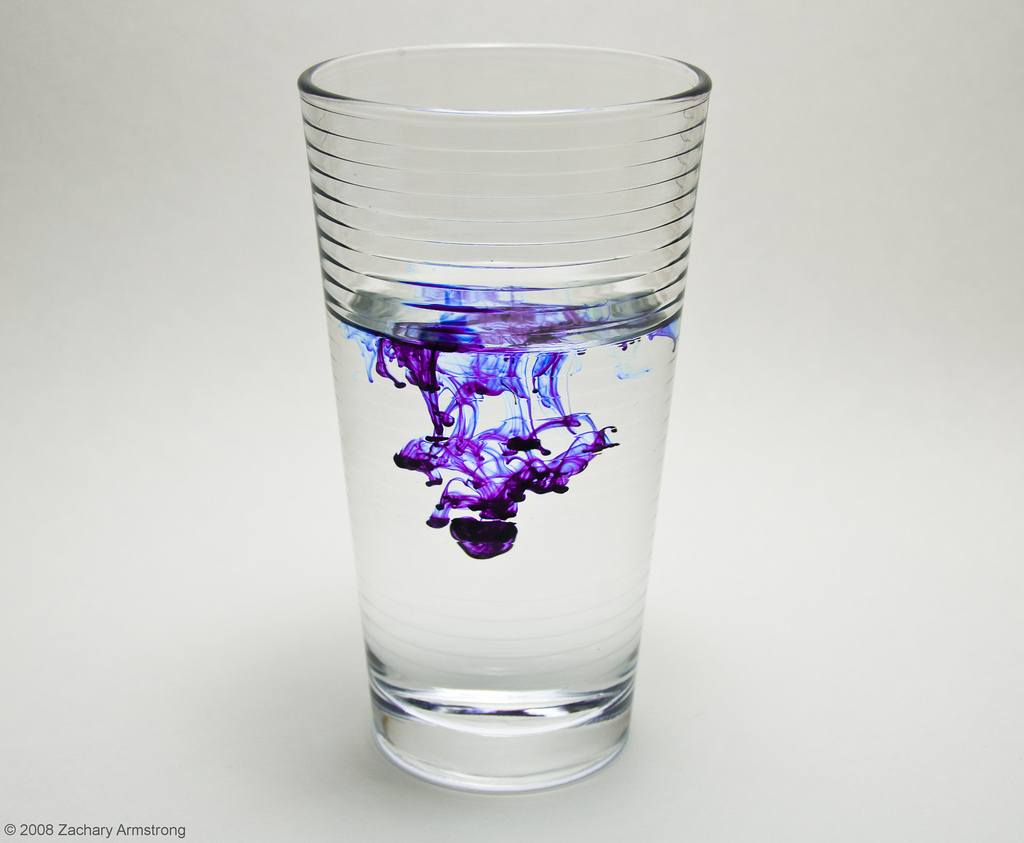
Where is there a low concentration of dye?
at the bottom of cup
in the color
at the top of cup
no concenteraion gradient
When does diffusion stop?
After a day and a night
When the particles are evenly spread out
When there are no particles left
When all the particles leave the system

Which of the following statements would be true in relation to the image?
There is no net movement of water from W to X
There would be movement of water from W to X
Osmosis of sugar molecules would occur from X to W
Solution X is more dilute and therefore a higher water potential. Water moves from X to W

Two identical cubes of beetroot are cut, both weighing 3.0g. Cube S is placed in concentrated salt solution and cube T is placed in pure water. What would be the masses be after 3 hours?
A
B
C
D
Why are water molecules able to enter the egg but NOT the sugar molecules?
Sugar molecules are too heavy.
The holes of the semi-permeable membrane were too small to let sugar molecules through.
Semi-permeable membranes need energy.
Semi-permeable membranes must be under pressure to work.
Dissolved gases move between the blood and body cells by which process?
absorption
respiration
diffusion
osmosis
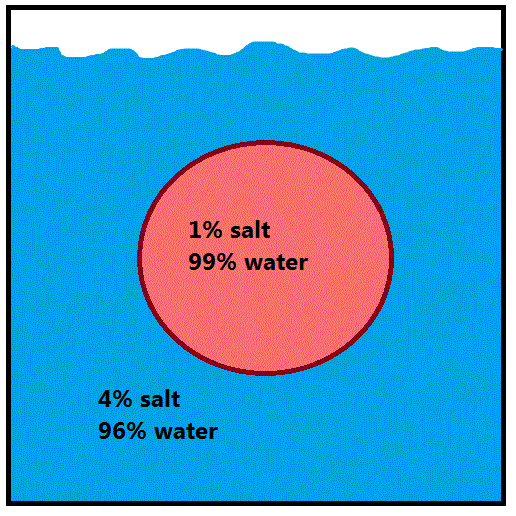
Where will the water go?
Into the cell
Out of the cell
Equally in & out - it's isotonic
There is no water
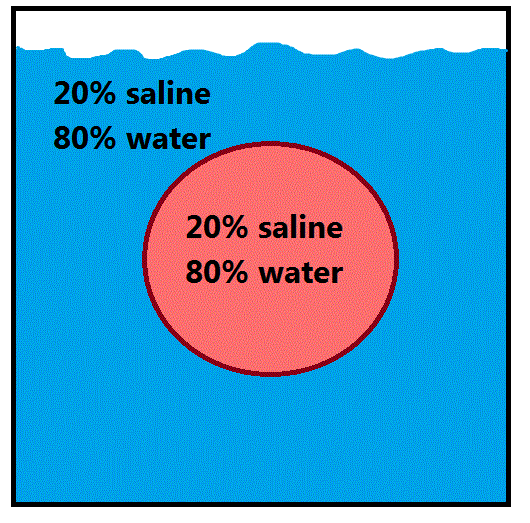
A blood cell is placed into the jar, as seen. Where will the water go?
Into the cell
Out of the cell
Equally in & out - it's isotonic
The water is a lie


What might happen if a cell did not have any ATP/energy?
It would not have enough energy to do active transport
It's cell membrane would break
The transport proteins would not be needed.


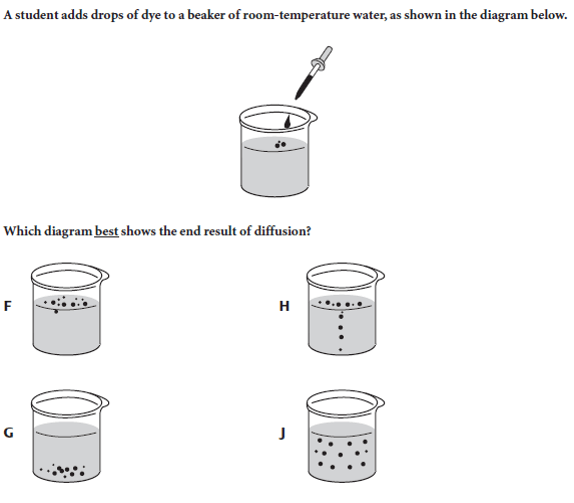
An animal cell placed in a salty solution will
Stay the same
Shrink- get smaller
Swell- get bigger

