
NEW
Font size
 Worksheets
Chemistry II. Matter
Total questions: 47
Worksheet time: 47mins
The definition of isotope is ..
two or more atoms of the same element with same number of protons but different number of neutrons.
two or more atoms of the same element with same number of protons but different number of electrons.
two or more atoms of the same elements with same number of nucleon but different number of neutrons.
two or more atoms of the same element with same number of electrons but different number of neutrons.

In a correctly written symbol what would be located in the "A" position?
number of neutrons
atomic number @ proton number
number of electrons
mass number @ nucleon number
An atom has 12 protons and 13 neutrons in its nucleus. Which is the correct symbol?


What does the mass number of an element represent?
The number of protons in an atom
the number of neutrons in an atom
the number of electrons in an atom
the number of protons and neutrons in an atom

What does it happen to this atom?
It LOSES electrons
It GAINS electrons
It GAINS protons
It LOSES protons
A formula with the lowest whole number ratio of elements in a compound is called
Molecular Formula
Chemical Formula
Empirical Formula
Distance Formula
What is the empirical formula for hydrogen peroxide which has a molecular formula of H2O2?
HO
H2O2
H2O
The empirical formula for a compound is CH2 and its relative atomic mass (Ar) is 70. What is its molecular formula? Use the periodic table to help you.
CH2
C5H10
C70H140
What coefficient would go in front of the O2?
___KNO3 → ___KNO2 + ___O2
What coefficients are needed to balance the reaction?
2, 2, 1
2, 3, 2
1, 2, 2
1, 3, 1
Fe2O3(s) + 3H2(g) → 2Fe(s) + 3H2O(l)
How many moles of iron can be made from 6 moles H2?
The amount of product that actually forms when a chemical reaction is carried out in a laboratory is called the _________ yield.
actual
theoretical
percent
excess

Complete the equation for the percent yield of a chemical reaction:
Percent yield=(________)÷(________)×100%
actual yield; theoretical yield
theoretical yield; actual yield
Actual yield = 62g
Calculate the percent yield.

In what respect the species given differ?
number of protons
number of neutrons
number of electrons
nucleon number

The ion shown contain..
10 protons, 12 neutrons and 12 electrons
12 protons, 12 neutrons and 12 electrons
12 protons, 12 neutrons and 10 electrons
12 protons, 24 neutrons and 10 electrons
The empirical formula for a compound is CH₂ and its molar mass is 56 g mol-1. What is the molecular formula?
C₄H₈
C₂H₄
C₅H₁₀
CH₂
Oxygen in H₂O₂ has Oxidation number of..
0
-2
+2
-1
All of the statements given are true EXCEPT
theoretical yield is the amount of product that would result if we used all of the limiting reactant.
actual yield is the amount of product that would result if all the limiting reactant reacted.
actual yield is the amount of product actually obtained in an experiment.
percentage yield is the ratio of actual yield to the theoretical yield multiply by 100.
The maximum amount of product that could be obtained in a chemical reaction can be calculated using
moles given of excess reactant
moles given of limiting reactant
moles needed of limiting reactant
stoichiometry of both reactant
In a redox reaction, the species reduced __
gains electrons and is the oxidizing agent.
loses electrons and is the oxidizing agent.
loses electrons and is the reducing agent.
gains electrons and is the reducing agent.
What is oxidation number of Mn in MnO2 ?
-2
+2
+4
+1
Oxidation is the _________ of electrons.
loss
gain
sharing
transfer

What type of bonding does this picture show?
Ionic
Covalent

What type of bonding does this picture show?
Ionic
Covalent
Generally, atoms form bonds so that _______________.
Each atom loses its electrons
Each atom has a stable electron configuration
Each atom has an unstable electron configuration
Each atom gains electrons
Generally low melting and boiling points
Ionic compounds
Covalent compounds
Generally high melting & boiling points
Ionic compounds
Covalent compounds
Poor electrical conductivity
Ionic compounds
Covalent compounds
Conducts electricity well when melted or dissolved
Ionic compounds
Covalent compounds
MgO
Ionic bond
Covalent bond
Metallic bond
Non-metallic bond
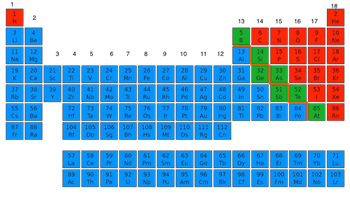
The chemical bond between a non-metal and another non-metal will be a ________ bond.
metal
ionic
covalent
polar
The chemical bond between a metal and a non-metal will be a _____ bond.
metal
ionic
covalent
polar
Sodium and Bromine will make a _____ bond.
ionic
covalent
metallic
Carbon and Oxygen will make a ___________ bond.
ionic
covalent
metallic
NaCl
ionic
covalent
metallic
Cations have a _____________ charge.
positive
negative
neutral
Anions have a ____ charge.
positive
negative
neutral
In ionic bonding, valence electrons are _______.
shared
transferred
destroyed
In covalent bonding, valence electrons are ______.
shared
transferred
destroyed
Why do all bonds form?
filling the outermost energy level to be stable
to make all atoms the same
to make other atoms unstable
to make all atoms different
Why don't noble gases form bonds?
They all have a full octet
Noble gases do form bonds
They only bond when with eachother
none of these answers are correct

