
 Worksheets
Intro Thermochemistry Notes Practice
Total questions: 50
Worksheet time: 3hrs 40mins
Which law states that energy cannot be created nor destroyed, but it can be transformed or transferred?
Dalton's Law
law of conservation of energy
Hess's Law
E=mc^2
What happens when kinetic energy increases?
Temperature increases.
Temperature decreases.
Temperature is not affected by kinetic energy.
For an exothermic reaction, ΔH is...
negative
positive
In an exothermic reaction, heat is a...
product (released)
reactant (absorbed)
If you touch an endothermic reaction, it will feel...
hot
cold

The graph is showing an ____________ reaction.
exothermic
endothermic
How do you calculate Enthalpy of a reaction?
ΔH = ΔHproducts - ΔHreactants
ΔT = q / mC
ΔG = ΔH -TΔS
E = mc2

Entropy is a measure of
accuracy
precision
the disorder of a system
the attraction of a nucleus for an electron
Quantity of heat needed to change the temperature of 1 g of a substance by 1 °C
Heat capacity
Calorie
Joule
Enthalpy
Specific heat

Which letter on the diagram represents a solid?
A
B
C
D
Which letter on the diagram represents the triple point?
A
B
C
D

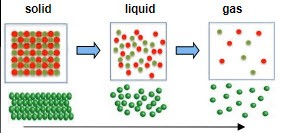
Which law of thermodynamics establishes absolute zero as the temperature at which the entropy of a system is zero?
1st law of thermodynamics
2nd law of thermodynamics
3rd law of thermodynamics
Zeroth Law

What is the metric unit for heat?
joules
grams
degrees celsius
calories

The first law of thermodynamics states that energy is
created
destroyed
conserved
created and destroyed
What does ΔH symbolize?
Enthalpy
Entropy
Energy
Matter
What device measures the change of energy for a system?
thermometer
calorimeter
spectrometer
pH meter

The diagram represents two solids and the temperature of each. What occurs when the two solids are placed in contact with each other?
Heat energy flows from solid A to solid B. Solid A decreases in temperature
Heat energy flows from solid A to solid B. Solid A increases in temperature
Heat energy flows from solid B to solid A. Solid B decreases in temperature.
Heat energy flows from solid B to solid A. Solid B increases in temperature.
Vaporization is what kind of change?
__________ is the transfer of heat by the movement of a fluid.
Conduction
Convection
Radiation
The amount of energy required to raise the temperature 1ºC for every gram is called____?
Thermal Energy
Specific Heat
Temperature
Kinetic Energy
What unit do you use to measure Thermal Energy?
J/g ºC
g
ºC
J

Water has a specific heat of 4.184 J/gºC. Wood has a specific heat of 1.760 J/gºC. What material needs more energy to raise the temperature by 1ºC
Wood
Water
Both are the same
How many Joules of energy are required to change 10 gram of liquid water from 20 C to 90 C? (specific heat of water=4.184 J/gC)
1400 J
2900 J
210,000 J
1,400,000 J
If the specific heat of water is 4.184 J/g∙°C, how much heat is required to increase the temperature of 1200 g of water from 23 °C to 39 °C?
-80,371.2 J
44,938.6 J
80,371.2 J
112,575.9 K
The specific heat of platinum is 0.133 J/g°C. How much heat(Q) is released when a 10 g piece of platinum cools from 100°C to 50°C?
66.5 J
665 J
0.0266 J
0.665 J
Which of the following best explains why the sand at the beach is hotter than the water?
Sand has a higher specific heat than water, requiring more energy to heat up than water.
Sand has a lower specific heat than water, requiring less energy to heat up than water.
Sand has a greater mass than water.
Water has a greater mass than sand.


In the Image, will the heat (+177.8 KJ) be a product or a reactant?
Product
Reactant

In the Image, will the heat (-890.4 KJ KJ) be a product or a reactant?
Product
Reactant
What is the sign of ΔH for an exothermic reaction?
Positive
Negative
Zero
Undefined
Which process has a negative ΔH?
Evaporation
Melting
Sublimation
Condensation
Breaking bonds is _________________. Forming bonds is ______________________
endothermic, exothermic
exothermic, endothermic
The mass of a sample is 30g. There’s a temperature change from 18°C to 35°C when it absorbed 625 J of heat. What is the specific heat of this sample?
2.78 J/g•°C
8.67 J/g•°C
1.23 J/g•°C
108.67 J/g•°C
1000
Convert 2.5 kcal = ____J (convert Kcal to cal first!)

