wayground logo

Free Printable Worksheets

NEW

Font size

S
M
L
XL
Worksheets

Periodicity Test Review

Total questions: 53

Worksheet time: 36mins

Name
Class
Date
1.
Which of the following groups is the most reactive?
a)
Alkali Earth Metals
b)
Aklali Metals
c)
Noble Gasses
d)
Transition metlas
2.
Which of the following is the least reactive?
a)
Alkali Earth Metals
b)
Alkali Metals
c)
Noble Gasses
d)
Transition Metals
3.
The horizontal rows of the periodic table are known as...
a)
Periods
b)
Groups
4.
The vertical columns on the periodic table are known as...
a)
Periods
b)
Groups
5.
One property of metals is they are good conductors of ... and ...
a)
Heat and Water
b)
Electrons and Protons
c)
Heat and Electricity
d)
Electricity and Electrons
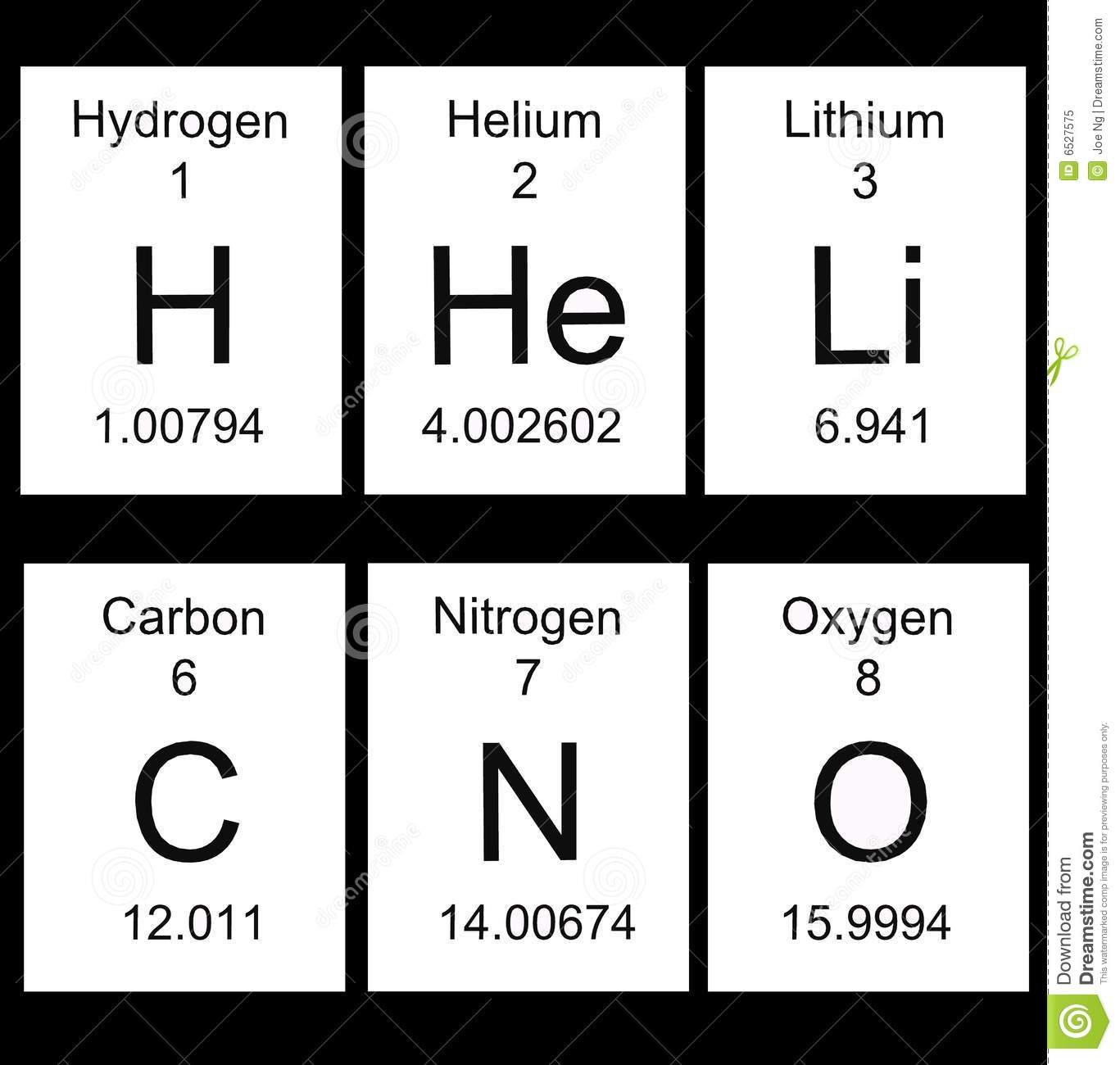
6.
Which element is this? 
a)
Fluorine
b)
Oxygen
c)
Carbon
d)
Sodium
7.
Which Element is this?
a)
Fluorine
b)
Oxygen
c)
Carbon
d)
Sodium
8.
As we shift right on the periodic table the atomic radii ...
a)
Increases
b)
Decreases
9.
As we shift right on the periodic table the ionization energy ...
a)
Increases
b)
Decreases
10.
 ... is the ability of an atom to capture an electron.
a)
Oxidation
b)
Reduction
c)
Electronegativity
d)
Valence
11.
How many valence electrons does Boron have? 
a)
5
b)
4
c)
2
d)
3
12.
How many valence electrons does Sodium have?
a)
5
b)
6
c)
1
d)
15
13.
How many valence electrons does Neon have?
a)
8
b)
9
c)
0
d)
3
14.
a)
energy levels
b)
valence electrons
c)
protons
d)
neutrons
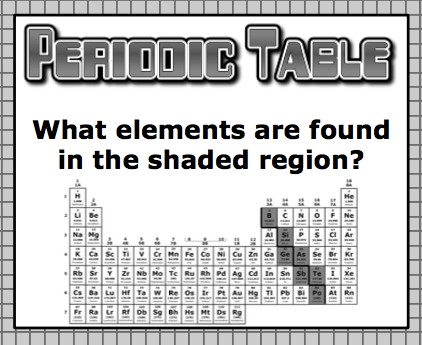
15.
a)
Metals
b)
Nonmetals
c)
Metalloids
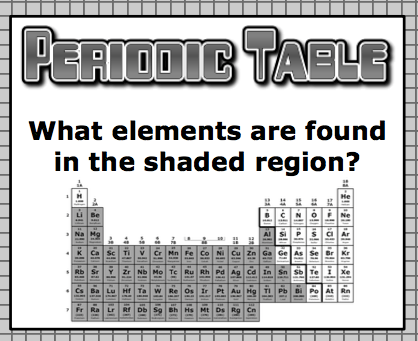
16.
a)
Metals
b)
Nonmetals
c)
Metalloids
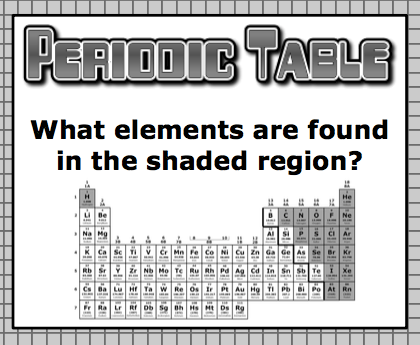
17.
a)
Metals
b)
Nonmetals
c)
Metalloids
18.
The number at the top of each square on the periodic table is the ...
a)
atomic number
b)
atomic mass
c)
Chemical Symbol
d)
Element Name
19.
How did Mendeleev arrange the elements?
a)
alphabetical 
b)
density
c)
melting point
d)
atomic mass
20.
As you move down the periodic table atoms get bigger.  This is because ____________.
a)
The atoms have more mass.
b)
The atoms have more protons.
c)
The atoms have more energy levels
d)
The atoms have more nuetrons
21.
Electronegativity is...
a)
how good an atom is at attracting electrons
b)
the ability of an atom to lose electrons
c)
the energy required to remove an electron from a specific atom
d)
how easy it is to make friends. 
22.
Electronegativity __________ from left to right within a period and __________ from top to bottom within a group.
a)
decreases, increases 
b)
increases, increases
c)
increases, decreases 
d)
stays the same, increases
23.
List the following in order of weakest to strongest ionization energy.
P, Cs, Co, Sr
a)
P, Co, Sr, Cs
b)
Cs, Sr, Co, P
c)
Sr, Cs, Co, P
d)
P, Co, Cs, Sr
24.

Which of the following elements has the smallest atomic radius?

a)

Sulfur

b)

Chlorine

c)

Aluminum

d)

Sodium

25.

Which atom has the largest atomic radius?

a)

potassium

b)

rubidium

c)

francium

d)

cesium

26.

Which of the following will have a higher electronegativity than arsenic (As)?

a)

Carbon (C)

b)

Neon (Ne)

c)

Antimony (Sb)

d)

Germanium (Ge)

27.

Which of the following will have a lower ionization energy than Scandium (Sc)?

a)

Helium (He)

b)

Titanium (Ti)

c)

Calcium (Ca)

d)

Magnesium (Mg)

28.
The element with the largest electronegativity in the halogens is - 
a)
At
b)
F
c)
Cl
d)
Br
29.

The element with the lowest electronegativity in Period 3 is -

a)

Na

b)

Cl

c)

Ar

d)

Mg

30.

As you look from left to right across a period, electronegativity

a)

increases

b)

decreases

31.
Atomic radius generally increases as we move __________.  
a)
down a group and from right to left across a period 
b)
up a group and from left to right across a period 
c)
down a group and from left to right across a period 
d)
up a group and from right to left across a period 
32.

Who developed the Periodic Table?

a)

Mendeleev, who was a chemist and teacher

b)

Pavlov, who was a teacher and physchologist

c)

Ladahoff, who was a teacher and biologist

33.
Ionization energy is...
a)
the energy required to add an electron to a specific atom
b)
how much energy it takes to remove an electron from an atom
c)
the energy required to shield the outer electrons from the nucleus
d)
a measure of the ability of an atom to attract electrons
34.
Ionization energy is...
a)
the energy required to add an electron to a specific atom
b)
how much energy it takes to remove an electron from an atom
c)
the energy required to shield the outer electrons from the nucleus
d)
a measure of the ability of an atom to attract electrons
35.
The element with the largest electronegativity in the halogens is - 
a)
At
b)
F
c)
Cl
d)
Br
36.
The minimum energy required to remove an electron from the ground state of an atom
a)
electron configuration
b)
energy levels
c)
ionization energy
d)
ionic bond
37.
The tendency of an atom to attract electrons and acquire a negative charge
a)
electronegativity
b)
charge
c)
bonding ability
d)
electron configuration
38.
As you move across the periodic table atoms tend to get smaller because, ______________.
a)
the atoms have more mass.
b)
the atoms have less mass
c)
the atoms have more protons.
d)
the atoms have less electrons.
39.

Name for group 3-12 elements

a)

Alkali Metals

b)

Metalloids

c)

Alkaline Earth Metals

d)

Tranistion Metals

40.

The present day Periodic Table is arranged in order of increasing ____.

a)

Atomic Mass

b)

Atomic Number

c)

Atomic Weight

41.

Name for group 2 elements

a)

Halogens

b)

Alkali Metals

c)

Non-Metals

d)

Alkaline Earth Metals

42.

A property of nonmetals is that they are _______.

a)

Hard

b)

Brittle

c)

Good Conductors

d)

Lustrous

43.

The ____ do not have defined values for electronegativity.

a)

Halogens

b)

Noble Gases

c)

Alkali Metals

d)

Alkaline Earth Metals

44.

Among the groups of elements listed below, which have the same number of electrons in their outermost energy levels?

a)

Li, B, C, F

b)

Na, Mg, Al, S

c)

K, Ca, Rb, Sr

d)

N, P, As, Sb

45.

The atom with SMALLER atomic size:

a)

As

b)

Br

46.

The atomic with smaller atomic size

a)

N

b)

Bi

47.

The atom with the larger first ionization energy:

a)

Ti

b)

Mn

48.

The atom with the larger electronegativity:

a)

B

b)

In

49.

The atom with the larger electronegativity:

a)

Rb

b)

Cs

50.

Lithium has a smaller atomic radius than potassium, explain why.

a)

Lithium has less energy levels than potassium.

b)

Lithium has more energy levels than potassium.

c)

Lithium has more protons than potassium.

d)

Potassium has a smaller atomic radius

51.

Nitrogen has a smaller ionization energy than antimony. Explain why.

a)

Nitrogen has more energy levels than antimony. Therefore, the electrons are farther from the nucleus and it requires more energy to remove these electrons.

b)

Nitrogen has less energy levels than antimony. Therefore, the electrons are close to the nucleus and it requires more energy to remove these electrons.

52.

Which element has the highest electronegativity?

a)

Fluorine

b)

Cesium

c)

Francium

d)

Helium

53.

What electron configuration does group 1 end in?

a)

S2

b)

P1

c)

D1

d)

S1