
 Worksheets
Chemistry - Post Test for Foundation Course
Total questions: 25
Worksheet time: 26mins
Electrochemistry deals with
Conversion of Chemical Energy into electrical energy
conversion of Electrical energy into Chemical energy
Both 1& 2
None
Zinc-Carbon cell is also called as
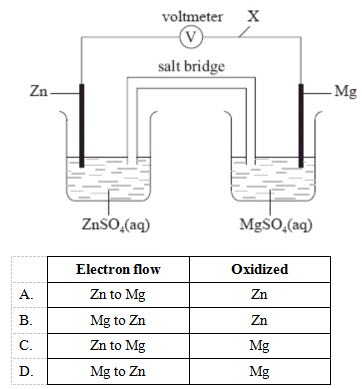
In Electro chemical Cell Oxidation always Occurs at
(a)

Large molecules made up of small monomers are called
polymers
peptides
peptones
monomers
Monomers of ethene in thousand numbers react together in addition polymerization to produce
polyamides
polyesters
poly(ethene)
all of them
Which of these is an example of synthetic polymer?
cotton fibers
rubber
wool
polyvinyl chloride (PVC)
What is the name of the reaction used to make polymers?
polymerization
cracking
polygonization
precipitation
Which polymers occur naturally?
Starch and Nylon
Starch and Cellulose
Proteins and Nylon
Proteins and PVC
What is a monomer?
Many molecules that can undergo polymerisation
A single molecule that can undergo polymerisation
A type of polymer
A fraction
What is a monomer?
Many molecules that can undergo polymerisation
A single molecule that can undergo polymerisation
A type of polymer
A fraction
POLYMER is also called
Micromolecule
Macromolecules
Dimer
Polynomial
What is the correct name of a polymer made of ethene?
(Poly)ethene
poly(ethene)
poly(chloroethene)
ethene
The term ‘sorption’ stands for ____________.
absorption
adsorption
both absorption and adsorption
desorption
(a) force is responsible for physisorption
Activated charcoal is used to remove coloring matter from pure substances. It works by___________.
Sorption
Absorption
Adsorption
Bleaching
Physisorption is held by
Covalent forces
Chemical forces
Vander Waal forces
Centrifugal forces
Chemisorption is held by
Covalent bond
Chemical forces
Van der Waal forces
Centrifugal
Surface compound formation takes place in
Physical adsorption
Desorption
Chemical adsorption
Sorption
When the concentration of adsorbate is more on the surface than the bulk of the adsorbent it is called as
Positive adsorption
Negative adsorption
Positive absorption
Negative absorption
Nano stands for ------------------ meter
1 billionth
1 millionth
10000
1000
Nano meter is
10^ -6 meter
10^ -9 meter
10^ -3 meter
10^ -2 meter
The unique property of nano materials is its
flexible structure
malleable behaviour
large surface area
small surface area
An example of zero dimensional material is
nano wires
nano rods
nano tubes
quantum dots

