
NEW
Font size
 Worksheets
WCM - Chpt3
Total questions: 16
Worksheet time: 9mins
Explain the differences between ‘Guided Media’ and ‘Unguided Media’.
Guided media employ an antenna for transmitting through air, vacuum, or water, whereas unguided media provide a physical path along which the signals are propagated
Guided media use fiber optic cables exclusively, while unguided media rely solely on coaxial cables.
Guided media provide a physical path along which the signals are propagated. Unguided media employ an antenna for transmitting through air, vacuum, or water.
Guided media transmit data through satellites, whereas unguided media use underground cables.
State three examples of ‘Guided Media’.
Fiber Optic Cables, Coaxial Cables, Twisted Pair Cables
Radio Waves, Microwaves, Infrared
Bluetooth, Wi-Fi, Satellite Communication
Ethernet, Cellular Networks, Infrared

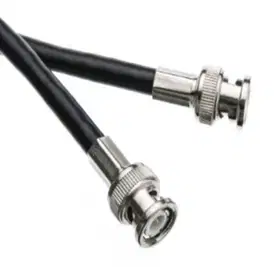
Identify the types of cables shown below:
Twisted Pair Cable
Coaxial Cable
Power Cable
Fibre Optic Cable
Identify the types of cables
Coaxial Cable
Twisted Pair Cable
Fibre Optic Cable
Power Cable
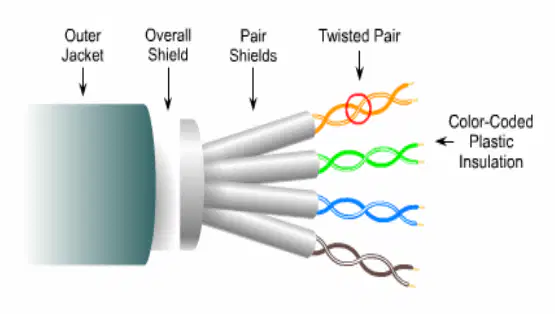
Identify the types of ‘Twisted-Pair’ cable
Shielded Twisted Pair Cable
Unshielded Twisted Pair Cable
Screened Twisted Pair Cable
Coaxial Cable

Identify the types of ‘Twisted-Pair’ cable
Shielded Twisted Pair Cable
Unshielded Twisted Pair Cable
Screened Twisted Pair Cable
Coaxial Cable
State two disadvantages of ‘Shielded Twisted-Pair’ (STP) as compared to ‘Unshielded Twisted-Pair’ (UTP) cable.
Less reliable and higher latency
Higher signal attenuation and shorter maximum distance
More expensive and difficult to install
Slower data transmission rates and less flexible
List one advantage of ‘Fibre Optic’ cables over ‘Copper’ cables.
Not susceptible to electromagnetic interference
Requires less maintenance
Easier to install
Cheaper to produce
Briefly explain the purpose of using the foil in a ‘Screened Twisted Pair’ cable.
The foil provides extra strength to the cable structure.
The foil protects EMI from entering or exiting the cable.
The foil enhances the cable's flexibility.
The foil improves the cable's data transmission speed.
State any one disadvantage of using ‘Unshielded Twisted Pair’ (UTP) cable.
More prone to electrical noise and interference
More expensive than other cable types
Requires more complex installation
Limited compatibility with network devices
State the ‘Frequency Range’ and ‘Applications’ for the UHF Band in radio transmission.
Range: 300 kHz – 3 MHz
Application: AM Radio, Maritime Communication, Long-Distance Communication
Range: 3 GHz – 30 GHz
Application: Satellite, Radar, Microwave Communication
Range: 30 MHz – 300 MHz
Application: FM Radio, VHF TV, Amateur Radio
Range: 300 MHz – 3 GHz
Application: TV (UHF), Mobile Phone, Satellite
State any four key variables of an Antenna.
·Bandwidth
·Polarization
·Beam Width
·Gain
•Modulation
•Voltage
•Resistance
•Refraction
•Speed
•Temperature
•Phase
•Amplitude
•Frequency band
•Transmission
•Interference
•Signal strength
Define the following terms for an Antenna: ‘Gain’, ‘Beam Width’.
'Gain' is the total amount of power an antenna can transmit regardless of direction, and 'Beam Width' is the distance between the antenna and the receiver
'Gain' is the frequency range over which the antenna operates, and 'Beam Width' is the physical size of the antenna.
Gain is an indication of the antenna concentration of radiated power in a certain direction and Beam width of an antenna is the angle within which the power radiated is above one-half (50%) of the value in the preferential (desired) direction.
'Gain' is the efficiency of the antenna in converting electrical power to radio waves, and 'Beam Width' is the time it takes for the antenna to rotate 360 degrees.
State the disadvantage of having an Antenna bandwidth wider than the desired bandwidth.
Increased signal attenuation
Higher power consumption
More susceptible to interferences
Reduced signal strength
Which Antenna has a greater gain? ‘Antenna X’ with a Gain of 24 dBi or ‘Antenna Y’ with a Gain of 23 dBd.
Antenna X
Antenna Y
Explain what an ‘Isotropic Antenna’ is.
It is an antenna that focuses all its radiated power in a single direction.
It is an antenna that can operate at any frequency without changing its design.
It is a theoretical ‘Isotropic Antenna’ has a perfect 360º vertical and horizontal beam widths.
It is an antenna with a very high gain in a specific direction but limited coverage in other directions

