
 Worksheets
Grace-Review
Total questions: 180
Worksheet time: 2hrs 45mins
A trait or change in lifestyle that helps a plant or animal survive in its environment
adaptation
evolution
homologous
vestigial
Organisms with the best suited adaptations for their environment are more likely to survive and reproduce than organisms that are not very well adapted
natural selection
artificial selection
creationism
a trait that gives an organism an advantage in their particular environment
overproduction
adaptation
selection
variation
A sudden change in the genes of an organism. It can cause abnormal physical traits.
fossil
extinction
mutation
Select the right word for this definition:
"in biology, changes that happen over time in the gene pool of a population."
evolution
extinction
mutation

One example of ___ is how moths that couldn't blend in with their environments as well as others died out over time.
mutation
natural selection
extinction
All of the genetic information found in a population
population
genetic drift
evolution
gene pool
Genetic Diversity is increased through this process.
Gene Flow
Genetic Drift
If a new trait DOES help an organism survive, what may happen to it?
It dies and its DNA is not passed on
It survives and its DNA is passed on
It changes its traits to adapt and survive
Evolution is
the change in the genetic makeup of a population over successive generations
the variation in genetic makeup or alleles within a population
Hunters killed elephants with tusks resulting in more tuskless elephants. The hunters were the ___ pressure changing the population
Selective
Unusual
Usual
exceptional
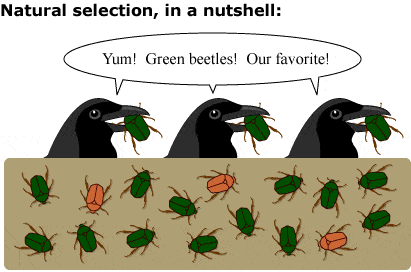
Cranes in a pond eat all of the green frogs causing an increase in survival of brown frogs. What is the selective pressure?
Cranes
Green Frogs
Brown Frogs
Pond Water

Members of different species
Can reproduce successfully
Differ genetically
Will never live together .


An organism made of only one cell is called . . .
Eukaryotic
Monocellular
Multicellular
Unicellular

This organelle is a rigid outer layer that protects plant cells.
Cell Membrane
Cell Wall
Nucleus
Chloroplast

This organelle controls what goes in and out of plant and animal cells.
Cell Wall
Cell Membrane
Cytoplasm
Cytoplasm

The _____________ stores food, water, wastes, and other materials in both plant and animal cells.
Vacuole
Mitochondria
Ribosomes
Chromatin

What is this structure?
Mitochondria
Nucleus
Chloroplast
Vacuole

A _____ organism is made of many cells, each specialized to do certain jobs.
Eukaryotic
Multicellular
Prokaryotic
Unicellular

This fluid in the cell is where the organelles are found. It contains water and chemicals the cell needs.
Blood
Cytoplasm
Plasma
Vacuole

These organelles convert the energy in food molecules to a form the cell can use.
Chloroplasts
Mitochondria
Lysosomes
Ribosomes

These tiny cell structures assemble protein molecules from amino acids.
Carbohydrates
Lipids
Nucleic Acids
Ribosomes

These organelles in plants capture light energy and store it in glucose molecules to be used as food.
Chloroplasts
Mitochondria
Endoplasmic Reticulum
Vacuoles

Plant cells and animal cells
are both prokaryotic
are both eukaryotic
do not have a nucleus
do not have DNA

Check all the organelles that can be found in an animal cell.
chloroplasts
mitochondria
nucleus
golgi complex

The function of the mitochondria is
is to make proteins for the cell.
transport materials in and out of the cell.
break down waste products for the cell.
break down glucose through cellular respiration and make energy for the cell.
Ribosomes are important because
they make proteins for the cell.
they make glucose for the cell.
they transport materials throughout the cell.
they control the cell's activities
Both an animal cell and a plant cell have a cell membrane.
TRUE
FALSE
Genetic material can be found in what organelle?
the golgi complex
the mitochondria
the nucleus
the chloroplasts
Smooth endoplasmic reticulum
does not have ribosomes on the membrane and makes lipids for the cell.
has ribosomes on the membrane and makes proteins for the cell.
has ribosomes on the membrane and makes lipids for the cell.
does not have ribosomes on the membrane and make glucose for the cell.
Rough endoplasmic reticulum
does not have ribosomes on the membrane and transports proteins for the cell.
does not have ribosomes and makes energy for the cell.
does not have ribosomes and makes proteins for the cell.
has ribosomes on the membrane and transports proteins for the cell.

Check the functions of the cell wall.
provides support for the plant cell
provides structure and support for the plant cell
provides energy for the animal cell
provides structure for the animal cell

The function of the golgi complex is to
make proteins for the cell.
make energy for the cell.
package and distribute materials such as proteins for the cell
controls the activities of the cell.

Check the three major differences between a plant cell and an animal cell.
cell wall
mitochondria
large central vacuole
chloroplasts

Chloroplasts are organelles that
make food for the plant cell by going through photosynthesis.
transport proteins.
package materials and distribute them throughout the cell.
break down waste products.
Lysosomes that are found in animal cells are like the "trash bags" of the cell because they
move materials throughout the cell.
release digestive enzymes that break down worn-out and damaged organelles and waste material in the cell.
make food for the cell.
make proteins for the cell.

Arrow 12 is pointing to what organelle in the plant cell.
the chloroplasts
the large central vacuole
the cell wall
the mitochondria

Arrow 7 is pointing to what organelle in the animal cell.
the large central vacuole
the chloroplasts
the cell membrane
the mitochondria
An organelle involved in breaking down lipids, proteins, carbohydrates, damage organelles, and bacteria are ___
Golgi Appaparatus
Vesicles
Vacule
Lysosomes
Both mitochondria and chloroplasts ____
contain their own unique ribosomes that are different than the cells
contain their own unique DNA that are different than the cells
are specialized organelles that capture and release energy
are found in both in plants and animals
Encloses the cell, it acts like a gatekeeper, allowing some materials to pass through it but not others.
Chloroplasts
Cell Wall
Cell Membrane
Cytoplasm
A rigid structure that surrounds the cell membrane for support and protection of the cell.
Chloroplasts
Cell Wall
Cell Membrane
Cytoplasm
Organelles where photosynthesis occurs, are green due to chlorophyll pigment found in them.
Chloroplasts
Cell Wall
Cell Membrane
Cytoplasm
A gel like fluid that takes up most of the space inside the cell. The organelles are found scattered throughout it.
Chloroplasts
Cell Wall
Cell Membrane
Cytoplasm
Organelles that package cellular materials and transports them within the cell or out of the cell.
Golgi Body
Endoplasmic reticulum
Large central vacuole
Lysosomes
A fluid like vesicle that stores water and provides support for the cell.
Golgi Body
Endoplasmic reticulum
Large central vacuole
Lysosomes
A cell organelle that is responsible for waste removal in the cell.
Golgi Body
Endoplasmic reticulum
Large central vacuole
Lysosomes
Powerhouse of the cell, organelle that is the site of ATP ( energy production ) and cellular respiration in plants and animals.
Nucleus
Ribosomes
Mitochondria
Vacuoles
Is the structure located in a plant and animal cell that is home to DNA, where new cells are made and directs cell activity
Nucleus
Ribosomes
Mitochondria
Vacuoles
Where proteins are made in the cells.
Nucleus
Ribosomes
Mitochondria
Vacuoles
Small structures in the cytoplasm that do special jobs.
Nucleus
Ribosomes
Organelles
Vacuoles
Saclike structures that store materials such as water, salts, proteins, and carbohydrates.
Nucleus
Ribosomes
Organelles
Vacuoles
Function of the cell membrane to block the movement of certain sizes, shapes and kinds of particles from entering the cell.
permeable
impermeable
semi-permeable
Plant cells and animal cells
are both prokaryotic
are both eukaryotic
do not have a nucleus
do not have DNA
The function of the mitochondria is
is to make proteins for the cell.
transport materials in and out of the cell.
break down waste products for the cell.
break down glucose through cellular respiration and make energy for the cell.
Smooth endoplasmic reticulum
does not have ribosomes on the membrane and makes lipids for the cell.
has ribosomes on the membrane and makes proteins for the cell.
has ribosomes on the membrane and makes lipids for the cell.
does not have ribosomes on the membrane and make glucose for the cell.
Rough endoplasmic reticulum
does not have ribosomes on the membrane and transports proteins for the cell.
does not have ribosomes and makes energy for the cell.
does not have ribosomes and makes proteins for the cell.
has ribosomes on the membrane and transports proteins for the cell.
Check the three major differences between a plant cell and an animal cell.
cell wall
mitochondria
large central vacuole
chloroplasts
Enzymes belong to which class of macromolecules?
lipids
carbohydrates
proteins
nucleic acids
DNA belongs to which class of macromolecules?
proteins
nucleic acids
carbohydrates
lipids
Sugar belongs to which class of macromolecules?
proteins
lipids
nucleic acids
carbohydrates

Which macromolecule is shown?
lipid
protein
nucleic acid
carbohydrate


*GLUCOSE

* look at the R.....

* cholesterol and triglycerides


hormones

The building blocks for organic compounds are called...
Polygons
Polymers
Monograms
Monomers
___ are used by cells to get quick energy.
Carbohydrates
Lipids
Proteins
Nucleic Acids
Nuts, butter, and waxes are examples of ____
Nucleic Acids
Lipids
Proteins
Carbohydrates
_____ help build organelles (cell parts) and help defend against illness.
Proteins
Nucleic Acids
Lipids
Carbohydrates
_____ store genetic information.
Carbohydrates
Lipids
Nucleic Acids
Proteins
What is the monomer of carbohydrates?
Monosaccharide
Nucleotide
Fatty Acid
Amino Acid
What is the monomer of proteins?
Amino Acid
Fatty Acid
Nucleotide
Monsaccharide
What is the monomer of lipids?
Monosaccharide
Fatty Acid
Amino Acid
Nucleotide
What is the monomer of nucleic acids?
Monsaccharide
Nucleotide
Amino Acid
Fatty Acid
What elements would be found in carbohydrates?
Carbon, Hydrogen
Carbon, Hydrogen, Oxygen
Carbon, Hydrogen, Oxygen, Nitrogen
Carbon, Hydrogen, Oxygen, Nitrogen, Phosphorous
What elements would be found in lipids?
Carbon, Hydrogen, Oxygen, Nitrogen, Phosphorous
Carbon, Hydrogen, Oxygen, Nitrogen
Carbon, Hydrogen, Oxygen
Carbon, Hydrogen
What elements would be found in proteins?
Carbon, Hydrogen, Oxygen, Nitrogen, Phosphorous
Carbon, Hydrogen, Oxygen, Nitrogen
Carbon, Hydrogen, Oxygen
Carbon, Hydrogen
What elements would be found in nucleic acids?
Carbon, Hydrogen, Oxygen, Nitrogen, Phosphorous
Carbon, Hydrogen, Oxygen, Nitrogen
Carbon, Hydrogen, Oxygen
Carbon, Hydrogen

Which is shown in the picture?
Monosaccharide
Fatty Acid
Amino Acid
Nucleotide

Which is shown in the picture?
Monsaccharide
Amino Acid
Fatty Acid
Nucleotide

Which is shown in the picture?
Amino Acid
Nucleotide
Fatty Acid
Monosaccharide

Which is shown in the picture?
Fatty Acid
Monsaccharide
Amino Acid
Nucleotide
When you step out into the cold, your body shivers in order to keep its temperature at 98.6F. Which characteristic of life does this represent?
All living things use energy
All living things contain cells
All living things maintain homeostasis
All living things grow
A camel has eyelashes that work to keep the dust and sand out of its eyes. Which characteristic of life does this represent?
All living things adapt to their environment
All living things grow
All living things have cells
All living things use energy
Which statement describes ALL living things?
They are composed of one or more cells.
They must reproduce sexually.
They have organ systems to carry out the processes of life.
They are capable of making their own food.
A baby song bird hatches from its egg with both parent songbirds watching. Which characteristic of life does this represent?
All living things reproduce
All living things maintain homeostasis
All living things use energy
All living things grow
The following are all characteristics of life EXCEPT:
made of cell(s)
eat food
respond stimuli
reproduce

Which characteristic is shown: A plant switches position and follows the sunlight throughout the day.
Grow and develop
Respond to a stimulus
Acquire and use energy
Reproduce
Which of the following is NOT an example of an adaptation?
birds migrating during the winter months
the total sum of all the chemical reactions in your body
humans evolving the ability to digest lactose (sugar in milk)
the ability of dolphins to communicate in aquatic environments

Which of these is not true about all organisms?
all living things are multicellular
all living things obtain and use energy
all living things reproduce

The following list represents characteristics of a living thing :
made of cells, has lungs, can reproduce
made of cells, grows and develops, uses energy
has similar chemicals, makes noises, made of cells
Which item listed is NOT a characteristic of life?
adjusting to stimuli
getting and using energy
growing and developing
breathing


Living things are based on a universal genetic
code. What molecule is responsible for that code?
RNA
Lipid
Protein
DNA
The combination of chemical reactions through
which an organism builds up or breaks down
materials as it carries out its life processes is called ...
absorption
metabolism
digestion
consumption
Maintaining a stable internal
environment is called
homeostasis
equilibrium
balance
evenness
Identify the characteristic: when you step out into the cold, your body shivers in order to keep its temperature at 98.6oF.
All living things use energy
All living things contain cells
All living things maintain homeostasis
All living things grow and develop
Identify the characteristic: green plants produce their own food through the process of photosynthesis.
All living things use energy
All living things contain cells
All living things maintain homeostasis
All living things grow and develop
Identify the characteristic: a caterpillar hibernates in a cocoon and emerges as a butterfly.
All living things adapt to their environment
All living things use energy
All living things respond to their environment
All living things grow and develop


Which of the following is a response?
a flashlight shined into the eye
a rubber band popping your hand
your pupils constricting when exposed to bright light
blood glucose levels drop significantly

Which of the following is an example of homeostasis?
adapting to your environment
maintaining an appropriate respiration rate
the sum of all of your chemical reactions
being composed of more than one cell
Which of the following is NOT an example of an adaptation?
birds migrating during the winter months
the total sum of all the chemical reactions in your body
humans evolving the ability to digest lactose (sugar in milk)
the ability of dolphins to communicate in aquatic environments
Identify the characteristic: A camel has eyelashes that work to keep the dust and sand out of its eyes.
All living things adapt/respond to their environment
All living things grow
All living things have cells
All living things use energy
The above question is an example of:
What is the independent variable in the above question?
Results
What part of an experiment contains the data tables and graphs?
Analysis
Conclusion
Hypothesis
Materials
What is the affect of salt water on the the height of blades of grass?
The above question is an example of:
Hypothesis
Conclusion
Procedures
Testable Question
What is the final step in the scientific method?
Write a conclusion about your results
Record and analyze the data
Form a hypothesis
Research your topic
Which is a good example of a hypothesis for the following scientific question, "Does playing violent video games lead to higher blood pressure?"
Playing violent video games gives people higher blood pressure.
If you have higher blood pressure, then you play violent video games.
If you play violent video games you will have higher blood pressure.
If you play violent video games, then you will have higher blood pressure.
Why is the following considered a bad hypothesis? "If your plants grew taller, then they were given fertilizer."
It doesn't have "if" and "then"
The prediction is wrong
The independent and dependent variable are in the wrong order
This is a good hypothesis
Jennifer wants to know if students do better on their homework if they listen to classical music or hip hop music. What is the independent variable in this experiment?
Students' grades on homework
The age of the students
The volume of the music
The type of music

