wayground logo

Free Printable Worksheets

Font size

S
M
L
XL
Worksheets

Intro to Chemistry Quiz

Total questions: 40

Worksheet time: 1hrs 12mins

Name
Class
Date
1.
Identify the equipment shown here:
a)
volumetric flasks
b)
graduated cylinders
c)
Erlenmeyer flasks
d)
Florence flasks
2.
What is special about graduated cylinders?
a)
They hold large quantities of liquid safely
b)
They measure small amounts very accurately. We use them when precision is important.
c)
They allow us to examine the liquid, we use them when looking for suspended solids.
d)
They are easily heated. We use graduated cylinders to heat liquids
3.
Beakers are used
a)
to measure volume with high accuracy and precision
b)
to hold small amounts of dry chemicals
c)
to recover dissolved solids
d)

to hold or gently heat liquids and observe reactions

4.

Which of the following pieces of chemistry lab equipment produces a flame from gas that is used for heating substances?

a)

Bunsen burner

b)

Beaker

c)

Crucible

d)

Erlenmeyer Flask

e)

Funnel

5.

How many significant figures?

0.150

a)

1

b)

2

c)

3

d)

4

6.

How many significant figures?

76490

a)

3

b)

4

c)

5

d)

6

7.

Which one is rounded correctly for the following equation?

1.987 - 0.48 = ?

a)

1.5

b)

1.51

c)

1.507

d)

2

8.

Which one is rounded to the correct number of significant figures for the following equation?

7520 x 0.021 = 157.92

a)

157.92

b)

157.9

c)

158

d)

160

9.
How many significant figures: 1000 mL
a)
1
b)
2
c)
3
d)
4
10.
Write 0.000972 in scientific notation.
a)
9.72 x 10⁻⁴
b)
9.72 x 10⁻³
c)
972 x 10-4
d)
9.72 x 10⁴
11.
How do you write
8.317 x 10⁶
in standard form?
a)
8, 371, 000
b)
83, 170, 000
c)
837, 100
d)
8, 317, 000
12.
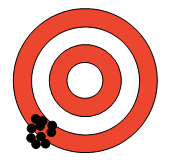
This bullseye demonstrates...
a)
High Accuracy & High Precision
b)
High Accuracy & Low Precision
c)
Low Accuracy & High Precision
d)
Low Accuracy & Low Precision
13.

What is the base unit for measuring volume?

a)

liters

b)

meters

c)

grams

d)

seconds

14.
What is the formula for DENSITY?
a)
D=M*V
b)
D=M/V
c)
D=V*M
d)
D=V/M
15.
1. The base unit for the length in metric system is:
a)
centimeters
b)
meters
c)
inches
d)
yards
16.
Flammability (burns): Chemical or Physical Property
a)
Chemical Property
b)
Physical Property
17.
Melting Point: Chemical or Physical Property
a)
Chemical Property
b)
Physical Property
18.
Boiling Point: Chemical or Physical Property
a)
Chemical Property
b)
Physical Property
19.
Physical properties are
a)
properties that can be observed without changing the identity of the substance
b)
properties that describe how a substance changes into a completely different substance
c)
properties that we can only observe with our eyes
d)
properties that we need special tools to observe
20.

Reactivity (bubbling, fizzing) is a --- property.

a)

Chemical

b)

Physical

21.
5 gallons to ? L 
1gal = 3.785 L
a)

18.93

b)

.1893

c)

1893

d)

1893000

22.
The length of a desk is 3.5 feet. How many centimeters is the length? 
(there are 2.54 cm in an inch)
a)
60
b)
120.23
c)
106.68
d)
117.12
23.

The human esophagus us about 250 mm log. How long is that in inches? 1 in = 2.54 cm

a)

10.64 in

b)

9.84 in

c)

11.35 in

d)

8.84 in

24.

How many kilograms of calcium are there in 173 pounds of calcium? (1 pound = 454 grams; 1 kg = 1000 g)

a)

1.10 kg

b)

78.5 kg

c)

110 kg

d)

78500 kg

25.
I must follow all instructions, written and verbal, about the laboratory procedures given by the teacher.
a)
True
b)
False
26.

I will immediately notify the instructor about all accidents, no matter how minor they may seem.

a)

True

b)

False

27.
When in the lab...
a)
long sleeves and loose clothing should be rolled up
b)
closed toe shoes should be worn
c)
long hair should be pulled back
d)
all of the above
28.
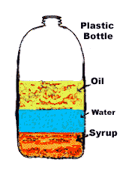
Which liquid is the least dense?
a)
oil
b)
water
c)
syrup 
d)
plastic bottle
29.
What is the volume of Object X?
a)
10.0 cm3
b)
15.0 cm3
c)
20.0 cm3
d)
25.0 cm3
30.

The amount of space an object occupies is called:

a)

Volume

b)

Mass

c)

Perimeter

d)

Area

31.

An experiment was conducted with plants, and it was found that one of the plants grew to a height of 3 meters. What type of data is this?

a)

Quantitative

b)

Qualitative

c)

Conclusive

d)

Variable

32.

A scientist conducted an experiment to determine how the amount of salt in a body of water affects the number of plants that can live in the water. In this experiment, the dependent variable is _______________________________.

a)

the water

b)

the temperature of the water

c)

the number of plants that can live in the water

d)

the amount of salt in the water

33.

Identify this substance.

a)

element

b)

compound

c)

mixture

34.

What is the difference between a compound and a mixture?

a)

one is made of only 1 element, the other is made of several elements

b)

a mixture does not have a chemical formula

c)

a compound can be made many different ways

35.

What is it called when light passes through a colloid and scatters/spreads out?

a)

Tyndall Effect

b)

Fog Effect

c)

Timer Effect

d)

Substance Effect

36.
What type of mixture separates upon standing?
a)
Solution
b)
Alloy
c)
Colloid
d)
Suspension
37.

Brass

a)

Homogenous

b)

Heterogeneous

38.
Convert from meters to cm:  9 meters
a)
900 cm
b)
90 cm
c)
0.9 cm
d)
0.09 cm
39.
Convert 8 kilometers to meters
a)
800 m
b)
80,000 m
c)
8,000 m
d)
.008 m
40.
490,000 g =____ kg
a)
490
b)
49
c)
4,900
d)
0.49