
 Worksheets
Unit 1 Chemistry Test
Total questions: 19
Worksheet time: 22mins
Identify the three base units of the SI System.
SI stand for...
Identify another name for the SI System.
Identify the best reason the metric system is used in science.
There is no logical reason
It is used internationally, and data can be shared and understood from country to country
Because it's sciencey
To confuse students in the USA.
A student uses an electronic scale to record the mass (in grams) of an object 3 separate times. Identify the best conclusion for the measurements taken by the student.
-The actual mass of the object is 10.00 grams.
1) The first measurement gives a mass of 10.01 grams.
2) A second measurement gives a mass of 9.99 grams
3) A third measurement gives a mass of 10.00 grams.
Identify the piece of equipment that is the most precise for measuring volume.

Beaker
Beaker

Graduated Cylinder
Graduated Cylinder

Erlenmeyer Flask
Erlenmeyer Flask

electronic scale
electronic scale

When taking a measurement for a liquid using a graduated cylinder, Identify the most accurate way of recording your measurement.

Identify the correct measurement and unit in the image provided.
40.0 g
45.0 mL
44.0 g
Calculate the density of an object that has a mass of 20.0 grams and takes up 15.0 mL of space.
300.0 g/mL
1.3 g/mL
20.0 g/mL
If a piece of pure gold is cut into 3 different sized pieces (small, medium and large piece), the density of the gold pieces will....
Define: Conversion Factor
A ratio used to convert from one unit of measurement to another.
A ratio used in math that tells you how many "things" you measured.
A ratio that allows you to measure more accurately.
A ratio that tells you how many inches are in one foot.
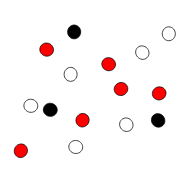
Identify ALL units of mass from the following options.
(a) (b) (c)
Grams/Milliliter (g/mL)
Potassium (K)
Gold (Au)
Sodium (Na)
black coffee
air
tap water (H2O)
A bald eagle
oil and water mix
Ham and cheese sandwich
Distilled Water (H2O)
Carbon dioxide gas (CO2)
Pure Bleach (NaClO)
Melting point and boiling point
Density
Conducts electricity
Cutting a peice of aluminum foil
Grinding salt rock to powder
Dissolving ice cubes in a cup of water
Reacting metal with acid
Separating water (H2O) into hydrogen (H2) and oxygen (O2)
Combustion of gasoline in a car engine
Flammable (combustible)
Ability to rust (oxidize)
How acidic or toxic a substance is
Digesting your lunch

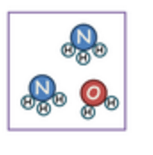
Classify this picture
mixture of compounds
compound
element
mixture of elements and compounds
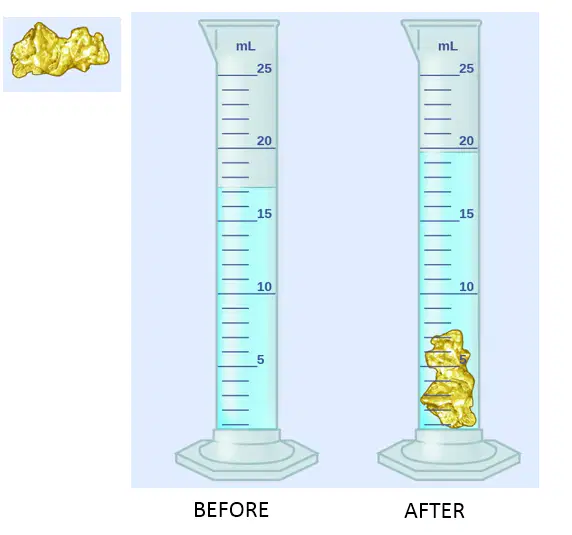
The diagram shows the before and after of gold nugget being dropped into a graduated cylinder. The density of gold is 19.3 g/mL.
-The mass of the gold nugget is 51.8 grams (g)
-The image on the left has a volume of 17.1 mL
-The image on the right has a volume of 19.8 mL
Calculate the density of the gold nugget then identify if the gold nugget is real gold or not.
12.0 g/mL
Not real gold
13.0 g/mL
Not real gold
19.2 g/mL
Real gold
19.1 g/mL
Not real gold

