wayground logo

Free Printable Worksheets

Font size

S
M
L
XL
Worksheets

Kinetics Challenge

Total questions: 69

Worksheet time: 53mins

Name
Class
Date
1.

What is the study of rates of chemical reactions called?

a)

kinetics

b)

thermodynamics

c)

stoichiometry

d)

equilibrium

2.

Define the term 'rate of reaction'.

a)

The rate of reaction is the temperature at which a reaction occurs

b)

The rate of reaction is the speed at which reactants are converted into products in a chemical reaction.

c)

The rate of reaction is the color change observed during a reaction

d)

The rate of reaction is the amount of reactants left after a reaction

3.

What is the role of a catalyst in a chemical reaction?

a)

A catalyst has no effect on the speed of a chemical reaction

b)

A catalyst speeds up a chemical reaction by lowering the activation energy required for the reaction to take place.

c)

A catalyst increases the activation energy required for a reaction

d)

A catalyst absorbs all the reactants in a chemical reaction

4.

Explain the difference between a homogeneous and heterogeneous catalyst.

a)

Homogeneous catalysts are only used in organic reactions.

b)

Homogeneous catalysts are solid while heterogeneous catalysts are liquid.

c)

Heterogeneous catalysts are always more efficient than homogeneous catalysts.

d)

Homogeneous catalysts are in the same phase as the reactants, while heterogeneous catalysts are in a different phase.

5.

How does temperature affect the rate of a chemical reaction?

a)

Temperature has no effect on the rate of a chemical reaction

b)

Temperature decreases the rate of a chemical reaction by slowing down reactant molecules

c)

Temperature increases the rate of a chemical reaction by providing more kinetic energy to reactant molecules.

d)

Temperature only affects the color of the chemicals, not the rate of reaction

6.

What is the collision theory of chemical reactions?

a)

Reactant particles must not collide for a reaction to occur.

b)

Reactant particles must collide with improper orientation for a reaction to occur.

c)

Reactant particles must collide with insufficient energy for a reaction to occur.

d)

For a reaction to occur, reactant particles must collide with sufficient energy and proper orientation.

7.

Discuss the concept of activation energy.

a)

Activation energy is only applicable to biological processes.

b)

Activation energy is the minimum amount of energy required to start a chemical reaction.

c)

Activation energy is the maximum amount of energy required to start a chemical reaction.

d)

Activation energy is not related to chemical reactions.

8.

What is the order of a reaction?

a)

Sum of the powers to which the concentrations of the reactants are raised in the rate law equation.

b)

The volume of the reactants

c)

The temperature at which the reaction occurs

d)

The rate constant of the reaction

9.

How can you determine the rate law of a reaction experimentally?

a)

Conduct multiple experiments varying initial reactant concentrations, measure initial rates, and use the method of initial rates to determine the rate law.

b)

Only conduct one experiment with varying initial reactant concentrations

c)

Use the final rate instead of the initial rate

d)

Ignore reactant concentrations and focus on temperature changes

10.

What is a rate-determining step in a reaction mechanism?

a)

The rate-determining step is the slowest step in a reaction mechanism.

b)

The rate-determining step is the final step in a reaction mechanism.

c)

The rate-determining step is the first step in a reaction mechanism.

d)

The rate-determining step is the step with the highest concentration of reactants.

11.
What makes an effective collision?
a)
When molecules collide.
b)
When molecules collide with the proper orientation.
c)
When molecules collide with proper orientation and enough kinetic energy.
d)
High Temperature.
12.

The ______________is required to break the bonds of the reactants.

a)

Carbonic energy

b)

Activation energy

c)

Plutonic energy

d)

Energi Gaib

13.

Why does a higher temperature increase the rate of a reaction?

a)

it increases both the frequency and energy of particle collisions

b)

it only increases the frequency of particle collisions

c)

it only increases the energy of particle collisions

d)

it reduces the activation energy of the reaction

14.

Why does a higher concentration increase the rate of reaction?

a)

it increases the amount of reactants

b)

it lowers the activation energy

c)

it increases the energy of particle collisions

d)

it increases the frequency of particle collisions

15.
In an exothermic reaction, heat is ...
a)
taken in
b)
given out
16.
What does NOT happen when the temperature is increased?
a)
Particles collide more often
b)
Particles collide with more energy
c)
Particles move faster
d)
More particles collide in the correct orientation
17.
The following graph shows two different reaction pathways for the same overall reaction at the same temperature. Which pathway is slower and why?
a)
Red, because the activation energy is larger
b)
Blue, because the activation energy is lower
c)
both reaction progress at the same rate
18.

How does a catalyst work in speeding up a reaction?

a)

By lowering the activation energy or reaction

b)

by giving them more energy

c)

by making them more available

19.

A temperature increase causes the particles ......

a)

to slow down

b)

move faster

c)

collide higher

d)

in the right order

20.

Which factors affect the rate of a reaction?

a)

temperature

b)

concentration

c)

surface area

d)

pressure

e)

catalyst

21.
A substance that increases speed of chemical reaction without being being changed is called:
a)
Catalyst
b)
Acid
c)
Base
d)
pressure
22.
Exothermic reactions...
a)
Absorb energy
b)
Release energy
c)
Release Color
d)
Absorb Color
23.
Explosions can happen when there is a large amount of powdered substance because of a large
a)
temperature
b)
surface area
c)
concentration
d)
pressure
24.
Products will form faster if____________
a)
the particle size of the reactants are larger.
b)
temperature is decreased.
c)
concentration of the reactants are increased.
d)
the reaction is not stirred.
25.
Which of these will NOT speed up the rate of reaction between a strip of magnesium and hydrochloric acid?
a)
tightly coil up the strip of magnesium
b)
cut up the strip of magnesium
c)
increase the concentration of the hydrocholoric acid
d)
increase the temperature of the hydrocholoric acid
26.
Why does a higher concentration increase the rate of reaction?
a)
it increases the amount of reactants
b)
it lowers the activation energy
c)
it increases the energy of particle collisions
d)
it increases the frequency of particle collisions because there are more collision sites
27.
Why does a higher temperature increase the rate of a reaction?
a)
it increases both the frequency and energy of particle collisions
b)
it only increases the frequency of particle collisions
c)
it only increases the energy of particle collisions
d)
it reduces the activation energy of the reaction
28.
In an exothermic reaction the products have
a)
more energy than the reactants
b)
the same energy as the reactants
c)
less energy than the reactants
d)
no energy
29.
In an endothermic reaction the products have 
a)
more energy than the reactants
b)
less energy than the reactants
c)
the same energy as the reactants
d)
no energy
30.
Increasing the concentration of the reactants will slow down the reaction.
a)
false 
b)
true
31.
Exothermic reactions release heat to the surroundings.
a)
true
b)
false
32.
Smaller particle size allows for a _________ surface area to be exposed for the reaction.
a)
larger
b)
smaller
33.
A ______________ is a substance that increases the rate of a reaction without being used up during the reaction. 
a)
catalyst
b)
product
c)
reactant
d)
solute
34.
Which factors increase the rate of a reaction.
a)
increasing temperature
b)
increasing concentration
c)
increasing surface area
d)
all of these
35.
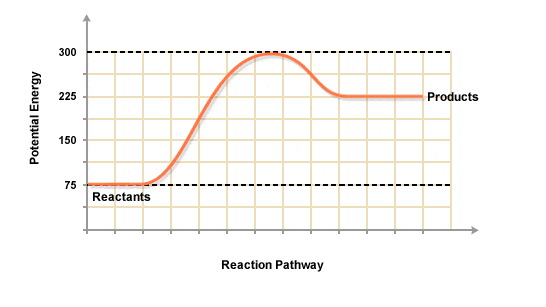
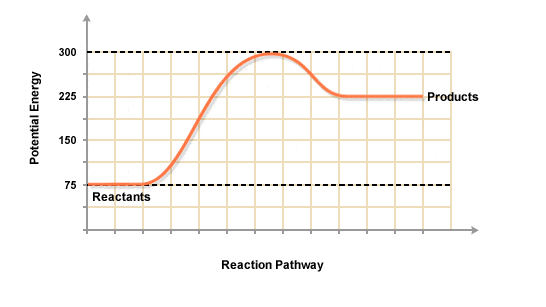
What is the activation energy of the reverse reaction?
a)
75 kJ
b)
300 kJ
c)
150 kJ
d)
225 kJ
36.
Increase in temperature of the reactants can do one of the following
a)
Slow collision frequency
b)
Allow less effective collision between the particles
c)
Cause particles to lose speed
d)
Increase collision between the particles thus increasing the rate.
37.
Activation energy is required to start a chemical reaction. What is activation energy?
a)
The energy needed for a reaction to occur
b)
The minimum amount of energy needed for a reaction to potentially occur
c)
The energy added by a catalyst
d)
The energy possessed by the products
38.
What is the energy of the activated complex?
a)
75 kJ
b)
225 kJ
c)
300 kJ
d)
225 kJ
39.
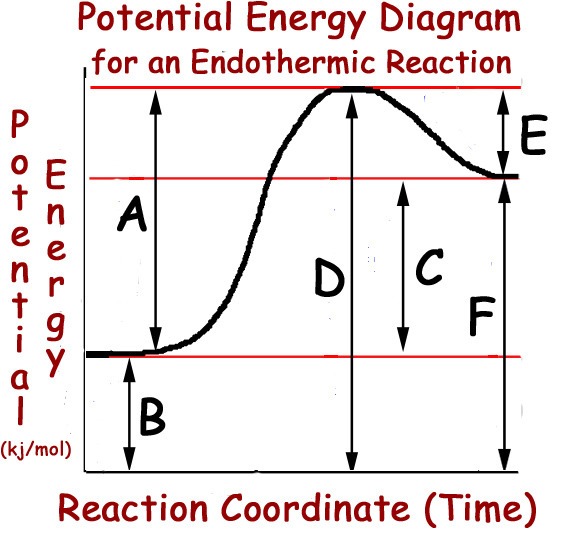
What letter represents the activation energy?
a)
A
b)
B
c)
C
d)
D
40.
What type of reaction is this?
a)
Endothermic
b)
Exothermic
41.
Which of the following increase the reaction rate?
a)
less surface area
b)
lower temperature
c)
an inhibitor
d)
increased concentration
42.
Why does a higher temperature increase the rate of a reaction?
a)
it increases both the frequency and energy of particle collisions
b)
it only increases the frequency of particle collisions
c)
it only increases the energy of particle collisions
d)
it reduces the activation energy of the reaction
43.
To slow down a chemical reaction you will do one of the following:
a)
Place the reactants in hot water
b)
Place the products in ice bath
c)
Place the reactants in a ice bath
d)
Keep stirring the reactants with a stirring rod
44.
Decreasing the particle size increases the reaction rate because
a)
It makes particles move faster
b)
It increases the likelihood of collisions with the correct geometry
c)
It decreases the surface area available to react
d)
It increases the number of collisions
45.
Reaction rate means...
a)
amount of product formed
b)
speed of reaction
c)
concentration of reacting particles
d)
combining reactants with products
46.
Which of the following factors increases only the effectiveness of collisions?
a)
temperature
b)
catalysts
c)
concentration
d)
particle size
47.
Which of the following is NOT a factor affecting reaction rate?
a)
temperature
b)
catalysts
c)
particle size
d)
polarity
48.
More collisions correspond to a: 
a)
Faster reaction rate  
b)
Slower reaction rate
c)
Constant reaction rate 
d)
None of the above
49.
Under the collision theory, the particles must collide with  ____ and ____ for a reaction to occur.
a)
sufficient rate and sufficient energy
b)
sufficient surface area and correct orientation
c)
sufficient catalyst and sufficient energy
d)
sufficent energy and correct orientation
50.
What two factors govern whether a collision between reacting particles will be effective?
a)
orientation and potential energy 
b)
kinetic energy and temperature 
c)
kinetic energy and orientation 
d)
potential energy and kinetic energy 
51.
Which factors increase the rate of a reaction.
a)
increasing temperature
b)
increasing concentration
c)
increasing surface area
d)
All of these
52.
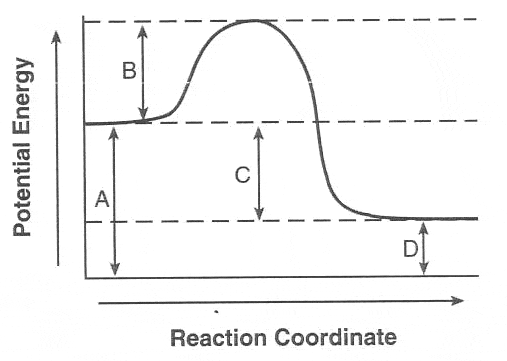
What type of reaction is this?
a)
Endothermic
b)
Exothermic
53.
A possible rate law for a third overall order of a reaction is __________________
a)
Rate = k [A]2[B]2
b)
Rate = k [A][B]3
c)
Rate = k [A]3 [B]
d)
Rate = k [A]2[B]
54.

Which would dissolve faster?

a)

A

b)

B

c)

A and B

d)

None of the above

55.

A temperature increase causes the particles

a)

to slow down

b)

move faster

c)

collide higher

d)

in the right order

56.

_______ refers to how much solute is dissolved in

a solution.

a)

Surface Area

b)

Catalyst

c)

Temperature

d)

Concentration

57.
Usually lowering the temperature will slow down a reaction.
a)
false
b)
true
58.
Increasing the temperature will increase the kinetic energy of particles, therefore increasing the collisions between particles.
a)
false
b)
true
59.
Smaller particle size allows for a _________ surface area to be exposed for the reaction.
a)
larger
b)
smaller
60.
True or False? The higher the concentration of a solution the less solutes it has in it.
a)
True
b)
False
61.
Catalysts permit reactions to happen with a __________ activiation energy.
a)
lower
b)
higher
62.
A ______________ is a substance that increases the rate of a reaction without being used up during the reaction. 
a)
catalyst
b)
product
c)
reactant
d)
solute
63.
Grinding a seltzer tablet into powder increases the rate of reaction due to...
a)
increased concentration of reactants
b)
increased surface area
c)
increased speed of particles.
d)
better orientation of reactants
64.
The rate of a chemical reaction is NOT affected by which of the following:
a)
temperature
b)
concentration
c)
particle size (surface area)
d)
All of these affect reaction rates
65.

The ____________ states that atoms, ions, or molecules must collide in order to react.

a)

transition state

b)

activation energy

c)

rate law

d)

collision theory

66.

If the concentration of a reactant is increased, the reaction rate will ___________.

a)

increase

b)

decrease

c)

stay the same

67.

If the temperature is reduced, a reaction rate will ______

a)

increase

b)

decrease

c)

stay the same

68.
A catalyst works by
a)
changing the order of the reaction
b)
increasing the temperature
c)
lowering the activation energy
d)
making the activated complex
69.

Which of the following increase the reaction rate?

a)

less surface area

b)

lower temperature

c)

increasing pressure

d)

increased concentration