
Font size
 Worksheets
12 Business Chapter 8-9 Revision
Total questions: 28
Worksheet time: 53mins
Match the following definitions
a planned and structured approach that moves a business from its current state to a desired future state
Change Management
the function or practice in business to become different
Change
a desired or future state in which the organisation will be after a change has been implemented
Vision for Change
a professional who provides expert advice in a
particular area to a business
Consultant
providers of expert knowledge in a
particular field to a business
Professional Services
Organize these business environments into the right categories
Owners/ managers
Employees
Organisational culture
Organisational structure
Customers
Suppliers
Competitors
Socio-economic
Technological
Economic
Environmental
Political
Legal
Ethical
Responding to technological change. Place these in order.
Change
Forces
Enables
Place these in the correct order for vision for change
Strategic plan
Vision for change
Change
Organize these options into the right categories for consultants and professional services
find opportunities to differentiate a business from its competitors
examine a business’s processes to find
improvements that will assist future growth
complete a cost–benefit analysis to determine
opportunities for growth
determine strategies to regain market share
identify ways to reduce costs
lawyers – experts on legal matters
accountants – experts on financial matters
Match the following for Lewin's Model of Change
This step involves preparing all stakeholders to accept the change. In this stage the business needs to
communicate and prepare for the change
Unfreeze
In this stage, the actual change takes place. This is the implementation step and requires stakeholders to
embrace the change for it to be effective
Change
In this stage, the changes made are solidified and normalised within a business. The change becomes
permanent and stability is regained.
Refreeze
Organize Lewin's Model for Change into the right categories
Prepare for the change
Determine the change
Manage the change
Implement the change
Communicate the change
Involve all stakeholders
Solidify the change
Sustain the change
Celebrate the success
Match the following definitions for Lewin's Force Field Analysis
a tool used to identify and analyse
the positive factors (driving forces) and negative factors
(restraining forces) in an environment where change is
occurring
Force Field Analysis
the forces that support a change
Drivers of change
the forces that resist a change
Restraining forces
Label the diagram for Lewin's Force Field Analysis
Driving forces
Change
Restraining forces
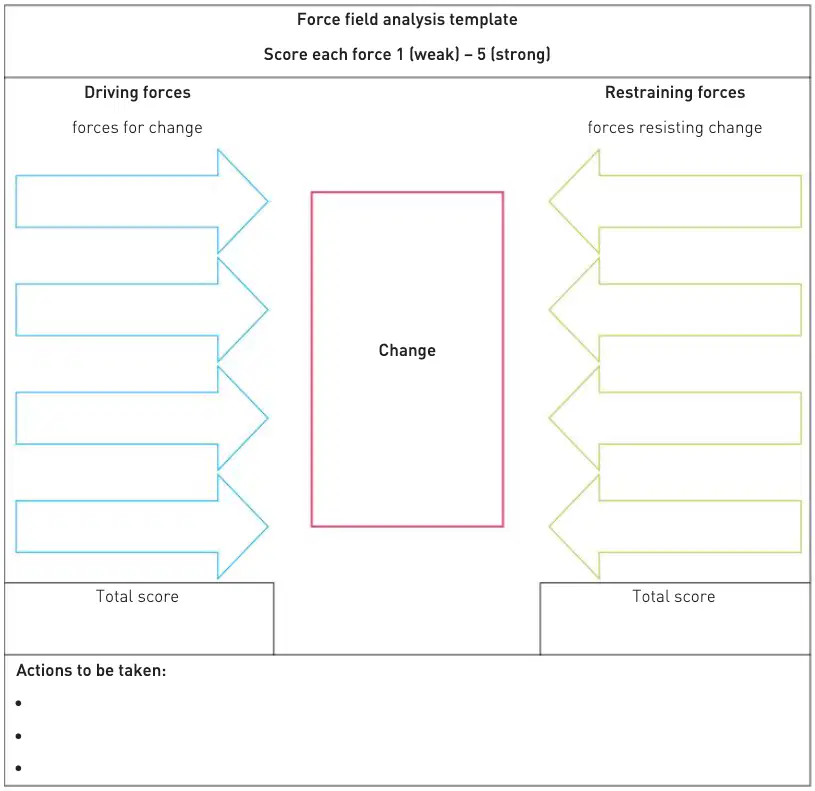
Organize these fictitious options for Lewin's Force Field Analysis into the right categories
Need to improve the speed of production
Customers are demanding new products
Need to raise output volume
Maintenance costs are increasing
Cost of the new technology
Downtime during the upgrade
Good relationship with existing
suppliers
Staff are reluctant
Reorder the first five steps of Kotter's eight-step model of change
Create a sense of urgency
Form a powerful coalition
Create a vision for change
Communicate the vision
Empower action
Reorder the last three steps of Kotter's eight-step model of change
Create quick wins
Build on the change
Make it stick
Label the blanks in Kotter's eight-step model of change
Engage and enable
the organisation
Create the climate
for change
Implement
the change
Label each of Kotter's eight steps
Communicate the vision
Create quick wins
Empower action
Build on the change
Create a vision for change
Create a sense of urgency
Make it stick
Form a powerful coalition
Label the management styles
Consultative
Autocratic
Participative
Persuasive
Organize these characteristics into the right management styles
Manager has total control and ensures everything is completed
Makes all the decisions about change
Manager persuades others to follow
Maintains control over the change
Consultation with stakeholders
Some involvement of stakeholders in the change
Management and employees make decisions together
Participation of all stakeholders in change process
What are the five common areas of Business Compliance?
r____ s________ l__ p______ r__________
(use lowercase only)
(a)
Organize these strategies for overcoming resistance to change
Communication
Participation
Negotiation
Manipulation
Threat
Match the following strategies of overcoming resistance to change
the process of sending and receiving information through verbal or non-verbal means
Communication
the act of being involved or taking part in
some action
Participation
a bargaining process with the aim of reaching an agreement
Negotiation
the skilful, or sometimes scheming, exercise of influence over someone to achieve a desired outcome
Manipulation
a tactic used with the intention of enforcing conformity
Threat
Label the change process
Transition
Current State
Future State
Match the following definitions
the process of changing from one state to
another
Transformation
the approach taken to implement change
in a business in order to achieve a desired outcome
Change Process
a process by which management reviews the overall performance of the business and its
employees to determine how goals can be better reached
Performance Management
an objective, set by
a business, that can be measured to allow business
performance to be assessed
Key Performance Indicator (KPI)
an employer-directed separation strategy that
occurs when an employer reduces the number of employees
because a position is no longer require
Redundancy
Label the Performance Management Cycle
Identify needs
Feedback results
Measure performance
Set objectives
Organize these steps into the right performance review categories
Connect the employee performance to the change objectives.
Clarify the duties and responsibilities associated with the change
Provide clear direction that links the objectives with the change.
Use performance appraisal to measure performance during change.
Use performance appraisal to provide feedback to individuals on their progress
Assess achievements, strengths and weaknesses of managing change.
Link the objectives of the change to the performance results of an employee
Provide feedback and incentives on the results achieved and show the link to the change objectiv
Reward behaviours required for the change to be achieved
Identify the training needed to implement the change.
Identify career development potentials that have resulted due to the change
Link training and development needs to the objectives of the change
Label the KPI process
Strategise
Evaluate
Measure
Match the following definitions in the KPI process
the objectives are established: What do we want to achieve?
Strategise
the progress is measured: How are we going?
Measure
the performance is assessed: Did we achieve the objective?
Evaluate
Retraining is the process of learning n__ s____
(use lowercase only)
(a)
What are the three outcomes of performance management?
Clue, the first word ends in "y"
(use lowercase only)
(a)
Organize these possible management strategies into their most correct categories.
Profitability
Growth
improving employee skill and
proficiency levels through training
initiatives
improving communication levels within the organisation during the change process
enhancing relationships and building a corporate culture that embraces the change
rebuilding and promoting corporate culture
promoting a clear vision for the change and its benefits to employees
developing training or retraining programs for existing employee
implementing performance management programs such as performance appraisals and KPI
implementing a code of conduct to uphold ethical standards
product – consider the unique selling point of
the products sold
price – price effectively to avoid financial
consequences.
place – position the business to reach
customers, suppliers and distribution channels
promotion – select promotional techniques to
create the most cost-effective marketing strategy
people – employ a team that meets the
marketing objectives of the business
production – development of new products and services
process – developments in technology to improve operations
quality controls – measuring and improving the quality of
products and services
introducing production technologies to support changes in the production process

