
 Worksheets
Native Americans and the West 1870s-1890s
Total questions: 69
Worksheet time: 46mins


What inventions changed the West after the Civil War and encouraged settlement in the west?
railroads
barbed wire
Windmills
Windmills, barbed wire, and railroads
Why did the U.S. government support the slaughter of buffalo?
It was a convenient way to supply western settlers with food and shelter.
It was seen as a way to bring the Native Americans of the Plains under control.
It provided supplies to the states in the East.
It was necessary to make land available for settlement.
The main reason for the population increase in the West between 1870-1890 was
immigration from Europe
better health care
natives being forces onto reservations
cheap land
What factor did the most to lead to the destruction of Native American culture and
power?
The Lewis and Clark Expedition west in the early 1800’s
The defeat of the Sioux at the Battle of Little Bighorn
The systematic destruction of Buffalo herds in the late 1800’s
The growing reliance on farming among Native Americans
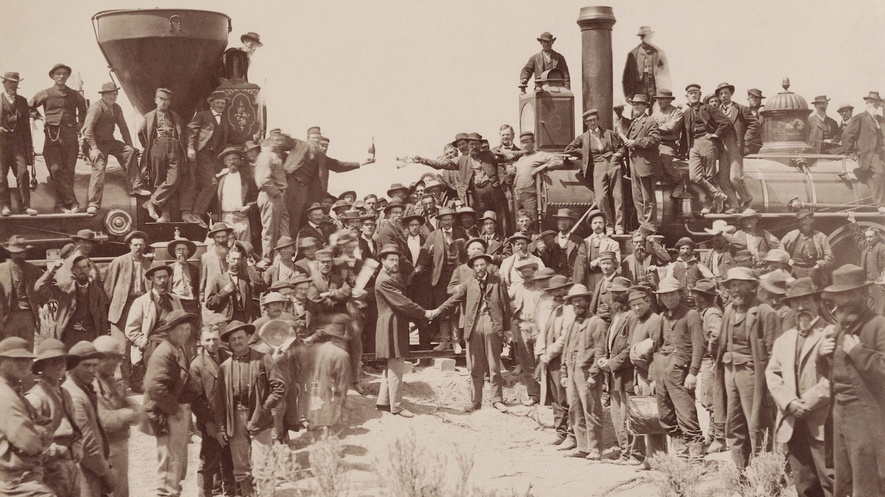
What two groups of immigrants helped build the railroads of the United States?
Indians and Mexicans
Mexicans and French
Chinese and Irish
English and Spanish
The introduction of windmills for ranching in the West allowed
electricity to the region
air conditioning for the region
wind power to be generated to operate farm equipment
the irrigation of crops without access to rivers

What was the impact that this image had on cattle drives?
It made cattle drives easier because there was a set route
It closed the frontier and made cattle drives difficult
It helped organize cattle drives
It tied cows together
Why was the destruction of the buffalo a serious threat to Plains Native Americans?
The buffalo was their mascot
The buffalo was their main food source
The buffalo protected the Native Americans
The buffalo were related to the Native Americans
The arrival of rail lines in the west was important to farmers mainly because it allowed them to ship goods
more quickly
less expensively
more quickly and less expensively
less quickly and more safely

Railroads destroyed the land the cattle use
Railroads destroyed the land the cattle use
The demand for beef in the East brought growth to the industry
Cattle drives decreased because railroads blocked the path.

How did ranchers use the image to the right to support ranching on the Great Plains?
To power outdoor lights, so that ranchers could watch over their livestock at night
To supply power to pumps that brought underground water the surface
To provide shelter from the harsh winds that swept across the region
To provide shelter from the harsh sunlight and rain
The primary goal of manifest destiny was
secession of southern states from the nation
removal of European influence from South America
end slavery in the new territories
expansion westward to the Pacific Ocean
The California Gold Rush, the Homestead Act, and the completion of the Transcontinental Railroad all
encouraged westward settlement.
promised everyone, even Natives a home in the west.
recognized Native American Indian land rights.
promoted the conservation of natural resources.
What did historian Frederick Jackson Turner think was most important in the development of American
history?
voting rights
the railroad
the frontier
cattle
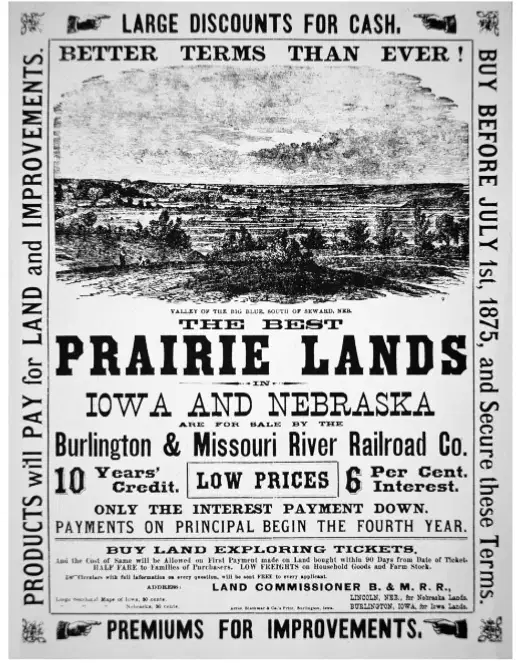
What were posters like this one meant to encourage?
gold mining
settlement of western territories
employment by the railroads
enlistment in the army
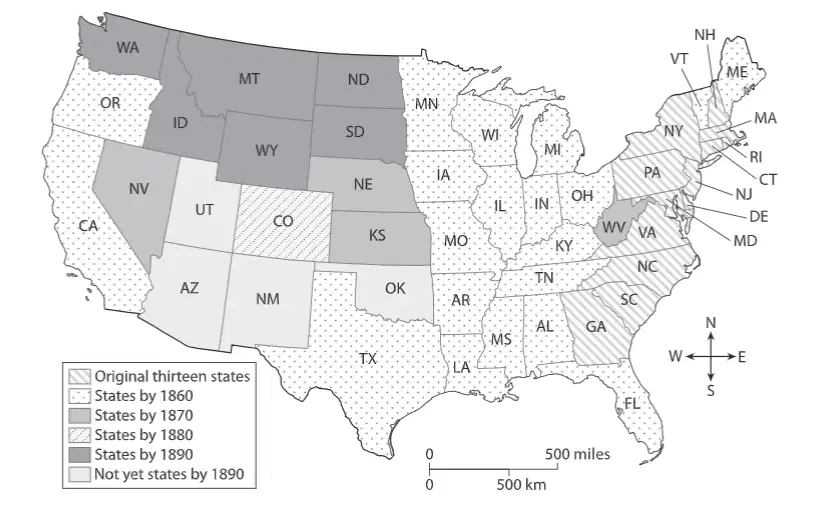
According to the map, what happened in the United States between 1860 and 1890?
Ten new territories in the West became states.
California, Oregon, and Texas became states
The United States added no new territories.
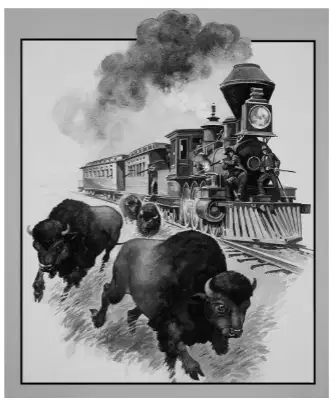
What is one way in which Native American ways of life changed as settlers moved west?
The transatlantic railroad ran through the homes of the largest Native American groups.
Treaties removed the source of conflict between Native Americans and settlers.
Native Americans were asked to share their cultures with the new settlers.
Bison were hunted for profit and sport to the point of depletion.
What effects did Wild West shows such as Buffalo Bill’s have?
They portrayed the West inaccurately.
They raised money to help new farmers.
They created a unique American identity.
They encouraged settlers to respect Native American land.
What were the consequences of the Dawes Act for Native Americans?
Sitting Bull was arrested by the Bureau of Indian Affairs.
Native Americans had to abandon their communal way of life.
American officials banned the Ghost Dance in Dakota Territory.
Many Native Americans sold their land to white settlers for less than the land was worth.
Frederick Jackson Turner, “The Significance of the Frontier in American History”
According to Turner, what has the American intellect gained from the frontier?
great material wealth
a grasp of artistic things
strength and individualism
knowledge of good versus evil
What effect did the Gold Rush have on the Native Americans of the Pacific coast?
The Gold Rush caused settlers to drive Native Americans from their lands.
The Gold Rush caused a new wave of treaties to be made.
The Gold Rush led to Native Americans growing rich.
The Gold Rush kept settlers away from the Pacific.
What was the purpose of institutions such as the Carlisle Indian Industrial School?
to offer higher education to Native Americans
to provide job skills training to Native Americans
to push Native Americans off their ancestral lands
to force the assimilation of Native Americans
Why did people who moved west call themselves Exodusters?
They felt their experience was similar to this Bible's story of Exodus
It described how they had left out of the dust of the south
Their migration was unique and they came up with their own name for their migration
Who were the Exodusters?
African Americans who left the south for Kansas in the late 1800s
African Americans who traveled north after Reconstruction
White settlers who moved into Kansas and forced African Americans out
African Americans who remained in the south after Reconstruction

Homestead Act
Allowed women, former slaves, and poor families to own land on the Great Plains
Caused people to return to Europe
Required settlers to farm and build a house on the land
Gave people 160 acres if they lived there 5 years
Caused people to move to San Francisco

What were most homes on the Great Plains built out of?
Bricks
Bedrock
Wood
Sod
Which of the following assisted settlers to farm on the great plains?
steel plow and the reaper
transcontinental railroad and the telegraph
Windmill powered water pumps
PUSH factors push people away from an area.
Which of the following were "push factors" that pushed people away from where they were living and made them interested in moving out west?
political turmoil in Europe
inadequate schools for children
lack of opportunities in the overcrowded East Coast Cities
conflict and poverty in the south for African Americans
Pull factors DRAW people to an area.
Which of the following were "pull factors" that pulled people toward the West?
wide open, unsettled land for cattle grazing
big cities and factories
growth of gold and silver mining
agricultural opportunities given by the Homestead Act
easy transportation out west thanks to the transcontinental railroad

An unsettled or barely settled area in America where mostly Native Americans lived
frontier
homestead
vaquero
exoduster

The area of America from the Missouri River to the Rocky Mountains. The land was mostly flat and grasslands.
Great Plains
frontier
homestead
Sitting Bull
_____________________ signed the Homestead Act on May 20, 1862.
Abraham Lincoln
Thomas Jefferson
Meriwether Lewis
William Clark
Factories in the East relied on settlers in the West to-
create new states to help the country grow
build railroads for shipping goods
provide homes for women and children
provide raw material for making products
*Loneliness
*Harsh Weather
*Hard, dry ground
*Expensive tools
*Difficulty Farming
*Conflicts with Cattle Ranchers and Native Americans
The items on this list helped convince-
some people in the East to try homesteading
some homesteaders to give up and return East
the United States government to pass the Homestead Act
some immigrants from Europe to settle in the United States
Why were the Exodusters enticed to go to Kansas?
To start a new life in Liberia
To join the Ku Klux Klan
To work as sharecroppers on plantations
To escape segregation in the American South

“If you tie a horse to a stake, do you expect he will grow fat? If you pen (put in a cage) an Indian on a small spot of earth and compel him to stay there, he will not be contented nor will he grow and prosper.”
—Chief Joseph of the Nez Perces, 1879
In this quotation, Chief Joseph is referring to the United States government policy of
Extending railroads through western lands.
The movement of Native Americans onto reservations
The outlawing of Native American ceremonies.
Converting Native Americans to Christianity

“If you tie a horse to a stake, do you expect he will grow fat? If you pen (put in a cage) an Indian on a small spot of earth and compel him to stay there, he will not be contented nor will he grow and prosper.”
In this quotation, Chief Joseph is asking that his listeners
Understand that American Indians being forced to live on reservations is not right and is harmful to their spirit.
Answer two important questions
Adopt the government’s position.
Think about the treatment of animals.

The railroads hired what type of immigrants to work in small passages and dangerous situations like digging tunnels through the mountains?
Russian
Chinese
Indians
Irish

What was found in California that caused thousands to move west?
Oil
Gold
Silver
ancient artifacts
Why did Black-Freedmen want to move west?
To strike it rich
To discover new land
To get away from discrimination and have a better way of life for family
To chase the buffalo

Why were Native American children taken away from their families and stripped of their culture and language?
The government wanted Native American children to learn English and assimilate into white culture.
Government used children to bribe Indians to be good
The Government gave money to the Native American parents to use their children in factories.
So they could make the children better translators for their tribes.
This event led to a massacre of the Arapaho and Cheyenne tribes, and ultimately led to these tribes being forced onto reservations
Battle of Big Horn
Transcontinental Railroad
Sand Creek Massacre
Pony Express
Victory battle for the Lakota and Cheyenne; also known as Custer’s Last Stand.
Battle of Wounded Knee
Populist Party
Battle of Big Horn
Sand Creek Massacre
Law that divided reservations into individual plots of land.
Reservations
Open Range
Land Grants
Dawes Act
Railroad that joined the Union Pacific and Central Pacific Railroads in Utah.
East Coast RR
Central Pacific RR
Union Pacific RR
Transcontinental RR
Process in which a group is forced to adopt another group’s way of culture or way of life.
Assimilation
Reservations
Battle of Wounded Knee
Exoduster
Native American boarding school that was open between 1879-1918.
Pennsylvania School
Carlisle School
St. Andrews
St. Vincents
Led to the slaughter of 150-300 Lakota by the US Army before being pushed on reservations (Hint: we watched the video of the before conversation in class presentation).
Assimilation
Sand Creek Massacre
Battle of Wounded Knee
Battle of Big Horn
Under the Homestead Act, a person could claim up to _____ acres of public land.
100
160
640
250
Areas in the Great Plains with a large amount of cattle ranching.
cattle kingdom
ghost towns
boom towns
sodbusters
Settlements that developed where the cattle trails ended and it met a railroad line.
boom towns
cow towns
ghost towns
reservation
The Dawes Act had which negative effects for the Native Americans?
It split their tribal lands into family plots, destroying their sense of community.
New family plots were far from their ancestral lands.
The new lands forced several tribes to live together.
The new land was not good for farming and the promised supplies were not delivered.
Are these in the correct timeline order?
Indian Removal Act (Andrew Jackson)
Indian Appropriations Act (created reservation system)
Indian Wars (tribes fight back)
Dawes Act (division of tribal lands into family plots)
Yes
No
What kinds of jobs were created thanks to Manifest Destiny and westward expansion?
Bankers, accountants, lawyers, merchants
Doctors, teachers, architects, soldiers
Land speculators, miners, homesteaders, ranchers, railroad workers

