
 Worksheets
UNIT 2ᴀ ― Anatomy & Physiology
Total questions: 136
Worksheet time: 1hrs 8mins
SEXUAL INTERCOURSE is 𝚊𝚔𝚊 (a) .
A sexual act is said to be __________ when it aims only to unite a man and a woman.
UNITIVE
PROCREATIVE
A sexual act is said to be __________ when it is done for conception or reproduction.
PROCREATIVE
UNITIVE
SEX ORGANS are 𝚊𝚔𝚊 __________.
Genitalia
Gonads
Gametes
PRIMARY SEX ORGANS are 𝚊𝚔𝚊 __________.
Gonads
Genitalia
Gametes
The male PRIMARY SEX ORGANS 𝚊𝚔𝚊 GONADS.
Testes
Penis
The female PRIMARY SEX ORGANS 𝚊𝚔𝚊 GONADS.
Ovaries
Vagina
The "copulatory organ" of males.
Penis
Testes
The "copulatory organ" of females.
Vagina
Ovaries
SEX CELLS are 𝚊𝚔𝚊 __________.
Gametes
Gonads
Genitalia
What are male gametes called? [𝚂𝙰𝚃𝙰]
Sperm Cells
Reproductive Cells
Testes
Penis
What are female gametes called?
Egg Cells
Ovaries
Vagina
These are immature sperm cells.
Spermatids
Spermatozoa
These are mature sperm cells.
Spermatozoa
Spermatids
These are immature egg cells.
Oocytes
Ovum / Ova
These are mature egg cells.
Ovum / Ova
Oocytes
This is production of gametes.
(a)
This is production of sperm cells.
(a)
This is production of egg cells.
(a)
Spermatogenesis starts from __________ to death.
Puberty (≈ between 9-14 Y/O)
Birth
18 Y/O
Spermatogenesis starts from PUBERTY (≈ between 9-14 Y/O) to __________.
Death
60 Y/O
70 Y/O
80 Y/O
90 Y/O
Oogenesis starts from __________ to MENOPAUSE.
Puberty (≈ between 8-13 Y/O)
Birth
18 Y/O
Oogenesis starts from PUBERTY (≈ between 8-13 Y/O) to __________.
Menopause
60 Y/O
70 Y/O
80 Y/O
Death
This is the period of sexual maturity making someone capable of reproduction.
(a)
When do males reach the stage of puberty?
≈ between 9-14 Y/O
≈ between 8-13 Y/O
When do females reach the stage of puberty?
≈ between 8-13 Y/O
≈ between 9-14 Y/O
This is the production of gametes.
Gametogenesis
Copulation
Ovulation
Fertilization
Implantation
This is the physical act involving the insertion and thrusting of the erect penis into the vagina.
Copulation
Gametogenesis
Ovulation
Fertilization
Implantation
This is the release of an egg cell from the ovaries.
Ovulation
Copulation
Gametogenesis
Fertilization
Implantation
This is union of sperm cell and egg cell in the ampulla.
Fertilization
Ovulation
Copulation
Gametogenesis
Implantation
This is the attachment of a fertilized egg to the the uterus.
Implantation
Fertilization
Ovulation
Copulation
Gametogenesis
The penis and scrotum are parts of the male __________.
EXTERNAL GENITALIA
INTERNAL GENITALIA
The testes, ducts, and accessory glands are part of the male __________.
INTERNAL GENITALIA
EXTERNAL GENITALIA
This is a pair/⇆ external pouch-like structure located behind the penis that houses and protects the testicles in the male reproductive system.
(a)
This muscle regulates the temperature of the testes by expanding or contracting the scrotum.
(a)
In COLD TEMPERATURE, dartos muscle __________ causing the scrotum to be pulled closer to the body.
CONTRACTS
RELAXES
In HOT TEMPERATURE, dartos muscle __________ causing the scrotum to hang more loosely.
RELAXES
CONTRACTS
This is the distal portion of the penis.
Glans 𝚊𝚔𝚊 Glans Penis / Penile Glans
Body 𝚊𝚔𝚊 Shaft
Root
The the most erogenous zone in males.
Glans 𝚊𝚔𝚊 Glans Penis / Penile Glans
Scrotum
Perineum
Nipples
Ears
The is a fold of skin that covers the tip of the penis; is removed on circumcision.
(a)
This is the mid portion of the penis.
Body 𝚊𝚔𝚊 Shaft
Glans 𝚊𝚔𝚊 Glans Penis / Penile Glans
Root
This is the proximal portion of the penis.
Root
Body 𝚊𝚔𝚊 Shaft
Glans 𝚊𝚔𝚊 Glans Penis / Penile Glans
The TESTES are 𝚊𝚔𝚊 (a) .
These are coiled structures located within the testes referred to as "the site of sperm production".
(a)
Sertoli Cells are 𝚊𝚔𝚊 __________.
Sustentacular Cells / Supporting Cells
Interstitial Cells
Which cells produce Androgen-Binding Protein (ABP)?
Sertoli Cells
Leydig's Cells
This is produced by the Sertoli Cells.
Androgen-Binding Protein (ABP)
Testosterone
Leydig Cells are 𝚊𝚔𝚊 __________.
Interstitial Cells
Sustentacular Cells / Supporting Cells
Which cells produce testosterone?
Leydig Cells
Sertoli Cells
This is produced by the Leydig Cells.
Testosterone
Androgen-Binding Protein
EPIDIDYMIS is 𝚊𝚔𝚊 (a) .
Which one among these ducts is a pair/⇆ coiled tubes at the back of each testis?
Epididymis
Vas Deferens
Ejaculatory Ducts
Urethra
This is a muscular tube that extends from the epididymis to the ejaculatory duct; carries sperm out from epididymis to the ejaculatory ducts.
Vas Deferens
Ductus Epididymis
Ductus Ejaculatorii
Urethra
Which one among these is a pair of ducts formed by the union of the vas deferens and the seminal vesicle duct where sperm get mixed with seminal fluid?
Ejaculatory Ducts
Ductus Deferens
Epididymis
Urethra
This extends from the bladder to the external opening at the tip of the penis which carries urine and semen out of the male body.
Urethra
Ejaculatory Duct
Vas Deferens
Epididymis
These is/are gland/s located behind the bladder that produces ≈ 60% of the total seminal fluid volume
Seminal Vesicles / Seminal Glands
Prostate Gland
Bulbourethral Glands / Cowper's Glands
These is/are gland/s located below the bladder that produces ≈ 30% of the total seminal fluid volume.
Prostate Gland
Seminal Vesicles / Seminal Glands
Bulbourethral Glands
These is/are gland/s located below a gland produces pre-ejaculate/pre-cum and seminal fluid that comprises ≈ 5-10% of the total seminal fluid volume.
Bulbourethral Glands / Cowper's Gland
Prostate Gland
Seminal Vesicles / Seminal Glands
This term is 𝚊𝚔𝚊 sperm cells / male gametes.
Sperm
Pre-cum
Seminal Fluid
Semen
This is 𝚊𝚔𝚊 pre-ejaculate; is the fluid produced by the Cowper’s Gland to lubricate the penis during sexual intercourse
Pre-cum
Sperm
Seminal Fluid
Semen
This is produced by the accessory glands that provides nutrients and energy sources for sperm cells, aiding their motility and survival as they travel
Seminal Fluid
Pre-cum
Sperm
Semen
This is 𝚊𝚔𝚊 ejaculate; this is seminal fluid + sperm combined.
Semen
Seminal Fluid
Pre-cum
Sperm
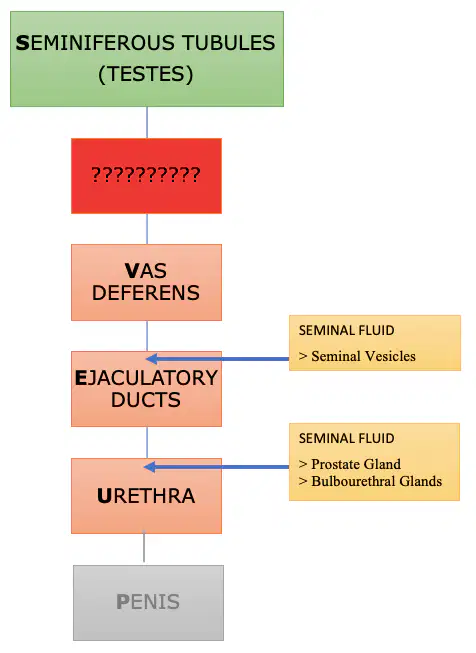
What is missing in this PATHWAY OF SPERM?
(a)
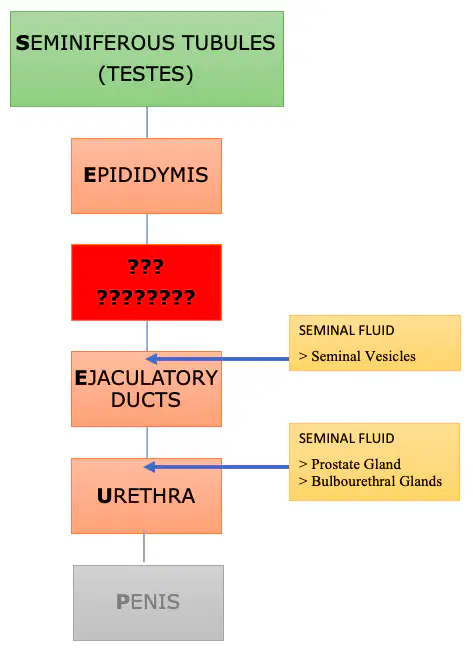
What is missing in this PATHWAY OF SPERM?
(a)
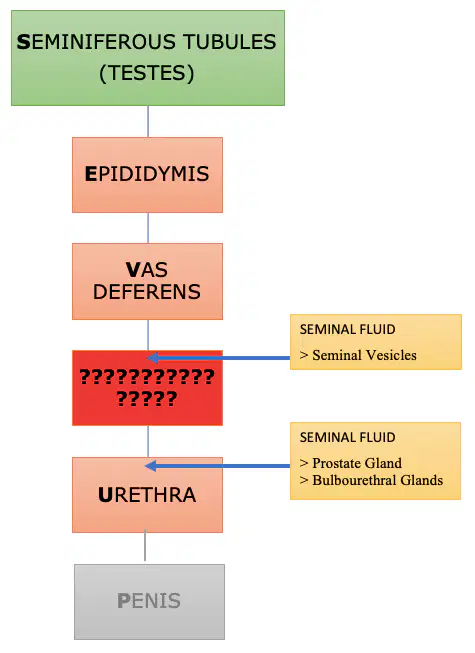
What is missing in this PATHWAY OF SPERM?
(a)
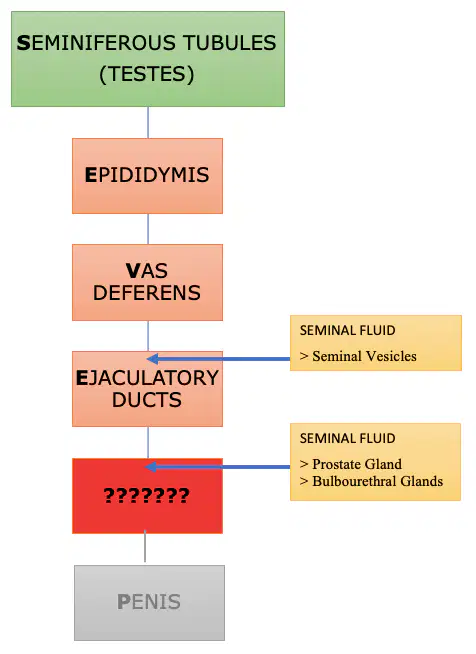
What is missing in this PATHWAY OF SPERM?
(a)
In females, this comprises the MONS PUBIS, LABIA MINORA, LABIA MAJORA, CLITORIS, VESTIBULE,
and the three ACCESSORY GLANDS (namely Bartholin's, Skene's and Mammary).
EXTERNAL GENITALIA
INTERNAL GENITALIA
In females, this comprises the VAGINA, UTERUS, FALLOPIAN TUBES, and OVARIES.
INTERNAL GENITALIA
EXTERNAL GENITALIA
In females, this 𝚊𝚔𝚊 Vulva / Pudendum.
EXTERNAL GENITALIA
INTERNAL GENITALIA
This is a rounded mass of fatty tissue located over the symphysis pubis 𝚊𝚔𝚊 pubic symphysis.
Mon Pubis
Clitoris
Labia Majora
Labia Minora
Urethral Meatus
This serves as a protective cushion over the pubic bone and contributes to the overall shape of the vulva; it also plays a role in providing padding during sexual intercourse.
Mon Pubis
Clitoris
Labia Majora
Labia Minora
Urethral Meatus
This is a highly sensitive organ located at the top of the vulva, usually beneath a hood of tissue; it is the most erogenous zones
Clitoris
Mon Pubis
Labia Majora
Labia Minora
Urethral Meatus
These are the "outer lips" of the vulva that enclose and protect the external genital structures.
Labia Majora
Clitoris
Mon Pubis
Labia Minora
Urethral Meatus
These are the “inner lips” within the labia majora that surround the openings to the urethra and vagina.
Labia Minora
Labia Majora
Clitoris
Mon Pubis
Urethral Meatus
This is the external opening of the female urethra is located just below the clitoris.
Urethral Meatus
Labia Minora
Labia Majora
Clitoris
Mon Pubis
Vagina is 𝚊𝚔𝚊 (a) ?
This is the external opening of the vagina.
Introitus
Hymen
Vaginal Rugae
Fornix / Fornices
This is a thin membrane that partially covers the vaginal opening.
Hymen
Introitus
Vaginal Rugae
Fornix / Fornices
These are series of ridges or folds present on the inner lining of the vaginal canal.
Vaginal Rugae
Hymen
Introitus
Fornix / Fornices
These are areas or pockets located at the upper end of the vaginal canal.
Fornix / Fornices
Vaginal Rugae
Hymen
Introitus
Uterus is 𝚊𝚔𝚊 (a) .
This is a hollow organ located in the pelvis.
Uterus
Vagina
Fallopian Tubes
Ovaries
This is the lower part of the uterus that connects to the vagina; it is cylindrical in shape and contains a narrow passageway called the cervical canal.
Cervix
Isthmus
Body 𝚊𝚔𝚊 Corpus
Fundus
This is the opening between the vagina and the uterus.
EXTERNAL OS
INTERNAL OS
This is the opening between the cervix and the body of the uterus.
INTERNAL OS
EXTERNAL OS
This is the narrow region that connects cervix to the body of the uterus.
Isthmus
Cervix
Body 𝚊𝚔𝚊 Corpus
Fundus
This is the largest part of the uterus.
Body 𝚊𝚔𝚊 Corpus
Isthmus
Cervix
Fundus
This is the central part of the uterus.
Body / Corpus
Isthmus
Cervix
Fundus
This is the uppermost dome-shaped portion of the uterus.
Fundus
Body 𝚊𝚔𝚊 Corpus
Isthmus
Cervix
Which is the innermost layer of the uterus?
Endometrium
Myometrium
Perimetrium
Which layer of the uterus is the site of implantation?
Endometrium
Myometrium
Perimetrium
Which is the layer of the uterus which contracts during labor to facilitate the delivery of a baby?
Myometrium
Endometrium
Perimetrium
Which is 𝚊𝚔𝚊 the Serous Layer; the outer layer of the uterus?
Perimetrium
Myometrium
Endometrium
Which of the 3 main ligaments of the uterus is 𝚊𝚔𝚊 Transverse Cervical Ligaments / Mackenrodt's ligaments?
Cardinal Ligament
Pubocervical Ligament
Uterosacral Ligament
Which of the 3 main ligaments of the uterus runs from the cervix to the sides of the pelvic wall?
Cardinal Ligament 𝚊𝚔𝚊 Transverse Cervical Ligaments / Mackenrodt's Ligaments
Pubocervical Ligament
Uterosacral Ligament
Which of the 3 main ligaments of the uterus is known as "the main support of the uterus"?
Cardinal Ligament 𝚊𝚔𝚊 Transverse Cervical Ligaments / Mackenrodt's Ligaments
Pubocervical Ligament
Uterosacral Ligament
Which of the 3 main ligaments of the uterus runs from the pubic symphysis to the cervix?
Pubocervical Ligament
Cardinal Ligament 𝚊𝚔𝚊 Transverse Cervical Ligaments / Mackenrodt's Ligaments
Uterosacral Ligament
Which of the 3 main ligaments of the uterus runs from the cervix to the sacrum/sacral bone?
Uterosacral Ligament
Pubocervical Ligament
Cardinal Ligament 𝚊𝚔𝚊 Transverse Cervical Ligaments / Mackenrodt's Ligaments
This ligament runs from the uterus (all 4 subparts) to the the sides of the pelvic walls.
Broad Ligament
Round Ligament
This ligament runs from the uterine horn (near the fundus of the uterus) to the labia majora.
Round Ligament
Broad Ligament
Fallopian Tubes are 𝚊𝚔𝚊 (a) ?
This is the part of fallopian tube that is connected to the uterus.
Interstitial 𝚊𝚔𝚊 Intramural
Isthmus
Ampulla
Infundibulum
This is the constricted or the narrowest portion of the fallopian tube between the interstitial part and the ampulla.
Isthmus
Interstitial / Intramural
Ampulla
Infundibulum
This is the widest and longest part of the fallopian tube.
Ampulla
Isthmus
Interstitial / Intramural
Infundibulum
This is the part of the fallopian tube referred to as "the site of fertilization".
Ampulla
Isthmus
Interstitial / Intramural
Infundibulum
This is the funnel-shaped, most distal part of the fallopian tube; it has finger-like projections called fimbriae that help capture the egg released from the ovary during ovulation.
Infundibulum
Ampulla
Isthmus
Interstitial / Intramural
This is the finger-like projections of the infundibulum that help capture the egg released from the ovary during ovulation.
(a)
Ovaries are 𝚊𝚔𝚊 (a) .
This is the innermost layer of the ovary that contains a network of blood vessels, lymphatics, nerves, and muscle fibers.
Medulla
Cortex
The layer of the ovary known as the site of oogenesis.
Cortex
Medulla
The functional layer of the ovary; the site of oocyte formation and maturation, as well as the production of hormones like estrogen and progesterone.
Cortex
Medulla
The hormone produced by Developing Follicles.
ESTROGEN
PROGESTERONE
Estrogen is primarily produced by __________.
DEVELOPING FOLLICLES
CORPUS LUTEUM
Progesterone is produced by __________.
CORPUS LUTEUM
DEVELOPING FOLLICLES
The hormone primarily produced by corpus luteum.
PROGESTERONE
ESTROGEN
Bartholin's Glands are 𝚊𝚔𝚊 (a) .
This is a pair of glands situated at the sides of the vaginal introitus that secretes mucus that helps to keep the vagina lubricated.
Bartholin's Glands / Paravaginal Glands / Major Vestibular Glands
Skene's Glands / Paraurethral Glands / Lesser Vestibular Glands
This is a pair of glands situated at each side of the urethral orifice that secrete fluids involved in female ejaculation.
Skene's Glands / Paraurethral Glands / Lesser Vestibular Glands
Bartholin's Glands / Paravaginal Glands / Major Vestibular Glands
Which one is homologous to the male GLANS PENIS?
Clitoris
Clitoral Hood
Labia Majora
Vagina
Ovaries
Which one is homologous to the male PREPUCE / FORESKIN?
Clitoral Hood
Clitoris
Labia Majora
Vagina
Ovaries
Which one is homologous to the male SCROTUM?
Labia Majora
Clitoral Hood
Clitoris
Vagina
Ovaries
Which one is homologous to the male PENIS?
Vagina
Labia Majora
Clitoral Hood
Clitoris
Ovaries
Which one is homologous to the male TESTES?
Ovaries
Vagina
Labia Majora
Clitoral Hood
Clitoris
Which one is homologous to the male SPERM CELL?
Egg Cell
Ovaries
Vagina
Labia Majora
Clitoris
Which one is homologous to the male VAS DEFERENS?
Fallopian Tubes
Skene's Glands
Bartholin's Glands
Clitoral Hood
Clitoris
Which one is homologous to the male BULBOURETHRAL GLANDS?
Bartholin's Glands
Fallopian Tubes
Skene's Glands
Clitoral Hood
Clitoris
Which one is homologous to the male PROSTATE GLAND?
Skene's Glands
Bartholin's Glands
Fallopian Tubes
Clitoral Hood
Clitoris
Which one is homologous to the female CLITORIS?
Glans Penis
Prepuce / Foreskin
Scrotum
Penis
Testes
Which one is homologous to the female CLITORAL HOOD?
Prepuce / Foreskin
Glans Penis
Scrotum
Penis
Testes
Which one is homologous to the female LABIA MAJORA?
Scrotum
Prepuce / Foreskin
Glans Penis
Penis
Testes
Which one is homologous to the female VAGINA?
Penis
Scrotum
Prepuce / Foreskin
Glans Penis
Testes
Which one is homologous to the female OVARIES?
Testes
Penis
Scrotum
Prepuce / Foreskin
Glans Penis
Which one is homologous to the female EGG CELL?
Sperm Cell
Testes
Penis
Scrotum
Glans Penis
Which one is homologous to the female FALLOPIAN TUBES?
Vas Deferens
Prostate Gland
Bulbourethral Glands
Prepuce / Foreskin
Glans Penis
Which one is homologous to the female BARTHOLIN'S GLANDS?
Bulbourethral Glands
Vas Deferens
Prostate Gland
Prepuce / Foreskin
Glans Penis
Which one is homologous to the female SKENE'S GLANDS?
Prostate Gland
Bulbourethral Glands
Vas Deferens
Prepuce / Foreskin
Glans Penis

