
 Worksheets
Ladder Safety Questions
Total questions: 45
Worksheet time: 23mins
Who should inspect ladders for visible defects before each use?
Any employee
A qualified person
The ladder owner
A supervisor
What should be done with damaged or worn ladders?
Repaired immediately
Used with caution
Destroyed
Stored away
Which of the following is NOT a requirement for ladder inspection?
Ladders should be free of oil, grease, or slippery materials
All hardware and fittings need to be properly and securely attached
Ladders should be painted regularly
The ladder base must have slip-resistant material
What should be checked to ensure the top section of an extension ladder will not fall?
Ropes and pulleys
Ladder extension locks
Rung locks on the rails of the top section
Extension guide brackets
What should be done with a ladder that has been exposed to fire or strong chemicals?
Cleaned thoroughly
Discarded
Repaired
Used with caution
Which of the following should be checked when inspecting metal ladders?
Integrity of rungs and rails
Loose rungs, nails, bolts screws and other metal parts
Cracks, chips and splinters
The two front legs should be of the same length
What should you look for in wooden ladders during an inspection?
Deformed rails or rungs from heat, chemical or environmental exposure
Spreaders are intact and lock correctly
Chips, splits, cracks and splinters in the rails
Tags or stickers reading "CAUTION-Do Not Use Around Electrical Equipment"
When inspecting self-supporting step ladders, what should be checked?
Sharp edges, corners and burrs
The two front legs should be of the same length and the two hind legs should also be of the same length
Holes and knots
Damage from corrosion
What should you do to keep the area around the top and bottom of a ladder clear?
Place tools and materials around the ladder.
Keep the area clear of any obstructions.
Allow people to walk around the ladder.
Store heavy equipment near the ladder.
What should you do if you need to use a ladder in a crowded area?
Ignore the crowd and set up the ladder.
Erect warning signs or barricades to guide traffic away from the foot of the ladder.
Set up the ladder in the middle of the crowd.
Ask people to hold the ladder while you climb.
Where should you never set up a ladder?
In a hallway.
In a driveway.
In front of a door unless the door is locked or a guard is posted.
In a heavy traffic area.
What should you do if one foot of the ladder sits in a low spot?
Leave it as it is.
Build up the surface with firm material or use leg levelers or mudsills.
Move the ladder to a different spot.
Use the ladder without any adjustments.
How should you position the extension ladder to ensure it won't slip?
Place the base of the ladder one foot away from whatever the top of the ladder leans against, for every four feet in height of the ladder.
Place the base of the ladder directly under the top.
Place the base of the ladder two feet away from the top.
Place the base of the ladder as close to the top as possible.
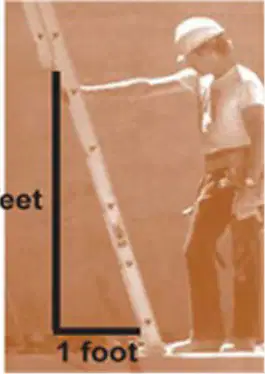
How can you check if a ladder is at the correct angle?
By measuring the height of the ladder.
By extending your arm straight out and touching the closest part of the ladder without bending.
By placing the ladder on a flat surface.
By using a level to check the angle.
What should you avoid doing to make a ladder reach farther?
Setting it on boxes, barrels, bricks, or other unstable bases.
Extending the ladder fully.
Placing the ladder on a flat surface.
Using a longer ladder.

What should be done when two or more separate ladders are used to reach an elevated work area?
The ladders should be placed side by side.
The ladders should be offset with a platform or landing between them.
The ladders should be tied together.
The ladders should be used one at a time.
How far should the side rails extend above the upper landing surface?
24 inches.
30 inches.
36 inches.
40 inches.
What is one way to prevent a ladder from slipping?
Use safety shoes on ladder feet
Use a ladder without any support
Place the ladder on a slippery surface
Use a ladder with broken steps
How should the foot of the ladder be braced to prevent slipping?
With stakes or stout boards
With ropes only
With a single nail
With a piece of cloth
What should be done to prevent the ladder from being displaced?
Tie, block, or otherwise secure the ladder
Leave the ladder unsecured
Place the ladder on an uneven surface
Use a ladder with missing rungs
How should the top support of a ladder be supported?
Equally on the two rails
Only on one rail
On a curved surface
On a slippery surface
What is the minimum overlap length in inches for a ladder size up to and including 32 feet?
46
36
58
70
What is the maximum working load in pounds for a ladder with a duty rating of IAA?
225
250
300
375
Which ladder type has a maximum working load of 300 pounds?
I
IA
II
IAA
What is the minimum overlap length in inches for a ladder size over 48 feet, up to and including 60 feet?
36
46
58
70
What is the duty rating for a ladder with a maximum working load of 250 pounds?
I
IA
II
IAA
What is the load capacity of a Type I ladder?
375 pounds
300 pounds
250 pounds
200 pounds
Which type of ladder is recommended for light duty household use?
Type IAA
Type IA
Type II
Type III
What should you do to avoid overreaching while on a ladder?
Lean further to reach the desired spot
Descend and reposition the ladder
Stand on the top rung
Use a longer ladder
What is the recommended body position while climbing or working on ladders?
Near the top of the ladder
Near the middle of the step or rung
Leaning to one side
Standing on one foot
What does maintaining three points of contact with the ladder mean?
Two feet and one hand
One foot and two hands
Two feet and two hands
One foot and one hand

What is the recommended way to carry tools and equipment when using a ladder?
Carry them yourself while climbing the ladder.
Use a backpack to carry them.
Have coworkers hand up tools and equipment.
Leave them at the bottom of the ladder.
Where should you not stand on a step ladder?
On the topcap or the step below the topcap
On the middle steps
On the bottom step
On the side rails
When should ladders be moved, shifted, or extended?
When they are not in use
While they are in use
When someone is standing on them
When they are broken
What should you always follow for proper use of ladders?
Your own judgment
Manufacturer's recommendations
Advice from friends
Online tutorials
What should you avoid doing while using a ladder?
Taking short cuts
Following safety guidelines
Using the ladder for its intended purpose
Reading labels/markings on the ladder
What should you do if you feel sick, dizzy, or panicky while on a ladder?
Climb down in a hurry
Drape your arms around the rungs and rest your head against the ladder until you feel better, then climb down slowly and carefully
Jump off the ladder
Ignore the feeling and continue working
How many people should be on a ladder at a time?
Two people
Three people
Only one person, unless the ladder is designed for more
As many as needed
What type of ladders should NOT be used around exposed electrical wiring?
Wooden ladders
Metal ladders
Non-conductive ladders
Painted ladders
What should you wear to ensure safety while using a ladder?
Shoes with slip resistant soles
Sandals
High heels
Barefoot
What should you consider using when using extension ladders?
Fall protection systems
Painted wooden ladders
Metal ladders
Sandals
What should be done if the ropes on extension ladders become frayed or badly worn?
Continue using them.
Replace them.
Tie them together.
Ignore the damage.
What should be avoided when using ladders?
Using ladders with broken or missing steps, rungs, cleats, safety feet, side rails, or other defects.
Using ladders with all parts intact.
Using ladders on a flat surface.
Using ladders with proper support.
What should be done to the metal bearings of extension ladder rung locks and pulleys?
They should be painted.
They should be lubricated periodically.
They should be left dry.
They should be replaced every month.
What should be done to keep ladders free of oil, grease, or slippery materials?
Clean them frequently.
Leave them as they are.
Cover them with a cloth.
Store them in a damp place.

