
 Worksheets
Unit 2: Cell Structure & Function Review
Total questions: 40
Worksheet time: 45mins
Mattias Schleiden and Theodor Schwann studied plant and animal cells under a microscope. Together these men concluded that plants and animals are made up of cells. Which scientist furthered their study to complete our modern cell theory?
Robert Hooke, who first observed cells and gave them their name
Anton van Leeuwenhoek, who observed living cells in a drop of pond water
Rudolf Virchow, who introduced the idea that all cells are created from other preexisting cells
Ernst Ruska, who designed and built the first electron microscope
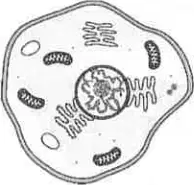
The diagram of the cell below is most likely which type of cell?
bacteria
plant
animal
fungus
Which two of the following are major structural components of the cell membrane?
cellulose
nucleic acids
phospholipids
proteins
starch
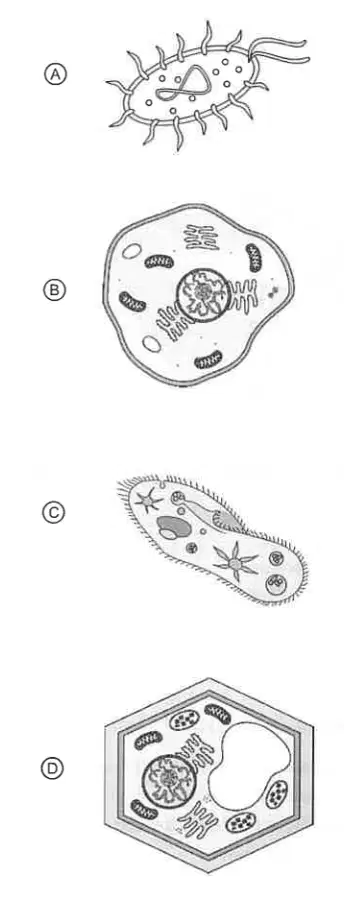
Which image below shows a plant cell?
A
B
C
D
Which of the following is an example of a prokaryote?
the green algae Volvox
the bacterium E. coli
the pine pollen grain Pinus
the roundworm C. elegans
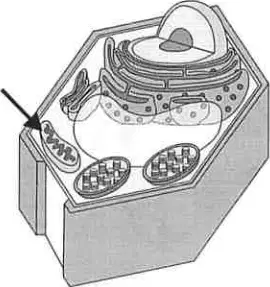
Study the diagram of a plant cell below. The organelle marked by the arrow is responsible for cellular energy. Identify this organelle:
mitochondrion
Golgi apparatus
endoplasmic reticulum
nucleus
What is the main function of a cell wall?
to support and protect the cell
to make and store DNA
to direct the activities of the cell
to help the cell move
Viruses are typically much smaller than cells of bacteria, but viruses and bacteria share several characteristics. Identify three characteristics below that are common to both viruses and bacteria.
contain genetic material
change over time through genetic mutations
undergo stages of growth and development
Identify three characteristics shared by plant, animal, and fungal cells.
eukaryotic
ribosomes
mitochondria
Coded instructions from the nucleus are used by which organelle to make proteins?
Golgi apparatus
endoplasmic reticulum
vacuole
ribosome
Which type of cells would you expect to contain the most mitochondria?
muscle cells that require the most energy
bone cells that require the most strength
red blood cells that transport gases
glandular cells that secrete hormones
Which evidences below cause scientists to consider viruses as nonliving? Choose the two best answer choices.
They do not have a nucleus nor membrane-bound organelles.
Outside a living host cell, they have no way to maintain a stable internal environment and cannot move on their own.
Which two organelles provide plant cells with energy?
chloroplasts
mitochondria
Which of the cell organelles form peptide bonds between amino acids?
(a)
Which organelle found in plant cells captures energy from the sun to convert it into high energy sugars?
(a)
Which two of the following are contained in both prokaryotic and eukaryotic cells?
DNA
ribosomes
membrane-enclosed organelles
nucleus
mitochondria
Pepsin is an enzyme produced by stomach cells to help digest protein. Stomach cells package and secrete pepsin in which of the following organelles?
Golgi apparatus
mitochondria
nucleus
ribosomes
In a plant, which of the following would represent the smallest level of organization?
a flower
a leaf cell
the epidermis
the root system
In an animal, which of the following structures represents the highest level of organization?
heart
mitochondrion
red blood cell
epidermis tissue
Marine biologists find a specimen that looks like a rock. They find it has the following characteristics. Which of the following two characteristics would best prove that this specimen is actually a living organism?
It reproduces by releasing sperm and eggs into the water around it.
Its interior contains blood and tissue made up of cells.
It has an outer shell made of polysaccharides.
It contains high levels of vanadium, a rare metal used to strengthen steel.
It does not move.
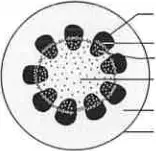
A cross-section of a plant stem is shown in the diagram below.
tissue
organ
system
organism

The 3 parts of the Cell Theory are...?
All living things are composed of cells
Cells are the basic units of structure and function in living things
All cells are produced from other cells
All living things are composed of cells
Cells are the basic units of dance and vibes in living things
All cells are destroyed from other aliens
All living things are composed of Jell-O
Cells are the basic units of structure and function in living things
All cells are produced from factories in Canada
All living things are composed of cells
Cells do karate and practice eating whole pies in their free time
All cells are produced from other cells
Which type of microscope was crucial in the development of cell theory?
Transmission electron microscope
Scanning electron microscope
Light microscope
Atomic force microscope
Who is considered one of the founding figures of cell theory?
Isaac Newton
Charles Darwin
Matthias Schleiden
Albert Einstein
Which component of cell theory did Rudolf Virchow contribute to?
Cells are the basic unit of life.
All living things are made of cells.
Cells arise only from pre-existing cells.
Cells contain the hereditary information necessary for regulating cell functions.
Which of the following statements is NOT a part of the modern cell theory?
All living organisms are composed of one or more cells.
The cell is the basic unit of life.
All cells arise from pre-existing, non-living materials.
Genetic information is passed on from cell to cell.
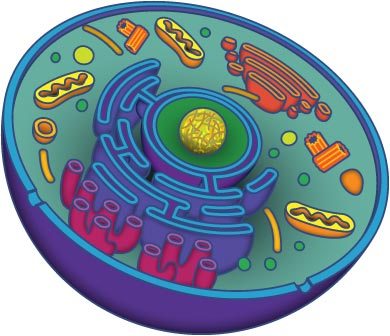
What is the primary function of the cell nucleus?
It is the site of cellular respiration.
It stores the cell's hereditary material.
It is responsible for protein synthesis.
It aids in cell division.
Which of the following is NOT a component of the Cell Theory?
The cell is the basic unit of structure and function.
All living things are composed of cells.
Cells are derived from preexisting cells.
Cells that have the best adaptations survive and pass the traits to their offspring.
What is the significance of the phrase "Omnis cellula e cellula" in cell theory?
It means all cells have a nucleus.
It means all cells are made of the same basic chemicals.
It means all cells come from pre-existing cells.
It means all cells have a cell wall.
In what year was cell theory formally articulated?
1665
1839
1858
1952
Which of the following discoveries was NOT directly involved in the development of cell theory?
The structure of DNA
The invention of the microscope
The observation of cells in plant tissue
The observation of animalcules in pond water
What did Theodor Schwann contribute to cell theory?
He discovered the cell nucleus.
He proposed that all animals are made of cells.
He identified the cell membrane.
He was the first to observe living cells under a microscope.
all plants and animals have ____________ , which is where cellular respiration occurs
ribosomes
chloroplasts
mitochondria
lysosomes
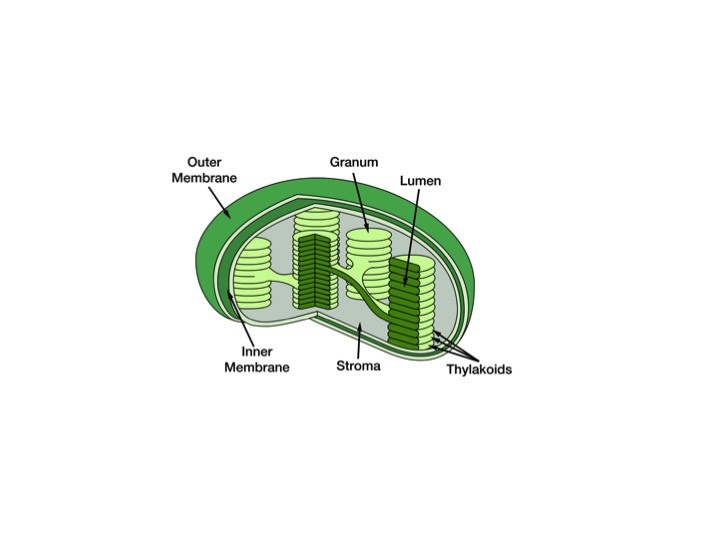
This organelle is the:
Mitochondria
Chloroplast
Match the following
Makes ATP (energy).
mitochondria
control center of the cell, contains DNA
nucleus
makes proteins
ribosomes
protects the cell and lets stuff in and out of cell, maintains homeostasis
cell membrane
converts sunlight into glucose (sugar) for the plant cell
chloroplast
Mitochondria are found in plant AND animal cells
True
False
Which organelle controls all activity of the cell?
nucleus
mitochondria
cell wall
cell membrane
Which features are found in plant cells but no animal cells?
Cells walls and chloroplasts
Mitochondria and ribosomes
Chromosomes and chloroplasts
Vacuoles

What makes something living?
It can hear.
It is made of cells.
It breathes in oxygen.
It doesn't reproduce.

