Worksheets
Understanding OHM's Law Quiz
Total questions: 68
Worksheet time: 49mins
What is the definition of Ohm's Law?
The current through a conductor between two points is directly proportional to the voltage across the two points.
The resistance of a conductor is inversely proportional to its length.
The power dissipated in a conductor is proportional to the square of the current.
The voltage across a conductor is inversely proportional to the current through it.
Which of the following is the correct formula for Ohm's Law?
V=IR
P=IV
R=IV
I=RV
If the voltage across a resistor is 12V and the current through it is 3A, what is the resistance?
2 ohms
4 ohms
6 ohms
8 ohms
Which of the following is an application of Ohm's Law?
Calculating the power consumption of an electrical device.
Determining the resistance of a resistor in a circuit.
Measuring the capacitance of a capacitor.
Finding the inductance of an inductor.
If the resistance in a circuit is doubled while keeping the voltage constant, what happens to the current?
It doubles.
It halves.
It remains the same.
It quadruples.
What is the unit of resistance?
Volt
Ampere
Ohm
Watt
In a series circuit with a total resistance of 10 ohms and a voltage supply of 20V, what is the current flowing through the circuit?
1A
2A
4A
5A
Which of the following statements is true about the relationship between voltage and current in Ohm's Law?
Voltage is inversely proportional to current.
Voltage is directly proportional to current.
Voltage is independent of current.
Voltage is equal to the square of the current.
If a resistor has a resistance of 5 ohms and the current through it is 2A, what is the voltage across the resistor?
5V
7V
10V
15V
Which of the following is NOT an application of Ohm's Law?
Designing electrical circuits.
Calculating the resistance needed for a specific current.
Measuring the frequency of an AC signal.
Troubleshooting electrical problems.
If the voltage across a resistor is 24V and the resistance is 8 ohms, what is the current through the resistor?
2A
3A
4A
6A
What happens to the resistance if the length of a conductor is increased, assuming all other factors remain constant?
Resistance decreases.
Resistance increases.
Resistance remains the same.
Resistance becomes zero.
In a parallel circuit, if one branch has a resistance of 10 ohms and another branch has a resistance of 20 ohms, what is the total resistance?
5 ohms
6.67 ohms
10 ohms
15 ohms
If the current through a resistor is 0.5A and the resistance is 10 ohms, what is the power dissipated by the resistor?
2.5W
5W
10W
20W
Which of the following is a correct statement of Ohm's Law?
I=RV
R=VI
V=RI
P=IV
If a circuit has a voltage of 15V and a current of 3A, what is the resistance in the circuit?
3 ohms
5 ohms
7 ohms
10 ohms


Calculate the voltage (V):
(a)
How do you calculate resistance?
Current x Voltage
Voltage x Power
Voltage ÷ Current
Current ÷ Voltage


How do you calculate the total resistance ( Rtotal ) in a series circuit with three resistors of 2Ω , 3Ω , and 5Ω ?
2Ω
5Ω
10Ω
3Ω
If a resistor has a resistance of 8Ω and the voltage across it is 16V , what is the current through the resistor?
1A
2A
4A
8A
What is the total resistance of two 10Ω resistors connected in parallel?
5Ω
10Ω
15Ω
20Ω
What is the unit of resistance?
Ampere
Volt
Ohm
Watt
If a resistor has a resistance of 10Ω and a current of 2A flows through it, what is the voltage across the resistor?
5V
10V
20V
40V
If a circuit has a voltage of 12V and a resistance of 4Ω , what is the current flowing through the circuit?
1A
2A
3A
4A
In a parallel circuit, if the resistance of each resistor is 6Ω and there are 2 resistors, what is the total resistance?
3Ω
6Ω
12Ω
2Ω
How do you calculate the total resistance in a series circuit with resistors R1 , R2 , and R3 ?
Rtotal=R1+R2+R3
Rtotal=R11+R21+R311
Rtotal=R1×R2×R3
Rtotal=3R1+R2+R3
What happens to the total resistance in a parallel circuit if more resistors are added?
It increases.
It decreases.
It remains the same.
It becomes zero.
If a circuit has a voltage of 24V and a current of 3A , what is the resistance?
6Ω
8Ω
12Ω
24Ω

The voltage of the battery is 8 volts. If the current must double but the light bulb is remaining the same, the battery must be replaced by one with ____ volts
16 volts
8 volts (the battery voltage won’t change)
4 volts
More information is needed
What is the relationship between electric current and voltage in a circuit?
Directly proportional
Constant
Unrelated
Indirectly proportional
How did Tesla use the equation P=IV to solve Edison's line loss problem?
He increased the power and decreased the voltage
He increased the voltage and decreased the current
He increased the current and decreased the power
He decreased the power and voltage
What is the power of a lamp whose current is 6A and the voltage across it is 120V?
120W
720W
16W
10W
An electric bulb is connected to a 220V generator. The current is 0.50 A.
What is the power of the bulb?
440W
220W
110W
55W
In the equation P=IV, what does P stand for?
Power
Potential
Polarity
Possibility
In the equation P=IV, what does V stand for?
Joules
Volts
Watts
Five
In the equation, P=IV, what does I stand for?
Current
Incandescent
Impulse
Insulator
The two ends of a 3.0-ohm resistor are connected to a 9.0-V battery. What is the total power delivered by the battery to the circuit?
3.0 W
27 W
0.33 W
0.11 W

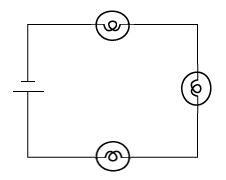
What kind of circuit would we find in a cheap strand of holiday lights, if one bulb goes out on the line they ALL go out?
Parallel Circuit
Series Circuit
Simple Circuit
Short Circuit


What is a circuit that only has ONE path for electricity to flow?
series circuit
closed circuit
parallel circuit
light bulb


If the cell above has a potential difference of 8V, what is the potential difference across one bulb?
8V
4V
16V
2V

Using the circuit shown solve for Total current flowing through the circuit (IT)
4 A
3 A
2 A
1 A

In this circuit, the bulb(s) that light up are:
1 only
2 only
1 and 2
None of them

All the lightbulbs in this circuit are lit. Which change would cause all the bulbs to go out?
Removing wire 1
Removing wires 2 and 4
Removing wires 2 and 5
Removing wires 3 and 4

This is an example of a _______ circuit
open
series
parallel
switch

A student builds a circuit made up of a battery, two light bulbs, and a switch. What will the student most likely observe in this circuit?
Light bulb 1 and light bulb 2 will both be on
Light bulb 1 will be off, but light bulb 2 will be on
Light bulb 1 and light bulb 2 will both be off
Light bulb 1 will be on, but light bulb 2 will be off
What is happening here?
Series circuit - Bulbs are lit
Series circuit - Bulbs are off
Parallel circuit - Bulbs are lit
Parallel circuit - Bulbs are off


If lamp 1 is unscrewed from its holder, what will happen to lamp 2?
It will get brighter
It will stay the same brightness
It will go out
Nothing will happen


If lamp 2 is unscrewed from its holder, what will happen to lamp1?
It will stay lit
It will go out
It will get dimmer
It will dissapear