
 Worksheets
Unit 1: Studying Science
Total questions: 20
Worksheet time: 20mins
Scientists make observations, conduct experiments, and draw conclusions. Which statement is true of all scientists?
Scientists study living things.
Scientists study the natural world.
Scientists study items found on Earth.
Scientists study things found in outer space.
Kim places a cup of water and a cup of cooking oil in the freezer. Every 30 minutes, Kim checks the cups. She records the time when the liquid in each cup freezes. Which question is Kim investigating?
Which liquid freezes faster, water or cooking oil?
Which liquid tastes better frozen, water or cooking oil?
Which item floats better, frozen water or frozen cooking oil?
Which item melts faster, frozen water or frozen cooking oil?
Kwan asks people in his class to report how many times per week they recycle. Kwan asks friends in two classes to collect reports from their classmates, too. What is true about Kwan's investigation?
It involves collaboration.
It follows the scientific method.
It produces results that don't change.
It explains why people recycle.
Franz wants to investigate moon craters. He drips water into a shallow pan of flour. He holds the dropper at a different height each time he moves to a new area of the pan. Franz observes that the water drops make dents of differing sizes in the flour. Which types of experiment is Franz conducting?
modeling
surveying
classifying
directly studying
A scientist looks at a graph of the results of his experiment. He draws a conclusion about the results. What is one way the scientist uses his conclusion?
to decide whether his results are correct
to decide whether his hypothesis is correct
to decide whether he should make a different conclusion
to decide whether he should share his results with others
During Carmela's investigation a plant grew 1 inch each week for 4 weeks. When she displays her drawing of the weekly changes in the size of the plant, what skill is she using?
communication
inference
observation
variables
Sarah is studying water. She thinks that adding salt to water may make it freeze at a higher temperature. Which word describes her statement?
conclusion
hypothesis
investigation
variable
Emily grew one plant on the windowsill. She grew another plant inside a black plastic bag. She made a poster about how the plant grew. What does Emily's poster do?
predicts the data
classifies the data
hypothesizes the data
communicates the data
Nicholas wants to add more blueberries to a muffin recipe. He thinks it will make the muffins taste better. What part of the inquiry process are the blueberries?
variable
question
hypothesis
conclusion
Connor and Dylan studied how far two toy pull-back cars travel. Each student pulled a car back and let it go. Then they measured how far each car traveled before it stopped. What part of the inquiry process did the students do?
made a prediction
drew a conclusion
conducted an investigation
communicated their results
Kiera is planning an investigation of fossils that scientists have found where she lives. Which would be her best source of information?
science dictionary
book about dinosaurs
local science museum
television show about rocks
Michi places a beaker of water in sunlight and measures how the water temperature changes. Which unit of measurement will Michi use to record his data?
grams
centimeters
degrees Celsius
cubic centimeters
Students in Zoe's class measure the time it takes a toy car to move along a track. Why should Zoe compare her data to other student's data?
to choose the best time to record
to see if she needs to change her data
to decide why the car moved slowly
to see if her data matches other student's data
Lataya collects one leaf from each tree around the school. What would be the best way for Lataya to find out which leaf has the greatest mass?
Hold the leaves, two at a time, in her hands.
Find the mass of each leaf in a pan balance.
Lay each leaf on a table beside a measuring tape.
Hang all of the leaves together from a spring scale.
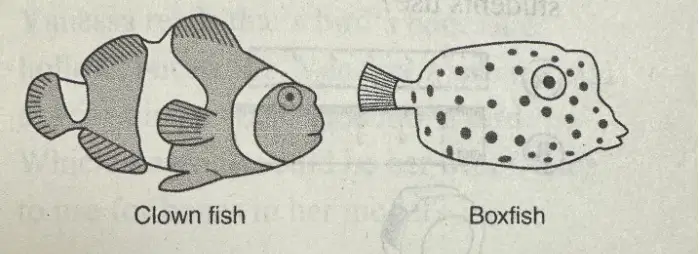
Shawna is studying two types of fish for a project. She draws pictures of the fish. Which is an observation Shawna might make of the fish?
The boxfish has a funny shape.
Most people have seen pictures of the clown fish.
People will laugh when they see the boxfish picture.
The clown fish has stripes around its head, body, and tail.
Thad looks at a photograph of a tadpole. He wonders how the tadpole's body changes as the tadpole grows. What type of model would be most useful for Thad to observe?
a set of plastic models of two different types of frogs
a computer animation that follows a frog through its life cycle
a set of diagrams that shows the different parts of a frog's body
a photograph of a tadpole and a photograph of a fully grown frog
A scientist plans to create a model of a coral reef. What must the scientist do when building the model?
include the most important parts
use a computer to build the model
build the model the same size as a reef
build the model so that it can be taken apart
Scientists use different models depending on the subject they are studying. What is true about all models?
Models are made by humans.
Models represent one object at a time.
Models are the same size as the objects they represent.
Models include every detail of the objects they represent.
Kate thinks about how to plant a garden. She imagines where the garden will be. She pictures what will grow in her garden and where. Next, Kate draws a picture of her garden. What is Kate doing?
She is creating two kinds of mental models.
She is creating a two-dimensional model from a mental model.
She is creating a three-dimensional model from a mental model.
She is creating a three-dimensional model from a two-dimensional model.
Vanessa reads that a bird's bones are hollow, but strong. Vanessa wants to build a three-dimensional model of a bird. Which material would be her best choice to use for bones in her model?
toothpicks
modeling clay
blades of grass
drinking straws

