
 Worksheets
The 3 Colonial Regions
Total questions: 42
Worksheet time: 30mins
Match the following locations with their historical significance in 1620.
Plymouth, Massachusetts
Where the Pilgrims/Separatists actually landed
Virginia
Where the Pilgrims/Separatists originally planned to settle
Jamestown
First permanent English Settlement 1607
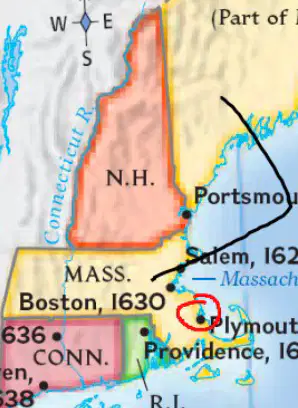
Which colony was established in 1620?
Portsmouth
Plymouth
Boston
New Haven
What economic activities were common in New England due to its proximity to the ocean?
Mining and Agriculture
Fishing, Whaling, and Ship Building
Textile Manufacturing and Banking
Farming and Ranching
What was a major industry in New England due to its dense forests?
Ship Building
Whaling
Lumber
Fishing
Which group of people settled in Massachusetts for religious freedom?
Quakers
Catholics
Puritans and Separatists
Anglicans
What was the main reason leaders in the dissenter colonies disagreed with the Puritan Church?
Economic policies
Religious tolerance
Political power
Trade regulations
What type of government is associated with the term "direct democracy"?
A government where representatives make decisions
A government where citizens vote on all decisions
A government ruled by a monarch
A government controlled by a single party

A
B
C
D
What was the main economic activity in the Southern Colonies?
Fishing and shipbuilding
Mining for gold and silver
Cash Crop agriculture
Maryland was a Southern colony that became a haven for the (a) religion.
Pennsylvania is a colony in WHICH REGION?
New England
Middle
Southern

New England

Middle

Southern

New England

Middle

Southern

Which colony is labeled on the map with #10?
Maryland
Virginia
North Carolina
South Carolina
Georgia

Which colony is marked on the map with a #1?
New York
Massachusetts
New Hampshire
Rhode Island

This region enjoyed the greatest diversity of religious and ethnic (cultural/national) backgrounds?
New England colonies
Middle colonies
Southern colonies

This region had the least amount of religious tolerance (for other religions/belief systems)?
hint: they were "Puritans" and had very strict religious expectations/rules
New England colonies
Middle colonies
Southern colonies

Colonists in this region lived "the most isolated" lives of the three colonial regions....
(because they were mostly spread out on large farms-- called plantations)
New England colonies
Middle colonies
Southern colonies

SLAVERY..... while it existed in ALL 3 regions, at first.... took the GREATEST hold in this region (because of the need for cheap farm labor)?
New England colonies
Middle colonies
Southern colonies

What were the TWO largest cities in the "Middle Colonies" region?
(2 answers)
Philadelphia, PA
(in Pennsylvania)
Boston, MA
(in Massachusetts)
New York City, NY
(in New York)
Baltimore, MD
(in Maryland)

Pilgrims arrived here in 1620
Plymouth
Jamestown
Roanoke island
San Salvador
A person who makes a long difficult journey to a special place for religious reasons
Pilgrim
pioneer
colonist
settler
Match each colonial region with the correct economic activities.
New England Colonies
Fishing, shipbuilding, lumber, industry
Middle Colonies
Grain farming, artisans, known as the breadbasket
Southern Colonies
Plantations, cash crops, slave trade
The (?) colonies were known for the Quaker religion, tolerance, diversity, and grain production, oftentimes called the breadbasket.
(a)
1. This document signed in 1215, first limited the powers of the king or queen of England and established certain rights?
The English Bill of Rights
The Magna Carta
The Constitution
The Declaration of Independence
1. This document signed in 1689 further limited the power of the king and queen of England and solidified certain rights?
The English Bill of Rights
The Magna Carta
The Declaration of Independence
The Federalist Papers

1. This document was signed in 1620 off of Massachusetts establishing the principles of self-government and a social contract for settlers to North America
The House of Burgesses
The Fundamental Orders of Connecticut
The Mayflower Compact
The Federalist Papers

1. What was Virginia’s first elected assembly called?
The Parliament
Congress
House of Burgesses
Charter


What was the Middle Passage?
The Middle Passage was a military conflict between African tribes during the colonial era.
The Middle Passage was a term used to describe the journey of European explorers to the New World.
The Middle Passage was a trade route between Europe and Asia.
The Middle Passage was the stage of the triangular trade in which millions of Africans were forcibly transported across the Atlantic Ocean to the Americas as part of the transatlantic slave trade.
What was the main purpose of the Middle Passage?
Trading goods between Europe, Africa, and the Americas.
Transporting enslaved Africans for forced labor
Promoting cultural exchange between different regions.
Establishing colonies in the New World.
What was the triangular trade?
The triangular trade was a system of trade during the colonial era that involved the exchange of goods between Europe, Africa, and the Americas.
The triangular trade was a system of trade between North America, South America, and Europe.
The triangular trade was a system of trade between Asia, Africa, and Europe.
The triangular trade was a system of trade between Africa, Asia, and the Middle East.

