Wayground logo

Free Printable Worksheets

Font size

S
M
L
XL
Worksheets

Unit 0 Review

Total questions: 57

Worksheet time: 57mins

Name
Class
Date
1.
An experiment is performed on plants to see how different liquids affect plant growth. Each plant in the experiment is given a different liquid; water, apple juice, or milk. Each plant has the same amount of soil, sunlight, and listens to the same music. In this investigation, the independent variable is ...
a)
The type of plant
b)
The amount of sunlight
c)
The type of music
d)
The type of liquid
2.
If I ride my bike to school instead of walking, then I will get to school faster. What is the dependent variable?
a)
True
b)
How fast you get to school
c)
Riding a bike or walking
d)
False
3.
Dependent variable means
a)
the scientist controls what to test
b)
educated guess
c)
ask a question
d)
what is being measured
4.
What is a factor that the experimenter has full control over and changes to see what happens?
a)
Dependent Variable
b)
Independent Variable
c)
Control group 
d)
Hypothesis
5.

THE PART OF THE EXPERIMENT THAT DOESN'T CHANGE

a)

CONTROL

b)

INDEPENDENT VARIABLE

c)

DEPENDANT VARIABLE

d)

constant

6.

A SUMMARY OF YOUR RESULTS

a)

CONCLUSION

b)

HYPOTHESIS

c)

QUESTION

d)

DATA

7.

The purpose of a control group is ____________________________________________.

a)

to live

b)

to make the experiment work

c)

controls are used as a basis for COMPARISON

d)

so that we know the results of the experiment are due to what we are testing

8.
This data characteristic refers to how close your measurement is to the true or actual measurement.
a)
precision
b)
sloppiness
c)
accuracy
d)
closeness
9.
This data characteristic refers to how close a set of measurements of the same quantity is to each other.
a)
precision
b)
sloppiness
c)
accuracy
d)
closeness
10.
The experiment set-up representing normal, typical or current conditions (the Independent Variable has not been changed in this set-up).
a)
control
b)
independent
c)
experimental
d)
dependent
11.

A dependent variable is __________.

a)

What is measured in an experiment

b)

What you change in an experiment

c)

A prediction about an experiment

d)

What stays the same in an experiment

12.

A qualitative observation is ________.

a)

Describing qualities and characteristics

b)

A guess you make using an observation

c)

Numbers and labels

d)

What is kept the same in an experiment

13.

What is an example of an inference?

a)

It is going to rain later today.

b)

The clouds are dark gray.

c)

The temperature is 67 degrees Fahrenheit.

d)

All of these are examples of inferences.

14.

Which of the following is an example of quantitive data?

a)

Mercedes Benz is a popular car's brand

b)

The painting is beautiful

c)

The age of earth round 4.5 billion years

15.

Which of the following is qualitive data?

a)

The door has height on 2 meter

b)

I touch an ice cube and it's cold

c)

The car's velocity reaches 100km/hout

16.

Information obtained through the senses.

a)

Observation

b)

Hypothesis

c)

Principle

d)

Inference

17.

The condition in an experiment that is changed or manipulated.

a)

Dependent Variable

b)

Experimental Group

c)

Independent Variable

d)

Control Group

18.

The condition in an experiment that is observed or measured

a)

Dependent Variable

b)

Experimental Group

c)

Independent Variable

d)

Control Group

19.

In an experiment the group that receives the experimental treatment.

a)

Dependent Variable

b)

Experimental Group

c)

Independent Variable

d)

Control Group

20.

Data expressed in words.

a)

Qualitative Data

b)

Quantitive Data

21.

Data expressed in numbers.

a)

Qualitative Data

b)

Quantitive Data

22.
Research question: does the distance a person kicks a soccer ball effect how well they will do on their math test.  What is the dependent variable?
a)
How far they kick the soccer ball
b)
who the person is
c)
how well they do on the math test
d)
Type of soccer ball.
23.
When experimenting with the growth of a plant, a scientist uses three (of the same type of) plants, two different fertilizers, equal light, and equal water. What type of variable is the fertilizer?
a)
Dependent
b)
Independent
c)
Control
d)
Compound
24.
What would the INDEPENDENT variable be in an experiment testing which types of paper airplane goes furthest?
a)
the paper used
b)
the type of paper airplane
c)
the distance of each plane's flight
d)
how hard the plane is thrown
25.
Research Question: Does the type of gasoline put in a car effect how fast the car can drive. What is the independent variable?
a)
Type of gasoline
b)
which car the gas is put into
c)
how fast the car can drive
d)
how much gas is put into the car
26.
The part of the experiment that remains the same for the control and experimental group.
a)
constants
b)
control
c)
independent
d)
dependent
27.
Mr. S. sets up an experiment to see how the mass of a ball affects the distance it rolls off a ramp.  Identify the independent variable.
a)
distance traveled by the ball
b)
height of the ramp
c)
mass of the ball
d)
weight of the ball
28.
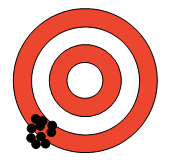
This bullseye demonstrates...
a)
High Accuracy & High Precision
b)
High Accuracy & Low Precision
c)
Low Accuracy & High Precision
d)
Low Accuracy & Low Precision
29.

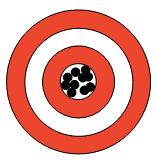
This bullseye demonstrates...

a)

High Accuracy & High Precision

b)

High Accuracy & Low Precision

c)

Low Accuracy & High Precision

d)

Low Accuracy & Low Precision

30.

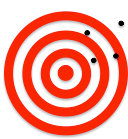
Describe the accuracy and precision of the image

a)

Very accurate and somewhat precise

b)

Very accurate but not precise at all

c)

Not accurate at all but very precise

d)

not accurate and not very precise

31.

Which best describes the target?

a)

Precise, but not accurate

b)

Accurate but not precise

c)

Precise and accurate

d)

Neither accurate nor precise

32.

What is used to measure (but not precise), heat, and mix large amounts of liquids?

a)

beaker

b)

flask

c)

test tube

d)

graduated cylinder

33.

Which equipment measures temperature in liquid or gas, and measures in degrees Celsius?

a)

hot plate

b)

beaker

c)

thermometer

d)

bunsen burner

34.

Which equipment heats liquids and some stir liquids?

a)

beaker

b)

graduated cylinder

c)

flask

d)

hot plate

35.

Which equipment heats objects with an open flame?

a)

hot plate

b)

thermometer

c)

bunsen burner

d)

beaker

36.

Which equipment allows you to drop a small amount of liquid?

a)

dropper

b)

test tube

c)

graduated cylinder

d)

flask

37.

This is used to pour lab materials into an object with a small opening

a)

scoop

b)

funnel

c)

bunsen burner

d)

goggles

38.

This is used to protect your eyes during an experiment

a)

scoop

b)

funnel

c)

bunsen burner

d)

goggles

39.

This is used to hold test tubes.

a)

fire extinguisher

b)

thermometer

c)

beaker

d)

tongs

40.

This is used to find the volume of a liquid

a)

graduated cylinder

b)

inference

c)

observation

d)

triple beam balance

41.
240 cm = ___________ m
a)
2400
b)
24
c)
2.4
d)
0.24
42.
1000 m = ___________ km
a)
100
b)
10
c)
1
d)
0.1
43.
15.6 L = ___________ mL
a)
15,600
b)
156,000
c)
1,560,000
d)
15,600,000
44.
2804 mg = ___________ g
a)
0.2804
b)
2.804
c)
28.04
d)
280.4
45.
0.57 mL = ___________ L
a)
5.7
b)
0.057
c)
0.0057
d)
0.00057
46.
0.932 g = ___________ mg
a)
9.32
b)
93.2
c)
932
d)
9,320
47.
3 km = ___________ mm
a)
30
b)
300
c)
3,000
d)
3,000,000
48.
 68 cm = ___________ mm
a)
0.68
b)
6.8
c)
68
d)
680
49.
 1234 mg = ___________ kg
a)
0.0001234
b)
0.001234
c)
0.01234
d)
0.1234
50.
55 mm = ___________ cm
a)
0.55
b)
5.5
c)
550
d)
5,500
51.
The SI unit for measuring mass is the
 __?__.
a)
meter (m)
b)
liter (L)
c)
cubic meter (m3)
d)
kilogram (kg)
52.
What prefix is represented by the following symbol:  h
a)
hecto
b)
kilo
c)
deci
d)
deka
53.

The SI unit for mass is _________.

a)

Pounds

b)

Inches

c)

Kilograms

d)

Ounces

54.

What is the SI unit for length

a)

M

b)

m

c)

mm

d)

cm

55.

what is the SI unit for time

a)

w

b)

h

c)

m

d)

s

56.
What is the correct SI unit for mass?
a)
Kilograms
b)
newtons
c)
pounds
d)
grams
57.
The SI unit for temperature is __?__.
a)
degree fahrenheit  (° F)
b)
degree celsius  (° C)
c)
kelvin  (K)
d)
degree centigrade  (°C)