
 Worksheets
Classification and Ecosystem Revision
Total questions: 40
Worksheet time: 55mins

Class
Which animal group drinks its mother's milk?
Reptiles
Birds
Mammals
Amphibians
Which animal group is covered in feathers?
Amphibians
Birds
Fish
Mammals
Temperature, light, air, water, and soil are all _____ parts of the environment
abiotic
biotic
living
alive
A population is...
Multiple species that live in one area
All of the living and nonliving things in an area
A group of one species in one area
None of these
Organisms that make up the living part of an ecosystem.
abiotic factors
biotic factors
ecosystem
ecology
Organisms that breaks down organic matter into nutrients is called...
Decided
Decomposer
Decoster
Debiotic
Reorder the first five levels of classification, from the most broad to more specific.
Kingdom
Phylum
Class
Order
Family
Sort the following into abiotic and biotic factors
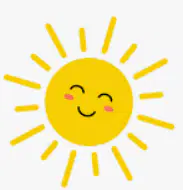
Sunlight

Water
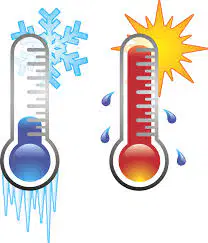
Temperature

Minerals
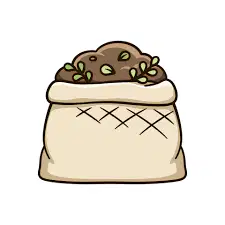
Soil
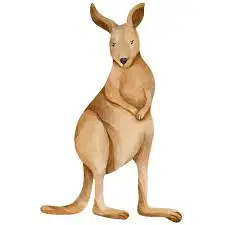
Kangaroo
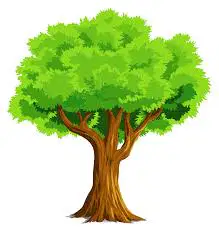
Tree
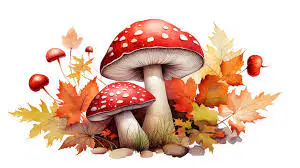
Fungi

Bacteria
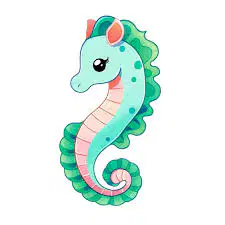
Sea Horse
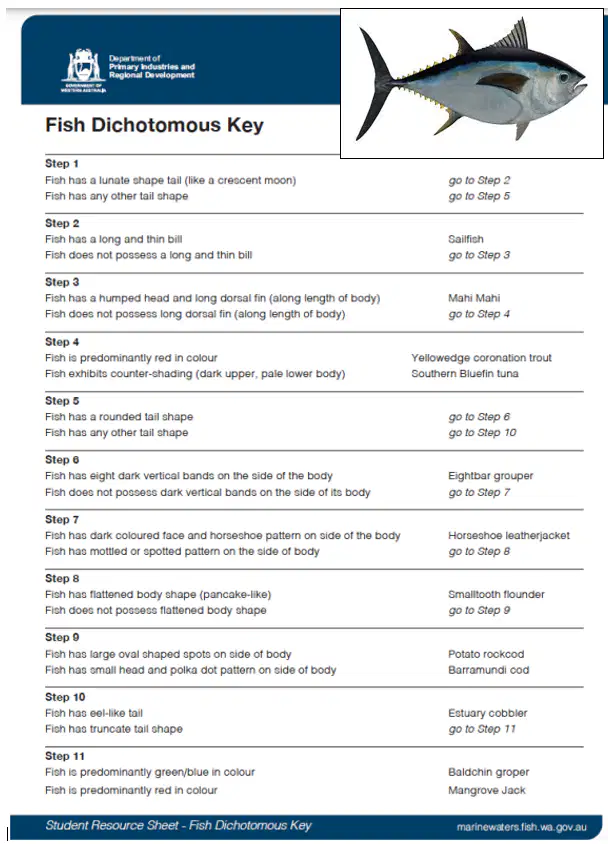
Use the dichotomous key to identify the fish.
Sailfish
Smalltooth flounder
Horseshoe leather jacket
Southern bluefin tuna
Explain the role of decomposers in an ecosystem.
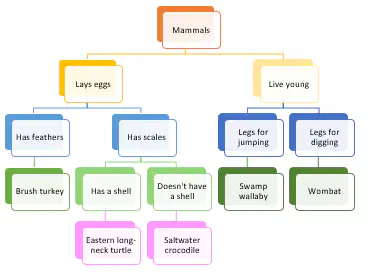
Describe the features of the Brushturkey

Identify leaf F
Cydonia
Magnolia
Aesculus
Fraxinus
Ilex
Draw the animal identified from the sound

Dichotomous mean branching into (a)
What do the arrows show in a food chain?
They point to the smallest animals
They point to the animal that tastes the best
They point to just the producers
They point in the direction that energy is flowing

Put this food chain in the correct order
Grass
Rabbit
Snake
Hawk
What organism is missing from this food chain?
Shrub -> (a) -> Insect Eating Bird -> Hawk
Circle every secondary consumer in red
Match each organism with the correct trophic level
Producer
Grass
Primary Consumer
Squirrel
Secondary Consumer
Insect Eating Bird
Apex Predator
Mountain Lion
Decomposer
Bacteria
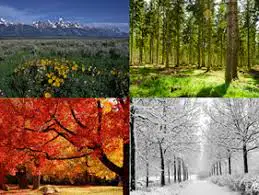
Abiotic factors change over time within given ecosystems. Organise the following options to show seasonal changes for a deciduous forest in Canada.
Rainfall
Extended sunlight
Flooding
Increased temperature
Snow
Less sunlight
Decresed temperature
Reduced nutrients

A highway is built through a forest. This will most likely have which of the following effects on the organisms in the area?
Increase the number of bird species in the forest
Raise the birth rate of the animals on the forest floor
Eliminate all species of plants found in the forest
Make it difficult for animals to move through the forest
Alligators are the large predators that eat many of the smaller animals in a swamp. How might removing the alligators from a swamp habitat create a decrease in vegetation?
Meat-eating animals would begin eating plants.
The plants in the swamp would get more sunlight.
More plant-eating animals would survive.
Plants would not be able to spread their seeds.
Which of the following are biotic factors?
animals
sunlight
trees
water
When wolves were brought back into Yellowstone, elk populations decreased. What happened to buffalo populations?
They also decreased
They stayed the same
They increased
Elk populations decreased when wolves returned to Yellowstone. Describe why this increased the Buffalo numbers.
Which of the following would NOT be a limiting factor for catfish in a pond?
sunlight
food
competition
space
Invasive species are a problem because (Select all correct answers)
They are able to out-compete native organisms
They use up more resources than the ecosystem can provide
The occupy more space than is already available
They disrupt the existing food web

Look carefully at the image. If energy is lost as it moves up the food chain, what trophic level has the most amount of energy?
1st level - producers
2nd level - primary consumers
3rd level - secondary consumers
4th level - tertiary consumers
Producers get energy from (a)
primary consumers eat (b)
secondary consumers eat (c)
tertiary consumers eat (d)
organisms that no one else eats are (e)
Correctly label each trophic level
apex predator
producers
primary consumers
secondary consumers
tertiary consumers
Which of the following best describes the flow of energy in an ecosystem?
Energy flows in a circular pattern.
Energy flows in a one-way direction from producers to consumers.
Energy is recycled by decomposers.
Energy is created by consumers.
What is a food pyramid used to represent in an ecosystem?
The number of species in an ecosystem.
The flow of energy through different trophic levels.
The migration patterns of animals.
The amount of water in an ecosystem.

Global temperature changes brought about hotter and dryer weather conditions in various parts of the world, especially rainforests that traditionally have lots of vines and ferns, due to consistent rainfall. DESCRIBE how scientists would determine a change in this ecosystem using the producers and abiotic factors.
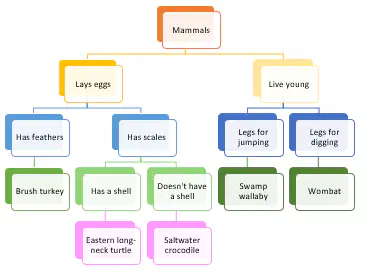
Match the following characteristics to the organism, using the dichotomous key.
Swamp wallaby
Doesn't lay eggs ; legs for jumping
Saltwater crocodile
Lays eggs ; has scales ; has no shell
Wombat
Doesn't lay eggs ; legs for digging
Eastern long-necked turtle
Lays eggs ; has scales ; has shell

