
 Worksheets
Unit 3: Microscopes and Cells Study Guide
Total questions: 38
Worksheet time: 19mins
Unlike Eukaryotes, prokaryote cells (bacteria) do not have a _________.
Cell Wall
Cytoplasm
DNA
Nucleus
Which of the following is NOT one of the main components of the cell theory?
All living things are made of cells
All cells come from existing cells
Cells are the basic unit of life
Cells must contain DNA
Who was the first person to see thousands of different species of microscopic life in his teeth gunk? He called them "animalcules"
Anton Van Leeuwenhoek
Matthias Schleiden
Robert Hooke
Theodor Schwann
Who was the first person to see cells under a microscope and give them a name?
Anton Van Leeuwenhoek
Robert Hooke
Theodor Schwann
Matthias Schleiden

What is number 1?
Objective Lens
Light Source
Eyepiece
Fine focus
What is number 2?
Objective Lens
Light Source
Eyepiece
Course focus
What is number 3?
Objective Lens
Light Source
Eyepiece
Course focus
What is number 4?
Objective Lens
Light Source
Eyepiece
Course focus

What is number 1?
Diaphragm
Arm
Base
Nosepiece
What is number 2?
Diaphragm
Arm
Base
Nosepiece
What is number 3?
Diaphragm
Arm
Base
Nosepiece
What is number 4?
Diaphragm
Arm
Base
Nosepiece
True or False: Matthias Schleiden studied plants and proposed that all plants are made of cells.
True
False
True or False: Theodor Schwann was the first person to see cells divide
True
False

What is number 1?
Endoplasmic Reticulum
Cytoplasm
Mitochondria
Cell Membrane
Ribosomes
What is number 2?
Endoplasmic Reticulum
Cytoplasm
Mitochondria
Cell Membrane
Ribosomes
What is number 3?
Endoplasmic Reticulum
Cytoplasm
Mitochondria
Cell Membrane
Ribosomes
What is number 4?
Endoplasmic Reticulum
Cytoplasm
Mitochondria
Cell Membrane
Ribosomes
What is number 5?
Endoplasmic Reticulum
Cytoplasm
Mitochondria
Cell Membrane
Ribosomes
What is the function of number 1?
The powerhouse of the cell. Converts food into energy
Internal Fluid or "jelly" that contains all the cell structures
Makes proteins for the cell
Membranous structure that acts as a highway for transport around the cell, also builds the cell membrane
The cell boundary that controls what enters and exits the cell
What is the function of number 2?
The powerhouse of the cell. Converts food into energy
Internal Fluid or "jelly" that contains all the cell structures
Makes proteins for the cell
Membranous structure that acts as a highway for transport around the cell, also builds the cell membrane
The cell boundary that controls what enters and exits the cell
What is the function of number 3?
The powerhouse of the cell. Converts food into energy
Internal Fluid or "jelly" that contains all the cell structures
Makes proteins for the cell
Membranous structure that acts as a highway for transport around the cell, also builds the cell membrane
The cell boundary that controls what enters and exits the cell
What is the function of number 4?
The powerhouse of the cell. Converts food into energy
Internal Fluid or "jelly" that contains all the cell structures
Makes proteins for the cell
Membranous structure that acts as a highway for transport around the cell, also builds the cell membrane
The cell boundary that controls what enters and exits the cell
What is the function of number 5?
The powerhouse of the cell. Converts food into energy
Internal Fluid or "jelly" that contains all the cell structures
Makes proteins for the cell
Membranous structure that acts as a highway for transport around the cell, also builds the cell membrane
The cell boundary that controls what enters and exits the cell

What is number 6?
Cell Wall
Central Vacuole
Chloroplasts
Golgi Apparatus
Nucleus
What is number 7?
Cell Wall
Central Vacuole
Chloroplasts
Golgi Apparatus
Nucleus
What is number 8?
Cell Wall
Central Vacuole
Chloroplasts
Golgi Apparatus
Nucleus
What is number 9?
Cell Wall
Central Vacuole
Chloroplasts
Golgi Apparatus
Nucleus
What is number 10?
Cell Wall
Central Vacuole
Chloroplasts
Golgi Apparatus
Nucleus
Which organelle is a water and nutrient storage site for the cell? They are a lot bigger in plant cells.
Vacuole
Cell Wall
Nucleus
Chloroplast
Which organelle is the garbage disposal for the cell? It will break things down with acidic chemicals.
Golgi Apparatus
Cytoskeleton
Vacuole
Lysosome
What is the outer most layer of plant cells? It provides structure and support and is made of cellulose (undigestable by humans).
Vacuole
Chloroplast
Cell Wall
Cell Membrane
Which organelle packages and ships products in and out of the cell? The cellular post office.
Golgi Apparatus
Cell Wall
Ribosome
Mitochondria
Which organelle, only found in plant cells, will convert sunlight into sugar through the process of photosynthesis
Lysosome
Endoplasmic Reticulum
Cell Wall
Chloroplast
All of the following are characteristics of living things EXCEPT:
Use Energy
Made of Cells
Respond to their surroundings
Need oxygen to survive
Fill the correct level of organization of life in the blanks.
_________ -> Tissue -> Organ -> Organ System -> __________
Cells, Organ
Tissue, Organelle
Organism, Cell
Cell, Organism
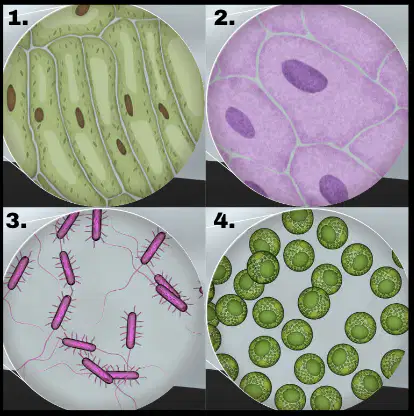
Which of the samples are Eukaryotic Cells?
1 and 4
1, 2, and 3
2 and 3
1, 2, and 4
Which of the samples are capable of doing photosynthesis (Contain chloroplasts)
1 and 4
1, 2, and 3
2 and 3
1, 2, and 4

