
 Worksheets
Telecommunications Quiz
Total questions: 92
Worksheet time: 46mins
Which of the following materials is considered the best conductor but is too expensive for widespread use?
Aluminium
Copper
Silver
Polymers
What does high resistance in a material indicate?
Good conductor
Good insulator
High capacitance
High voltage
Which of the following is NOT a parameter that a multimeter can test for?
Voltage
Current
Resistance
Frequency
According to Ohm's law, what is the relationship between voltage (V), current (I), and resistance (R)?
V = IR
V = I/R
V = R/I
V = I + R
What is an appropriate testing device to see if there has been a breakdown in insulation?
Using a voltmeter
Using a cathode ray oscilloscope
Using a megohmmeter
Using a multimeter
Why is copper widely used in electrical applications?
It is the best conductor
It is the cheapest metal
It is both a good conductor and is suitable for drawing into wires
It is resistant to corrosion
What process is used to remove impurities from pure copper?
Melting
Electrolysis
Chemical treatment
Mechanical filtration
What impact do small amounts of impurities have on copper?
They improve its conductivity
They have no impact
They can have large negative impacts on conductivity
They make it more ductile
What is a characteristic of Copper Beryllium alloy?
It is an inexpensive alloy
It has high tensile strength
It is more conductive than copper
It is more ductile than copper
How must Copper Beryllium be hardened?
By melting and cooling
Through precipitation hardening/natural aging
Through full annealing
By quench hardening
What is a limitation of Copper Beryllium?
It is very cheap
It has a poisonous oxide
It is highly conductive
It is very common
In what applications is Copper Beryllium used?
Electrical contacts and spring contacts
Overhead powerlines
Heat sinks
Building construction
Which alloy grants copper more tensile strength and is used for heavy overhead cables such as trains?
Copper Zinc (brass)
Copper Cadmium
Copper Tin
Copper Nickel
What is the primary desirable quality of Copper Zinc (brass)?
For its tensile strength
For its electrical conductivity
For its good corrosion resistance
For its thermal conductivity
What does a fibre optic system convert electric current into?
Sound
Light
Heat
Magnetic waves
Compared to copper, fibre optic cables are:
More expensive and more susceptible to interference
Cheaper, less susceptible to interference, and carry more information
Cheaper, more susceptible to interference, and carry less information
More expensive, less susceptible to interference, and carry less information
Which of the following is true about single mode fibre optic cables?
They are cheaper to produce
They have the highest bandwidth and lowest light losses
They use internal refraction
They are surrounded by cladding
What is a characteristic of multi modal fibre optic cables?
Light travels through a very narrow single core
They are expensive to produce
They use internal refraction
They have the highest bandwidth
What materials can the casing of a multi modal fibre optic cable be made of?
Only glass
Only acrylic
Glass or acrylic surrounded by cladding
Metal

Which type of fiber optic is depicted in the first diagram?
Single mode fiber optic
Stepped-index multimode
Graded-index multimode
None of the above
Microwaves send information through microwaves, but they are 'line of sight' and can only go about how many kilometers between towers?
10 km
20 km
40 km
60 km
What can be used as repeaters in microwave communication?
Towers
Satellites
Both towers and satellites
Wi-Fi modems
In microwave communication, why are repeater receivers and transmitters positioned at different heights?
To increase the distance between them
To avoid interference
To reduce the cost
To improve signal strength
What is the primary function of satellites in telecommunications?
To provide light to the Earth
To pick up information and send it around the globe
For GPS uses
To monitor weather patterns exclusively
What type of orbit is meant to stay above a single point on the ground?
Medium Earth Orbit
Low Earth Orbit
Geosynchronous/Geostationary
Asynchronous Orbit
At what altitude are Medium Earth Orbits typically found?
37,000 km
20,000 km
1,500 km
644 km
Which type of orbit is often used for GPS navigation?
Geosynchronous/Geostationary
Low Earth Orbit
Medium Earth Orbit
Asynchronous Orbit
What is a characteristic of Low Earth Orbit satellites?
They are geosynchronous
They have higher latency
They typically have the highest transmission speeds
They are used exclusively for weather monitoring
Which of the following orbits is used by the International Space Station?
Geosynchronous/Geostationary
Medium Earth Orbit
Low Earth Orbit
Asynchronous Orbit
What type of waves are used to transmit signals from the mobile phone to the cell base station?
Analog radio waves
Digital radio waves
Microwave radio waves
Infrared waves
What is the role of the satellite in the process of a mobile-to-mobile telephone call?
To convert analog signals to digital signals
To amplify the signal strength
To relay digital signals between ground stations
To provide direct communication between mobile phones
What is the final signal output type when the signal reaches the receiving mobile phone?
Digital voice output
Analog voice output
Microwave voice output
Radio voice output
What type of semiconductor is made when doping with an element with an electron surplus?
p-type
n-type
Silicon
Germanium
Which element is doped onto silicon to create a p-type semiconductor?
Arsenic
Phospherous
Boron
Germanium
Which of the following is NOT a semiconductor
Transistor
Diode
Capacitor
LED
What is the function of a double p-n junction in a transistor?
To pulse light through a fibre optic cable
To amplify sound
To control a switch by applying or removing voltage
To store data
What is a common use of LEDs in circuits?
To amplify signals
To act as a visual "on/off" indicator
To store data
To regulate voltage
What can Zener Diodes regulate in circuits?
Light emission
Sound amplification
Spikes in voltage into stable reference voltage
Data storage
What is the primary function of a transistor in a circuit?
To generate light
To amplify sound
To act as a switch or amplifier
To store data
How do lasers transmit digital data?
By magnifying signals
By focusing light beams
By pulsing light down an optic fibre cable
By providing insulation
What is the primary use of polymers in electronics?
To magnify signals
To alloy with copper
To provide insulation and casing for wires
To transmit digital data
What is the main difference between analogue and digital signals?
Analogue is binary, digital is a continuing wave
Analogue is a continuing wave, digital is binary
Both are binary
Both are continuing waves
Which is a reason why it is easier to transmit digital signals compared to analogue signals?
Digital signals are naturally occurring
Digital signals require more bandwidth
Digital signals are easier to compress
Digital signals do not need converters
What is the term used when converting analogue signals to digital signals to refer to how a converter approximates values between samples?
Quantising
Compressing
Sampling
Broadcasting
What is the effect of increasing the sampling rate when converting analogue to digital signals?
The waveform becomes less accurate
The waveform becomes more accurate
The waveform loses amplitude
The waveforms frequency increases
What happens to your voice when you sing into a microphone and it is stored in a computer?
It remains in analogue form.
It is sampled and quantised.
It is amplified.
It is converted to text.
What necessarily happens to soundwhen it is played on a speaker after being stored in a computer?
It remains digital.
It is turned back into analogue.
It is converted to text.
It is amplified.
Which is NOT a benefit of digital signal transmission?
Decreased power consumption.
Immunity to transmission noise and interference.
End to end encryption is possible
Increased signal quality
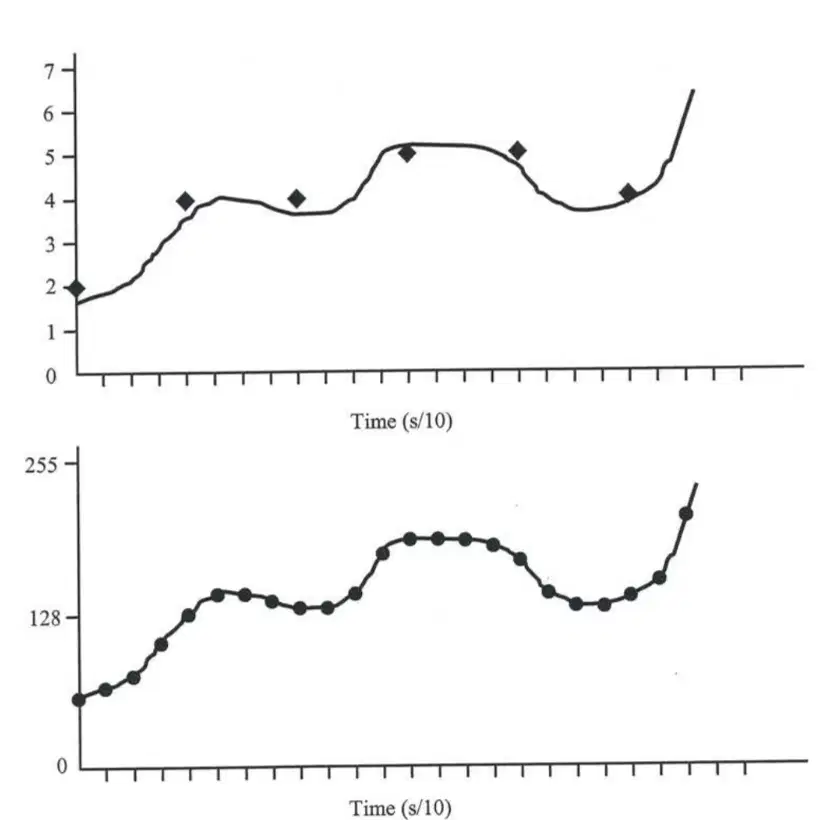
What do the graphs compare?
Digital vs analogue signal
How different computers digitise signal
Different sample rates when converting analogue to digital signal
Signal transmission using microwaves vs radiowaves
Which of the following is NOT a benefit of digital signal transmission?
Signals can be boosted or regenerated along their transmission path
The final product will look/sound more organic and natural
Signal can be stored and further processed
It is cheaper to send
Why can't radiowaves pass effectively through the ground?
They are absorbed by good conductors such as metals
They are absorbed by poor conductors such as sand
They are reflected by the ground
They are too weak to penetrate the ground
What is the purpose of sending radio signals to the ionosphere?
To increase the signal strength
To reduce the signal frequency
To reflect the signals back to earth
To absorb the signals
What is the maximum frequency used to send radio signals to other places on earth?
30MHz
1 GHz
3MHz
30GHz
What is NOT a reason why FM is preffered to AM?
It travels further distances
It requires less power to transmit
It is less susceptible to noise
It is cheaper to transmit
What is the main purpose of modulating carrier waves with signal waves?
To increase the amplitude of the carrier wave
To allow the signal to travel long distances
To decrease the frequency of the carrier wave
To eliminate noise from the signal
How does an AM receiver decode the original signal wave?
By manipulating the frequency of the carrier wave
By rectifying the carrier wave and interpolating the signal
By increasing the amplitude of the signal wave
By removing noise from the carrier wave
What is a main disadvantage of using AM signals?
They cannot travel long distances
They can be degraded by noise such as electrical interference or storms
They have a very high amplitude
They cannot be modulated
In Frequency Modulation (FM), what is converted into frequency changes in the carrier wave?
Amplitude changes in the signal wave
Frequency changes in the signal wave
Noise in the signal wave
Amplitude changes in the carrier wave
In FM, what does an increase in frequency indicate about the amplitude?
The amplitude is lower
The amplitude is higher
The amplitude remains the same
The amplitude is zero
Which component in a simple crystal radio receiver is used to allow the fixed coil to recieve multiple frequencies?
Antenna
Diode
Variable Capacitor
Earphones
What is the role of the diode in a simple crystal radio receiver?
To pick up the modulated radio wave
To resonate at the chosen frequency
To rectify and demodulate the signal
To make the fixed coil variable
What does the antenna in a simple crystal radio receiver do?
It tunes the radio to a desired frequency
It receives up the modulated radio wave
It demodulates the signal
It resonates at the chosen frequency
What is the "fluctuation envelope" in the context of a simple crystal radio receiver?
A. The modulated signal that is a sine wave
B. The signal wave that was modulated onto the carrier wave
C. The fixed coil that resonates at a set frequency
D. The variable capacitor used to tune the circuit
What happens to the modulated signal after the diode cuts off the negative half?
A. It becomes a sine wave
B. It leaves behind a fluctuating half wave rectified signal
C. It resonates at the chosen frequency
D. It is picked up by the antenna
What component in the AM radio circuit is responsible for selecting the desired frequency?
Antenna
Coil and Capacitor
Signal diode
Headphones
In the AM radio circuit, what is the function of the signal diode?
A. To amplify the signal
B. To select the desired frequency
C. To demodulate the signal
D. To filter out noise
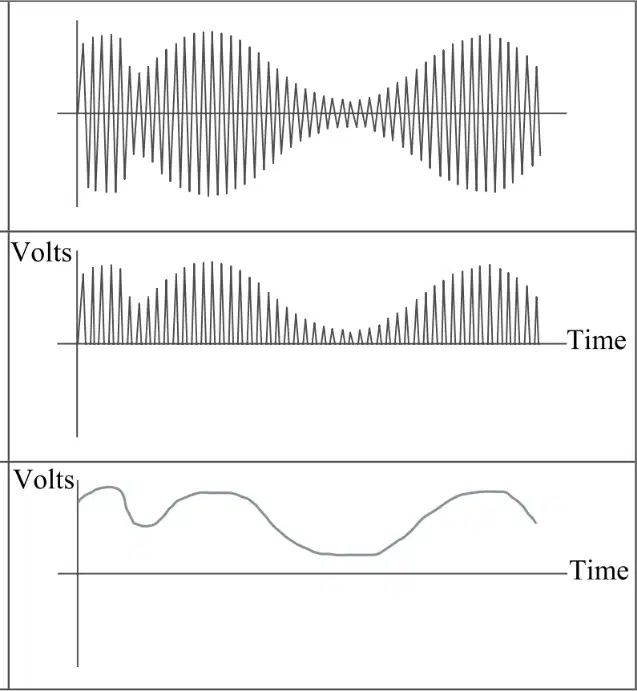
What do the waveforms in the second diagram represent in the context of AM radio?
The original audio signal
The modulated carrier signal
The demodulated audio signal
The modulated carrier signal after rectification
Which of the following statements is true about higher frequencies in Wi-Fi? (e.g. 5GHz vs 2.4GHz)
Higher frequencies have lower bandwidth and lower attenuation.
Higher frequencies have higher bandwidth and higher attenuation.
Higher frequencies have lower bandwidth and higher attenuation.
Higher frequencies have higher bandwidth and lower attenuation.
What are the common frequencies for Wi-Fi?
2.4GHz and 5GHz
2.6GHz and 5GHz
3.4GHz and 5GHz
2.4GHz and 3.4GHz
Which common household Wi-Fi frequency can send more data quickly but has higher attenuation?
2.4GHz
2.6GHz
3.4GHz
5GHz
Which frequency range is used for terrestrial TV?
A) 700 MHz
B) 2.4 GHz
C) 5 GHz
D) 26 GHz
Which element has 3 electrons and is used to create a p-type semiconductor?
Silicon
Boron
Phosphorus
Germanium
Which of the following is NOT a characteristic of LEDs (light emitting diodes)?
Cheap and energy efficient
Commonly used as an "on/off" indicator
Regulate spikes in voltage
Generate light
What is the primary function of Zener Diodes?
Generate light
Allow current to flow in one direction only
Regulate spikes in voltage into stable reference voltage
Act as an "on/off" indicator
Which of the following is a type of transistor?
LED
Zener Diode
NPN Junction
Capacitor
Which of the following is NOT a semiconductor device?
Diode
Transistor
Capacitor
LED
What happens to your voice when you sing into a microphone and it is stored in a computer?
It is turned into analogue
It is sampled and quantised
It is lost in transmission
It is amplified and enhanced
What is NOT an advantage of digital signals over analogue?
Error detection and correction
The signal can be multiplexed
End to end encryption
Highest possible quality signal
What did early mobile phones rely on for operation?
A shared public frequency
A fixed frequency per user
Satellite signals
Internet connection
What is commonly used in personal mobile devices to secure information?
Two factor authentication
Cloud storage
Data compression
Blockchain
What does high resistance indicate?
Good conductor
High capacitance
Good insulator
Poor insulator
Which material is a good conductor due to its low resistance?
Polymers
Wood
Aluminium
Rubber
What can multimeters test for?
Voltage only
Capacitance and transistor gain
Power
Phase angle
Which device can be used to visualise the waveform of an electrical signal
Voltmeter
Ammeter
Cathode ray oscilloscope
Ohmmeter
What is the main characteristic of a single mode fibre optic cable?
Light travels through multiple directions
It is inexpensive to produce
It has the highest bandwidth and lowest light losses
It has a wide core made of plastic
What is a disadvantage of single mode fibre optic cables?
They have high light losses
They are expensive to produce
They have low bandwidth
They are made of plastic
What type of orbit is located above the equator or "tropics"?
Medium Earth Orbit
Polar Orbit
Geosynchronous/Geostationary
Low Earth Orbit
Why are polar orbits good for photography and mapping?
They are close to the earth and can capture high quality images
The natural rotation of the earth exposes most of the earths surface to the orbit
They are always looking at parts of the earth exposed to sunlight
They require minimal steering/course correction
What common use of Medium Earth Orbits?
GPS & Navigation
TV signals
Military applications
High speed internet
Why are silicon and germanium compounds commonly used as semiconductors?
They have 2 electrons in their outer shell
They have 4 electrons in their outer shell
They have 6 electrons in their outer shell
They have 8 electrons in their outer shell
What property of polymers makes them ideal for use in various telecommunications applications?
High electrical conductivity
High thermal conductivity
Shock resistance
High density
What manufacturing process allows polymers to be easily mass-produced?
Extrusion
Injection moulding
Blow moulding
Compression moulding

