
 Worksheets
Unit 1 Test
Total questions: 34
Worksheet time: 37mins
What does SI stand for in SI System?
Systeme International
Science Interim
Super Independent
Supreme Iodine
How did the SI System spread through Europe?
The British took it everywhere they colonized
Baguette Trade
Napoleon's Empire
It was random with no way to track
Match the SI Unit to what it measures:
Gram
Mass
Meter
Length
Liter
Volume
What is another name for the SI System
English System
Imperial System
System of a Down
Metric System
Why is the SI system used in science?
Because the other units are for non-science measurements
Because the SI System is used internationally so data can be shared more easily
Because reasons
Because they are European measurements
Match the object to it's approximate measurement
Water bottle
1 Liter
Penny
1 gram
Golf Club
1 meter
Door
2 meters
Phone
200 grams
Select the target that best shows precision without accuracy.
Select the target that best shows accuracy without precision
Select the target that best shows neither accuracy or precision.
Select the target that best shows both accuracy and precision
(a) is how close a measurement is to the true value, and (b) is the ability to replicate the measurement.
The actual mass of an object is 10 grams. A student uses a scale and records the mass as 10.01 grams. They try again and get masses of 10.00 and 10.00 grams. The scale is....
Neither accurate nor precise
Precise but not accurate
Accurate but not precise
Both precise and accurate
Which piece of equipment is the most accurate?
Beaker
Erlenmeyer Flask
Graduated Cylinder
Pipette
Order the steps in reading a measurement from a graduated cylinder.
Determine the scale of the graduated cylinder (what each line reading is)
Get eye level with the meniscus
Read from the bottom of the meniscus
Add an estimated digit to your measurement

What is the most accurate reading on this graduated cylinder?
54.3 mL
52.8 mL
52 mL
54 mL
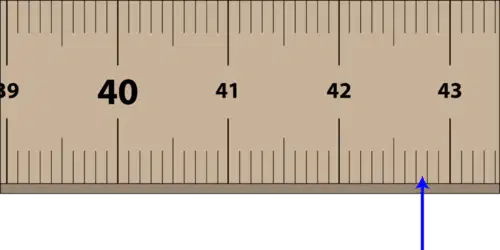
What is the most accurate reading on this meter stick? (Where the arrow is pointing)
42 cm
42.7 cm
42.75 cm
42.8 cm
Organize these options into the right categories
1.35
12,000,000
1.8 x 10⁶
3 x 10⁻⁹
0.6 x 10⁻⁹
322 x103
Which of the following are true about the FIRST factor of a number in scientific notation?
It is a number between 1 and 100
It is a number between 1 and 10
It needs to have a decimal
It may or may not have a decimal
What does the second factor of a number in scientific notation tell you?
How many places to move the decimal
Which direction to move the decimal
Whether the number is positive or negative
Whether the number is even or odd
When a number is written in scientific notation, if the exponent is positive the number is (a) , and if the exponent is negative the number is (b) .
Write the number 3,500,000 in scientific notation:
(a) x (b)
106
Write the number 0.000000742 in scientific notation
(a) x (b)
10−7
Organize how to solve a scientific notation calculation into each category of calculation
Add exponents
Multiply first terms
Divide first terms
Subtract exponents
Leave exponent alone
Adjust 1 term to make the same exponent
Complete the following calculation:
(3 x 10³) (5 x 10⁶)
Be sure your answer is in correct scientific notation
1.5 x 10⁹
15 x 109
1.5 x 10¹⁸
1.5 x 10¹⁰
Complete the following calculation:
(4 x 10⁵) + (5 x 10⁶)
Be sure your answer is in correct scientific notation
9 x 10¹¹
5.4 x 10⁶
5.4 x 10⁵
4.5 x 10⁶
Complete the following calculation:
(9 x 10⁵) / (3 x 10⁻⁵)
Be sure your answer is in correct scientific notation
3 x 10¹⁰
3 x 100
3 x 101
3 x 10⁻¹
If you were to solve the following, you would need to adjust one of the terms:
(1.2 x 10³) - (6 x 10²)
If you were to adjust the FIRST term, what would you do?
Increase 1.2 to 12 and Increase 3 to 4
Decrease 1.2 to 0.12 and Increase 3 to 4
Increase 1.2 to 12 and Decrease 3 to 2
Decrease 1.2 to 0.12 and Decrease 3 to 2
Set up the dimensional analysis to calculate how many days are in 34,500 minutes.
In any dimensional analysis problem, where would you expect to find the unit you are solving for?
Calculate how many seconds are in the school day (8:30 - 3:30).
12000 seconds
25200 seconds
35000 seconds
420 seconds
When setting up a conversion factor for a dimensional analysis problem, the unit you want to convert to goes on the (a) and the unit you are converting from goes on the (b) .
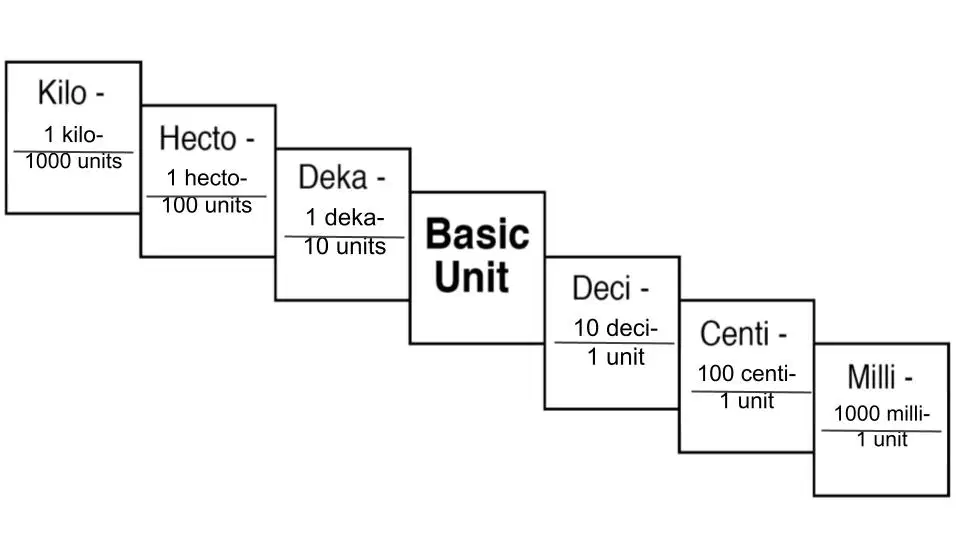
Using the conversion chart, convert 0.45 kilograms to decigrams.
450,000 dg
0.000045 dg
45 dg
4,500 dg
Using the conversion chart, convert 4000 milliliters to liters.
40 L
0.4 L
4 L
1000 L
Using the conversion chart, convert 1.6 x 10¹⁰ millimeters to kilometers
1.6 x 10⁴ km
2.7 x 10³ km
2.7 x 10⁹ km
1.6 x 10³ km

