
 Worksheets
Unit 2: Matter and Energy
Total questions: 35
Worksheet time: 1hrs 19mins
Name
Class
Date
1.
When things are hot molecules are moving...
a)
Fast
b)
Slow
c)
They are not moving
d)
They are moving by not fast or slow
2.
When things are cold molecules are moving...
a)
Fast
b)
Slow
c)
They are not moving
d)
They are moving by not fast or slow
3.
Heat and Temperature are the same thing
a)
True
b)
False
4.
Heat passes from...
a)
High to low
b)
Cold to hot
c)
Hot to cold
d)
Heat cannot be passed
5.

Diagram above shows the heating curve of naphthalene. Why the temperature remains constant along BC and DE?
a)
Heat energy is used to increase the kinetic energy of molecules.
b)
Heat energy is used to break the inter molecular forces between molecules.
c)
Heat energy is lost to surrounding.
d)
Heat energy is used to build up the inter molecular forces between molecules.
6.
Which material would NOT make a good baking pan (for high temperatures in the oven)?
a)
aluminum
b)
plastic
c)
steel
d)
glass
7.
A 15.75-g piece of iron absorbs 1086.75 joules of heat energy, and its temperature changes from 25°C to 175°C. Calculate the specific heat capacity of iron.
a)
0.46 J/gxoC
b)
1.654 J/gxoC
c)
2,567,446.875 J/gxoC
8.
How many joules of heat are needed to raise the temperature of 10.0 g of aluminum from 22°C to 55°C, if the specific heat of aluminum is 0.90 J/gx°C?
a)
297 Joules
b)
0.003 Joules
c)
297 J/gx°C
d)
0.003 J/gx°C
9.
When a piece of aluminum foil is taken out of the oven and cools from 100° to 50°, What is the change in temperature?
a)
50°
b)
0°
c)
100°
d)
150°
10.
The symbol for specific heat is .......
a)
c
b)
Q
c)
m
d)
t
11.
Specific heat is....
a)
The measure of kinetic energy of an objects particles
b)
A measure of the energy needed to increase the average kinetic energy of the particles
c)
The heating caused by the motion of flluid due to temperature difference
d)
The transfer of energy by electromagnetic radiation
12.
A high specific heat means...
a)
It heats up quickly with energy added
b)
It requires more energy to change temperature
13.
For a skillet, used for cooking, do you want a high or low specific heat
a)
High, so that it will need more energy to heat up
b)
Low, so that it will change temperature quickly
14.
Using the heat equation, what would the formula look like if we were solving for change in temperature?
a)
Q m = ∆T Cp
b)
Q / (m Cp) = ∆T
c)
Q m / Cp = ∆T
d)
m c Q = ∆T
15.
If I heat up 2 pans of water one has 100 mL in it and one has 1000mL. Which one heats up the fastest?
a)
100 mL
b)
1000 mL
c)
They both heat up at the same speed
d)
They cool down.
16.
Calculate the heat absorbed by 105.0 grams of water when it is heated to cook spaghetti. The initial temperature of the water is 20.0°C, and the final temperature of the water is 99.0°C. The specific heat of water is 4.18 J/g•°C.
a)
8778 J/g°C
b)
0.0005 J/g°C
c)
34673 J/g°C
d)
43451.1 J/g°C
17.
The temperature of an unknown piece of metal with a mass of 30.00 g changes from 25.0 °C to 35.0 °C when the metal absorbs 350.0 J of energy. What is the specific heat of the metal?
a)
1.17 J/g°C
b)
-1.17 J/g°C
c)
0.857 J/g°C
d)
-0.857 J/g°C
18.

What state of matter is X?
a)
solid
b)
liquid
c)
gas
d)
supercritical fluid
19.
What state of matter is Y?
a)
solid
b)
liquid
c)
gas
d)
supercritical fluid
20.
What state of matter is Z?
a)
solid
b)
liquid
c)
gas
d)
supercritical fluid
21.
What is point A?
a)
triple point
b)
critical point
c)
equilibrium point
d)
normal melting point
22.
What is point B?
a)
triple point
b)
critical point
c)
equilibrium point
d)
normal melting point
23.
What change occurs from F to E?
a)
sublimation
b)
deposition
c)
melting
d)
condensation
24.
What change occurs from E to C?
a)
sublimation
b)
freezing
c)
melting
d)
boiling
25.
What change occurs from C to D?
a)
condensation
b)
vaporization
c)
melting
d)
sublimation
26.

What is true regarding CO2 for temperatures above 31 °C?
a)
It can never be liquified.
b)
It decomposes.
c)
It has a high pressure.
d)
It is a plasma.
27.
What is the normal boiling point of this substance?
a)
150 °C
b)
100 °C
c)
-50 °C
d)
0 °C
28.
What is the normal melting point of this substance?
a)
150 °C
b)
100 °C
c)
-50 °C
d)
0 °C
29.
Above the temperature and pressure of point B, this substance exists as a ____________.
a)
solid
b)
liquid
c)
gas
d)
supercritical fluid
30.
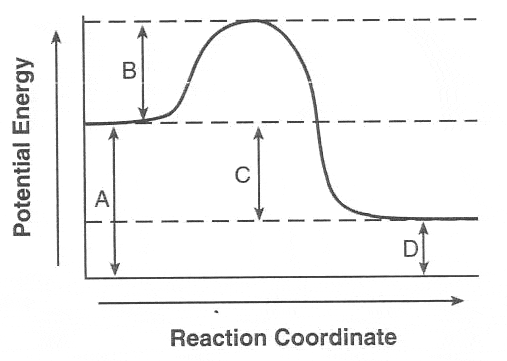
What type of reaction is this?
a)
Endothermic
b)
Exothermic
31.
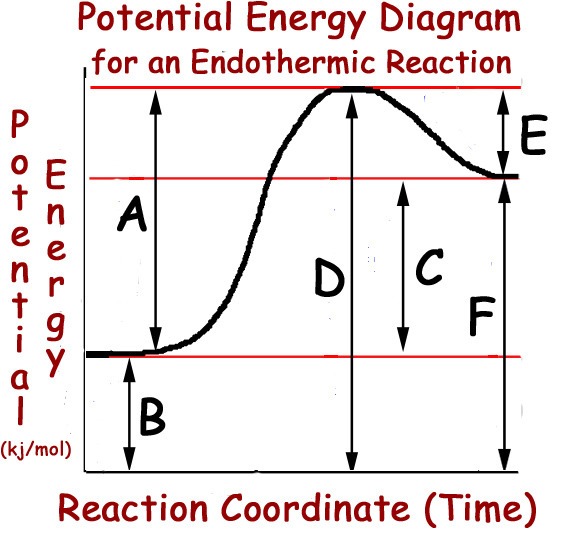
What letter represents the activation energy?
a)
A
b)
B
c)
C
d)
D
32.
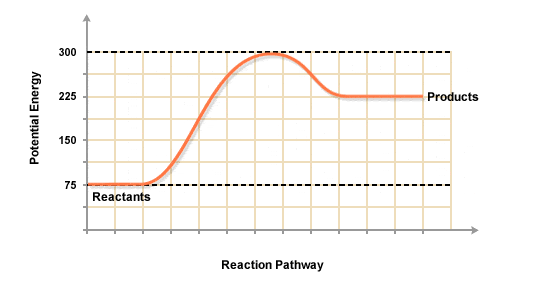
What is the energy of the transition state?
a)
75 kJ
b)
225 kJ
c)
300 kJ
d)
225 kJ
33.
A substance that increases speed of chemical reaction without being being changed is called:
a)
Catalyst
b)
Acid
c)
Base
d)
pressure
34.
Activation energy is required to start a chemical reaction. What is activation energy?
a)
The energy needed for a reaction to occur
b)
The minimum amount of energy needed for a reaction to potentially occur
c)
The energy added by a catalyst
d)
The energy possessed by the products
35.
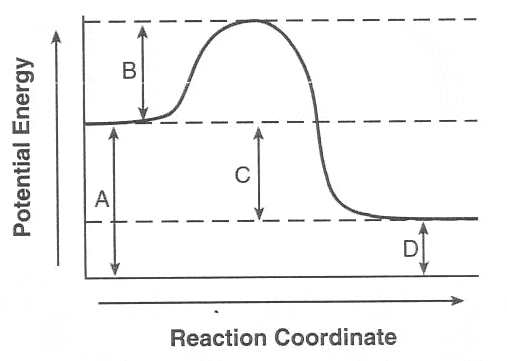
What letter represents the energy of the products?
a)
A
b)
B
c)
C
d)
D
100 %

