wayground logo

Free Printable Worksheets

Font size

S
M
L
XL
Worksheets

Volcano Quiz

Total questions: 34

Worksheet time: 34mins

Name
Class
Date
1.

What is the term for molten rock that reaches the surface of a volcano?

a)

Magma

b)

Lava

c)

Ash

d)

Crust

2.

Where are volcanoes most commonly found?

a)

At plate boundaries

b)

In the middle of tectonic plates

c)

Under the ocean

d)

In deserts

3.

What is magma that reaches the surface called?

a)

Ash

b)

Lava

c)

Steam

d)

Gas

4.

What happens when rock from the mantle melts and moves to the surface through the crust?

a)

Earthquakes occur

b)

Tsunamis form

c)

Volcanoes erupt

d)

Hurricanes develop

5.

Which type of volcano is known for slow, gentle eruptions and is the largest in size?

a)

Cinder Cone

b)

Stratovolcano

c)

Shield

d)

Composite Cone

6.

What is the simplest type of volcano?

a)

Shield

b)

Stratovolcano

c)

Cinder Cone

d)

Composite Cone

7.

What is the term for the outermost layer of the Earth through which magma moves to the surface?

a)

Mantle

b)

Core

c)

Crust

d)

Lithosphere

8.

Which layer of the Earth is directly below the crust?

a)

Core

b)

Mantle

c)

Outer Core

d)

Inner Core

9.

Which type of volcano is formed from the accumulation of volcanic debris?

a)

Shield Volcano

b)

Stratovolcano

c)

Cinder Cone

d)

Fissure

10.

What is the term for the molten rock beneath the Earth's surface?

a)

Lava

b)

Magma

c)

Ash

d)

Crust

11.

These volcanoes do not erupt explosively. They ooze lava that spreads over a wide area. The layers and layers of lava build up to form wide, gentle slopes.

a)

cinder cone

b)

caldera

c)

composite

d)

shield

12.

True or False: Only some volcanoes are active.

a)

True

b)

False

13.

When molten rock is below Earth's surface it is called ________.

a)

lava

b)

magma

c)

ash

d)

sediment

14.

What is a volcano?

a)

A type of mountain that can erupt

b)

A large body of water

c)

A type of tree

d)

A kind of animal

15.

Which type of volcanic eruption is the most explosive?

a)

Effusive eruption

b)

Strombolian eruption

c)

Vulcanian eruption

d)

Plinian eruption

16.

What is the name of the bowl-shaped area at the top of a volcano?

a)

Crater

b)

Valley

c)

Canyon

d)

Plateau

17.

​ (a)   is a fast moving avalanche of hot gas, ash, and rock that erupts from an explosive volcano.

Choose from the below words
Pyroclastic flow
ash fall
cinder cone
lahar
18.
What is the definition of dormant?
a)
sleeping
b)
extinct
c)
active
d)
invisible
19.
What are scientists that study volcanoes called?
a)
doctor
b)
vet
c)
volcanologist
d)
volcano scientist
20.
What is the opening that extends from the magma chamber to the top of the volcano called?
a)
magma
b)
lava
c)
vent 
d)
crater
21.
A volcano that has gentle sloping sides and is formed from runny lava
a)
Shield volcano
b)
Cinder cone
c)
Composite
d)
None of these
22.
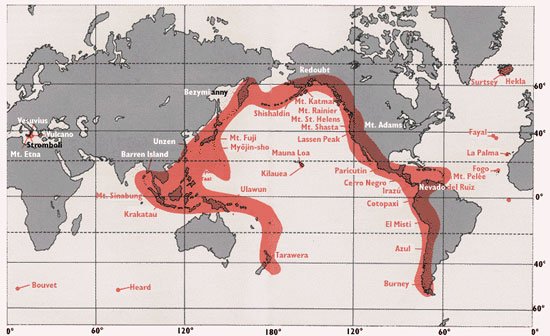
This is the name for the chain of volcanos around the edge of the Pacific Plate.
a)
Circle of Fire
b)
Ring of Lava
c)
Ring of Fire
d)
Circle of Magma
23.
This city was destroyed in 79 A.D. by the eruption of Mt. Vesuvius.
a)
Rome
b)
Munich
c)
Pompeii
d)
Naples
24.
What is molten rock that has formed deep within the Earth?
a)
Hot Spot
b)
Magma
c)
Lava
d)
Volcano
25.
The volcanoes on the Hawaiian Islands form due to which of the following?
a)
Divergent Boundary
b)
Hot Spot
c)
Subduction Boundary
d)
Transform Boundary
26.
Vocanoes are found...
a)
on land
b)
under water
c)
on islands
d)
all of the above
27.
What is molten rock that has formed deep within the Earth?
a)
Hot Spot
b)
Magma
c)
Lava
d)
Volcano
28.
Vocanoes are found...
a)
on land
b)
under water
c)
on islands
d)
all of the above
29.
Where are most volcanoes found?
a)
Southern Hemisphere
b)
Ring of Fire
c)
Mid-Atlantic Ridge
d)
Hot Spots
30.
What is the definition of dormant?
a)
sleeping
b)
extinct
c)
active
d)
invisible
31.
Where do volcanoes come from?
a)
Places where plates move apart
b)
Places where plates are moving together
c)
Hot Spots
d)
All of these options
32.
An opening through which the lava flows is called:
a)
crater
b)
caldera
c)
vent
d)
pipe
33.

Which theory helped scientists understand how and where volcanoes erupt?

a)

Theory of Plate Tectonics

b)

Theory or Relativity

c)

Theory of the Rock Cycle

d)

Big Bang Theory

34.
A live volcano
a)
Dormant volcano
b)
Active volcano
c)
Extinct volcano
d)
Shield volcano