

wayground logo

Free Printable Worksheets

Font size

S
M
L
XL
Worksheets

Introduction to Science Test

Total questions: 30

Worksheet time: 15mins
Name
Class
Date
1.
An observation is:
a)
using one or more of your senses to gather information.
b)
a testable guess.
c)
a prediction about the future.
d)
an interpretation based on observations and prior knowledge.
2.
An inference is:
a)
using one or more of your senses to gather information.
b)
a testable guess.
c)
a prediction about the future.
d)
an interpretation based on observations and prior knowledge.
3.
Observations can be divided into two types:
a)
Quantitative & Qualitative
b)
Independent & Dependent
c)
Constants & Controls
d)
Positive & Negative
4.
True or False? A quantitative observation deals with characteristics and cannot be expressed in numbers. Examples include color, shape, size, and texture.
a)
True
b)
False
5.
Inferences are always correct.
a)
True
b)
False
6.
A prediction is a forecast of what will happen in the future, based on
a)
what you want to see happen.
b)
what your friends say will happen.
c)
what the weatherman says will happen.
d)
past experience or evidence.
7.
A series of steps that scientists use to solve a problem is called:
a)
Hypothesis Inquiry
b)
Control Test
c)
Variable Process
d)
Scientific Method
8.
What is the first step of the scientific method?
a)
Develop a conclusion
b)
Form a hypothesis
c)
Ask a question
d)
Analyze the data
9.
When a scientist tests a hypothesis, they are performing a(n):
a)
observation
b)
experiment.
c)
conclusion.
d)
theory.
10.
Which step of the scientific method involves using graphs and charts to visualize data?
a)
Make an observation
b)
Analyze results
c)
Ask a question
d)
Communicate results with a report
11.
Scientists determine if the hypothesis is right or wrong when they
a)
research the question.
b)
collect the data.
c)
analyze the data.
d)
develop a conclusion.
12.
If your results do not support your hypothesis, what should you do?
a)
Ignore the results
b)
Change your data
c)
Revise the hypothesis & redesign your experiment
d)
End the experiment
13.
The factor in an experiment that is changed on purpose is the
a)
Independent variable
b)
Dependent variable
c)
Hypothesis
d)
Controlled variable
14.
The factor in an experiment that is measured or observed is the
a)
Independent variable
b)
Dependent variable
c)
Hypothesis
d)
Controlled variable
15.
What is the controlled variable in an experiment?
a)
The factor that is changed
b)
The factor being measured
c)
A factor kept the same
d)
A guess
16.
You are monitoring yourself to see how fast you can run the mile in PE. Each day that you run the mile, you record your time. You want to have a visual of your hard earned progress! Which kind of graph should you use to show your change in speed over time?
a)
pie chart
b)
bar graph
c)
line graph
d)
data table
17.
When you are checking to make sure you have all parts of your graph completed correctly, the "T" in TAILS reminds you to check your
a)
thermometer
b)
title
c)
think
d)
teacher
18.
Check ALL of the correct statements about graphing the INDEPENDENT Variable.
a)
Located on the Y-axis of a graph.
b)
Located on the X-axis of a graph.
c)
The factor changed/tested by the scientist.
d)
The data collected during the experiment.
19.
Check ALL of the correct statements about graphing the DEPENDENT Variable.
a)
Located on the Y-axis of a graph.
b)
Located on the X-axis of a graph.
c)
The factor changed/tested by the scientist.
d)
The data collected during the experiment.
20.
Which statement is true about the interval on a graph?
a)
Intervals are the numbers written on the Y-axis of a graph.
b)
The interval is decided by your scale (the largest data value).
c)
All of the above
d)
None of the above
21.
What must the interval always begin with on the Y-axis?
a)
With 1
b)
With the largest data point
c)
With 0
d)
With the average value
22.
True or False? The scale of a graph is determined by your range of data (minimum to maximum values).
a)
True
b)
False
23.
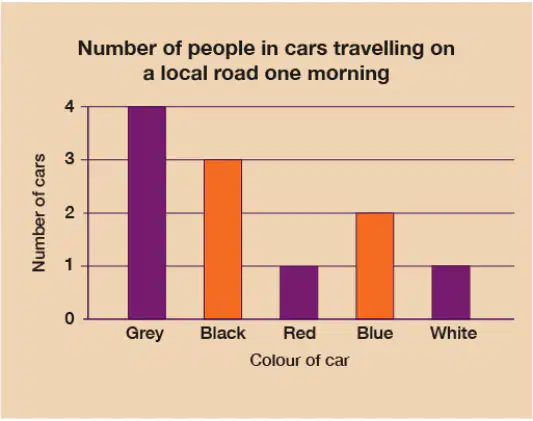
According to the bar graph, how many TOTAL cars drove on the local road that morning?
a)
9
b)
11
c)
15
d)
8
24.

What type of statement is "The grass is green."

a)

Quantitative

b)

Qualitative

c)

Inference

d)

Hypothesis

25.

What type of statement is "It is going to snow."

a)

Quantitative

b)

Qualitative

c)

Inference

d)

Hypothesis

26.

What type of statement is "The pillow is soft."

a)

Quantitative

b)

Qualitative

c)

Inference

d)

Hypothesis

27.

What type of statement is "The length of the ruler is 30cm."

a)

Quantitative

b)

Qualitative

c)

Inference

d)

Hypothesis

28.

What is the dependent variable for the scientific question, "How does the type of surface affect the distance a toy car rolls?"

a)

Type of surface (tile, carpet, wood)

b)

Distance the toy car rolls

c)

Toy car

29.

What is the independent variable for the scientific question, "How does the type of surface affect the distance a toy car rolls?"

a)

Type of surface (tile, carpet, wood)

b)

Distance the toy car rolls

c)

Toy car

30.

What is the controlled variable for the scientific question, "How does the type of surface affect the distance a toy car rolls?"

a)

Type of surface (tile, carpet, wood)

b)

Distance the toy car rolls

c)

Toy car
