wayground logo

Free Printable Worksheets

Font size

S
M
L
XL
Worksheets

Reconstruction Test Review

Total questions: 27

Worksheet time: 14mins

Name
Class
Date
1.

What was Abraham Lincoln's main goal for Reconstruction?

a)
To punish the Southern states for the Civil War.
b)
To establish a military dictatorship in the South.
c)
To promote industrialization in the South.
d)

To reunite the nation as fast and easily as possible

2.
1. Which would be the best meaning of the word RECONSTRUCTION?
a)
Withdrawal
b)
Majority vote
c)
Re-acquire
d)
Rebuild
3.
4. What was a common goal of the 13th, 14th, and 15th amendments to the United States Constitution?
a)
punishing the South for seceding from the Union
b)
allowing the states to veto federal laws
c)
granting basic rights to formerly enslaved persons
d)
creating a “separate but equal” society
4.
6. Racial segregation in the South after the Civil War was based on the belief that
a)
each culture had contributed equally to American society.
b)
some racial groups are superior to others.
c)
people should be treated equally regardless of race.
d)
freedmen required special assistance.
5.

Which amendment to the U.S. Constitution was primarily responsible for granting citizenship and ensuring due process to all persons born or naturalized in the United States?

a)

13th Amendment

b)

14th Amendment

c)

15th Amendment

d)

Civil Rights Act

6.

After the Civil War, what was the main purpose of the black codes enacted by Southern states?

a)

To encourage African Americans to migrate north.

b)

To restrict the rights and movements of freedmen.

c)

To provide land to former slaves.

d)

To promote racial equality in the South.

7.
9. Which change occurred in Southern agriculture in the years following the Civil War?
a)
Many formerly enslaved persons became sharecroppers.
b)
Subsistence farming became illegal.
c)
Cotton production ended.
d)
Most small farms were joined into large plantations.
8.

Which organization was established to assist newly freed African Americans after the Civil War?

a)

Black Codes

b)

Freedmen's Bureau

c)

Sharecroppers

d)

Radical Republicans

9.
11. Impeach mean to
a)
Convict
b)
Throw out of office
c)
Be put on trial for violating the Constitution.
d)
Imprison
10.

Which constitutional amendment officially ended slavery in the United States?

a)

The Emancipation Proclamation

b)

13th Amendment

c)

14th Amendment

d)

15th Amendment

11.
15. After the Civil War, freedmen in the South had difficulty improving their economic condition because
a)
migration of factory workers from Northern cities had created competition for jobs
b)
the federal government confiscated their 40-acre grants
c)
the system of sharecropping kept them in a cycle of poverty
d)
plantation owners hired cheap immigrant laborers
12.

In the late 1800s, Southern states enacted grandfather clauses primarily to

a)

increase voter turnout among all citizens.

b)

ensure equal voting rights for women.

c)

restrict African Americans from voting.

d)

promote literacy among immigrants.

13.
17. The Grandfather Clause was passed as a way for which of the following groups to avoid the literacy tests?
a)
Freedmen
b)
Poor White Southerners
c)
African-American women
d)
Native Americans.
14.
19. During Reconstruction, white southerners regained control of Southern state governments by
a)
ending the Black Codes.
b)
limiting voting rights for freedmen.
c)
forcing freedmen to move North.
d)
limiting sharecropping to whites only.
15.
20. Which of the following gives citizenship to anyone born in the United States?
a)
The Civil Rights Act
b)
13th Amendment
c)
14th Amendment
d)
The Reconstruction Act of 1867
16.
21. Which of the following prevented states from denying voting rights based on race?
a)
the 13th Amendment
b)
the 14th Amendment
c)
the 15th Amendment
d)
The Reconstruction Act of 1867
17.
23. Which constitutional right was the central focus in Plessy v. Ferguson (1896)?
a)
freedom of assembly guaranteed by the first amendment
b)
equal protection of the law under the 14th amendment
c)
equal voting rights guaranteed by the 15th amendment
d)
due process of the law in the fifth amendment
18.
24. The opinion expressed by Speaker B are most closely associated with
a)
Abraham Lincoln
b)
Southern Plantation Owners
c)
Radical Republicans
d)
The Freedmen's Bureau
19.
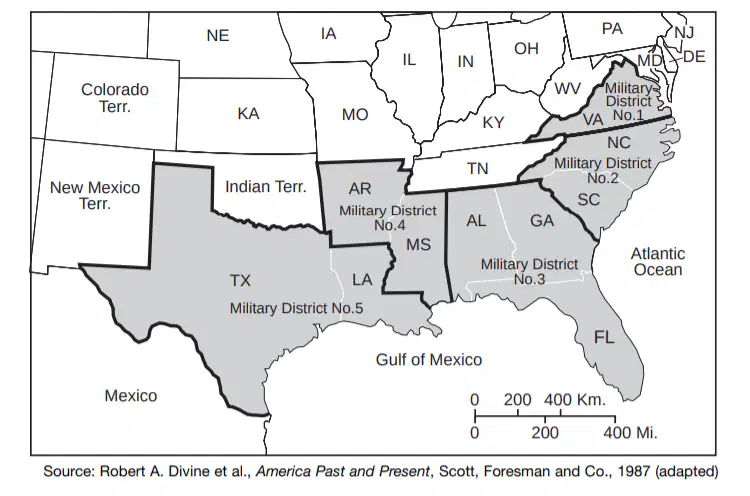
30. The military districts shown on the map were created during Reconstruction to
a)
pay for the physical rebuilding of the South
b)
move Native American Indians to reservations
c)
govern the former Confederate states
d)
enforce voting restrictions and Jim Crow Laws
20.
25. The opinions expressed by Speaker C are most closely associated with:
a)
Abraham Lincoln
b)
A freedman
c)
Radical Republicans
d)
A white Southerner
21.
Which of these amendments gives citizens the right to vote regardless of race, color or previous condition of servitude?
a)
13th Amendment
b)
14th Amendment
c)
15th Amendment
d)
18th Amendment
22.

Which statement should be placed in the box labeled with the number 2?

a)

Ensures all citizens the right to vote regardless of race, color, or previous condition of servitude.

b)

Bans slavery in the United States and all of its territories.

c)

Grants citizenship to all persons born in the United States and guarantees them equal protection under the law.

d)

Guarantees employment to all previous slaves.

23.

Select each Reconstruction Era Amendment.

a)

15th Amendment

b)

13th Amendment

c)

12th Amendment

d)

14th Amendment

24.

Which of the following best describes a key difference between Black Codes and Jim Crow laws?

a)

Black Codes were designed to enforce racial segregation, while Jim Crow laws restricted voting rights.

b)

Both Black Codes and Jim Crow laws were federal laws passed by Congress.

c)

Black Codes were enacted immediately after the Civil War to limit the rights of freedmen, while Jim Crow laws enforced racial segregation in the South after Reconstruction.

d)

Jim Crow laws were created to abolish slavery, while Black Codes promoted equal rights.

25.

How did Jim Crow laws differ from Black Codes in their impact on African Americans in the South?

a)

Both Jim Crow laws and Black Codes were abolished before the end of Reconstruction.

b)

Jim Crow laws were only enforced in Northern states, while Black Codes were used in the South.

c)

Black Codes provided African Americans with land, while Jim Crow laws abolished slavery.

d)

Jim Crow laws focused on maintaining racial segregation in public life, while Black Codes primarily restricted the legal rights and labor of freedmen.

26.

Match each Reconstruction Amendment to its main purpose:


1. 13th Amendment
2. 14th Amendment
3. 15th Amendment

A. Granted citizenship and equal protection
B. Abolished slavery
C. Gave African American men the right to vote

Which is the correct matching?

a)

1-B

2-A

3-C

b)

1-A

2-B

3-C

c)

1-C

2-B

3-A

d)

1-B

2-C

3-A

27.

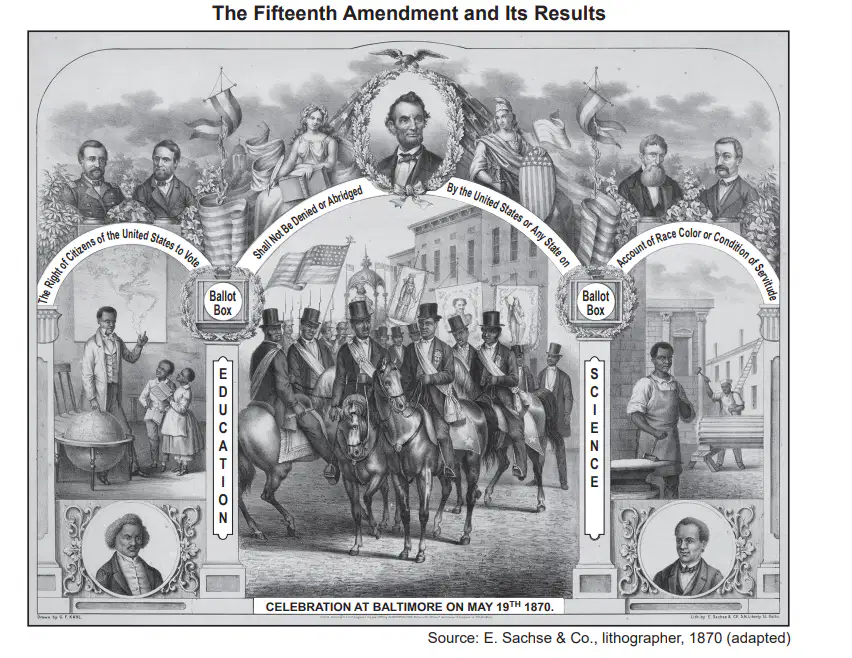
This question was taken off of last year's 11th Grade Regents Exam: Which method was used after Reconstruction to deny African Americans the right illustrated in this poster?

a)

establishment of the Freedmen’s Bureau

b)

decision of the Supreme Court in Brown v. Board of Education

c)

passage of literacy tests and poll taxes

d)

introduction of sharecropping