Font size
 Worksheets
Unit 2 quiz 1
Total questions: 30
Worksheet time: 29mins

The image shows the periodic grid of potassium. How many electrons are found in the potassium atom?
19
20
39
40
What charge does an atom have when it GAINS electrons?
Positive
Negative
Neutral
What subatomic particle changes in an ion?
The number of electrons
The number of protons
The number of neutrons


Where is the proton located?
In the very dense nucleus
Floating around in the negative electron cloud
In the loose nucleus
In the positive electron cloud

Which statement correctly describes an electron in an atom?
Electrons stay inside the nucleus and carry a neutral charge.
Electrons circle the nucleus and have a positive charge.
Electrons move around the nucleus and have a negative charge.
Electrons stay inside the nucleus and have a negative charge.

An iron atom has an atomic mass of 56. Its atomic number is 26. How many neutrons does the iron atom have?
30
26
56
82

What is the picture displayed?
atom
element
compound
What are the building blocks of matter?
Atoms
Protons
Cells
Neutrons
What is a cation?
A chemical compound without ions
An ion with a negative charge
An ion with a positive charge
An atom without an electric charge
What is an anion?
An ion with a negative charge
A chemical compound
An atom without charge
An ion with a positive charge
What is the relationship between valence electrons and the formation of ions?
The formation of ions depends on the number of protons in the nucleus, not on the valence electrons.
Valence electrons have no relationship with the formation of ions.
Valence electrons only affect the electrical conductivity of an atom, not the formation of ions.
Valence electrons determine an atom's ability to form ions.
How many valence electrons does a sodium atom have?
3
1
2
0
Neutrons are
negative
neutral
positive
cows
Electrons are...
negative and in the nucleus
not in an atom
positive and at the edge of the atom
negative and at the edge of the atom
Most of the atom is filled with...
electrons
the nucleus
empty space
protons
Which of the following is not a compound?
HCl
NaCl
Cl
CO2

How many protons are in this element?
47
117
107.87
Carbon dioxide is a compound.
TRUE
FALSE
Hydrogen is a compound.
TRUE
FALSE
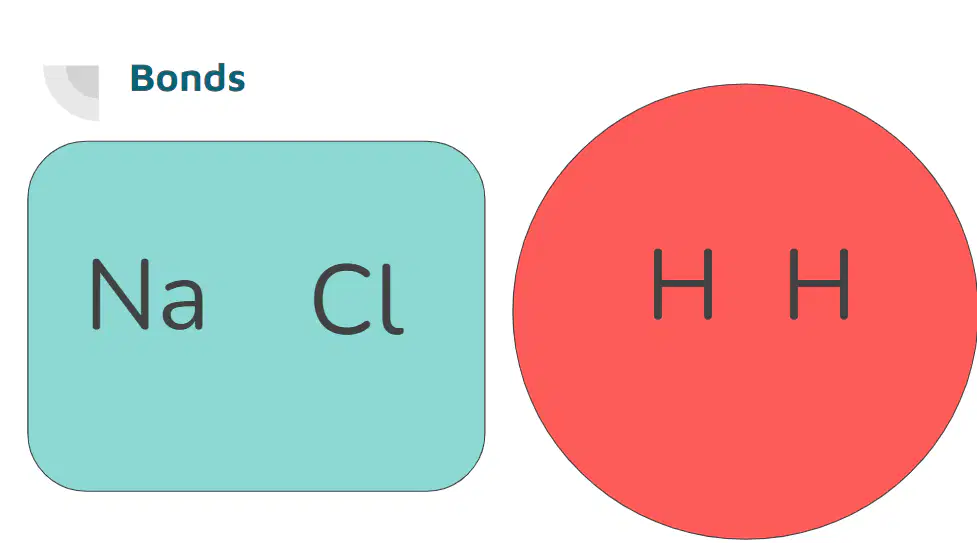
For each of the following, the ionic bond on the left and the covalent bond on the right:
Write the symbols for each element.
Draw a Lewis Dot structure for the valence shell of each element.
Draw an arrow (or more if needed) to show the transfer of electrons to the new element.
Write the charges on the ions.
Write the resulting chemical formula.