
 Worksheets
Unit 2 Foundations of Civilization Review
Total questions: 20
Worksheet time: 10mins
What were the major causes of the development of agriculture from 8,000 BC to 500 BC? Select TWO correct answers.
warmer climates and growth of vegetation
dwindling human population
nomadic hunting and gathering
domestication of plants and animals
clearing of arable land for settlements
Why is Mesopotamia often referred to as the cradle of civilization? Select TWO correct answers.
It is home to one of the earliest locations of hominids.
It is home to one of the earliest industrialized areas.
It is home to one of the earliest complex civilizations.
It is home to the first writing and first technologies.
It is home to one of the earliest desert valleys.
One necessity in and lasting impact of early civilizations was --
the absence of laws
the codification of laws
ways to challenge the laws
the intensification of laws
What general effect did the Neolithic Revolution have on religion? Religion became (a) organized.
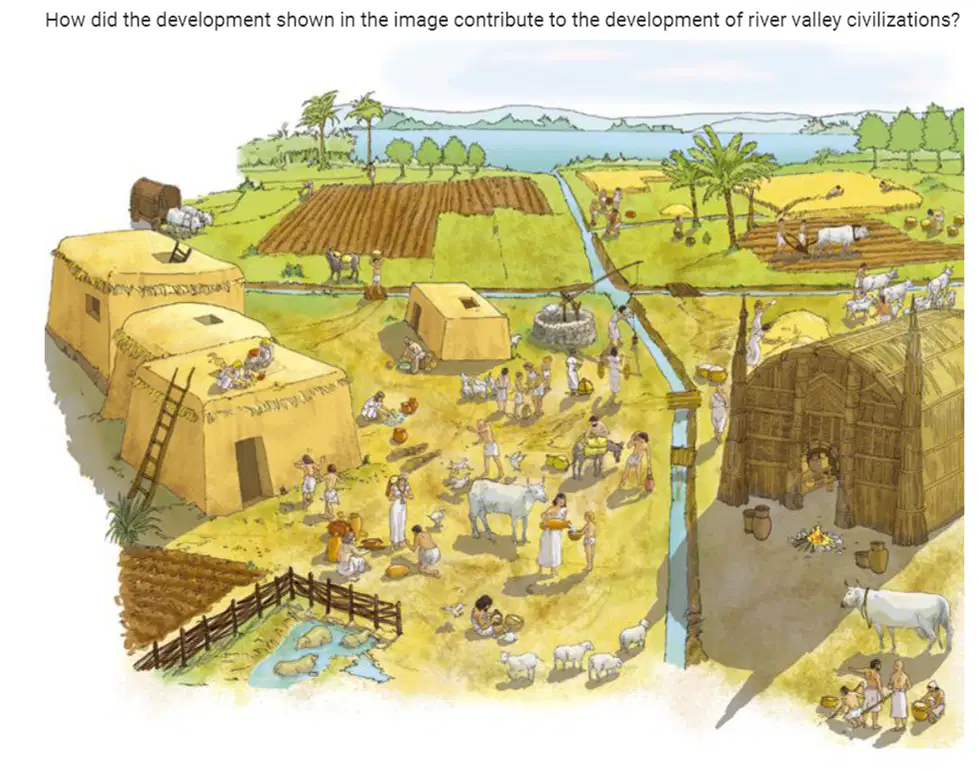
How did the development shown in the image contribute to the development of river valley civilizations?
Ziggurats gave each town a place of worship.
Fortified walls protected the village from attack.
Ships gave farmers a way to transport crops for trade.
Irrigation gave farmers a steady water supply from the river.
Which early development allowed people the ability to keep records and also express themselves creatively?
a writing system
a harvest calendar
a library collection
a government structure
Religion has changed the course of world history. Hinduism is one such religion. Choose the correct answer from each drop-down menu to complete the statements. Hinduism originated in the (a) , which is now present-day Pakistan. There is no known founder of Hinduism. The religion developed gradually over thousands of years from a combination of many different religions and cultural traditions.
What natural barriers protected ancient Egyptians from foreign invasion? Select TWO correct answers.
rivers
mountains
deserts
seas
swamps
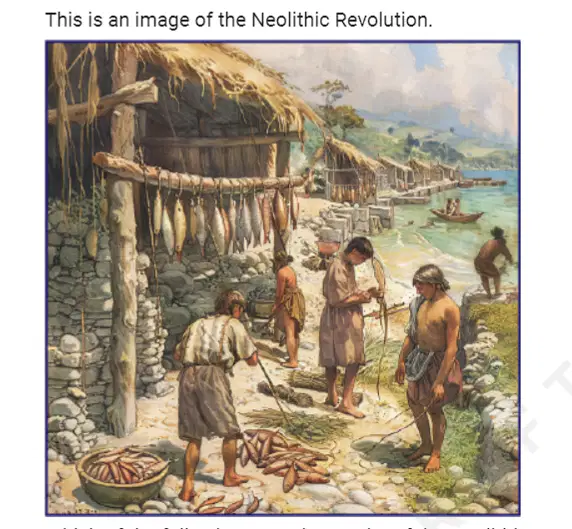
This is an image of the Neolithic Revolution. Which of the following were the results of the Neolithic Revolution? Select TWO correct answers.
Humans specialized in labor and developed as artisans.
Humans became nomadic in search of fresh water.
Humans learned to create bronze and advanced weapons.
Humans hunted wild animals and foraged for food.
Governments emerged to control civilization.
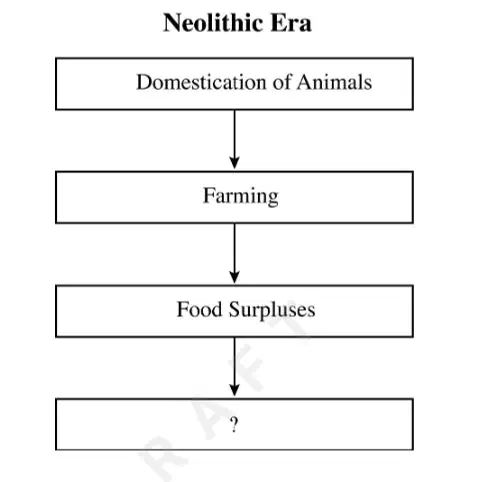
Which of the following correctly completes the chart?
Serfs
Trade
Empires
Religions
Ancient Egypt was a theocracy because—
the pharaoh served as head of the military.
the people considered their ruler to be a god.
the people considered their faith to be monotheistic.
the pharaoh handed down the monarchy to his children.
Which of the following was a characteristic of the Mandate of Heaven in China?
The right to rule depended on the caste system.
The right to rule changed based on the will of the people.
The right to rule depended on continued divine approval.
The right to rule remained within one family dynasty forever.
In early civilizations, how did theocracies primarily differ from monarchies?
In a theocracy, the monarch was viewed as a god.
In a monarchy, the monarch was viewed as a tyrant.
In a theocracy, the monarch was usually a military leader.
In a monarchy, the monarch was usually a project manager.
Which of the following is described above? Developed in Mesopotamia, Made laws objective, Set up a separate judiciary, Influenced later civilizations
Code of Hammurabi
Code of Uruk
Aramic Code
Dead Sea Scrolls
In ancient Mesopotamia, women could do which of the following?
Own private property
File for divorce
Hold public office
Teach for universities
What major ideas in mathematics, science, and technology were developed in the Fertile Crescent? Select TWO correct answers.
Water irrigation system
Mathematical subjects
Coined money
Cuneiform of writing
Pyramid structures
Which of the following BEST describes how the development of farming affected river valley civilizations?
Farming required the damming of rivers.
A surplus of food allowed a division of labor.
State ownership of common lands became popular.
Farming became the only way to make a living.
A government in which religious leaders hold power is—
a theocracy.
a monarchy.
an oligarchy.
an aristocracy.
All of the following are characteristics of civilizations EXCEPT _______.
settlement patterns
social class equality
literacy/written communication
form of government
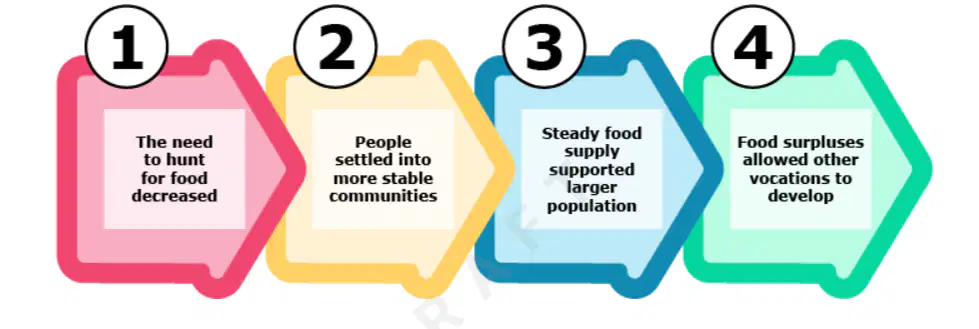
Which of the following is the best title for the graphic organizer?
Complex Institutions in Mesopotamia
Technological Advances in the Fertile Crescent
Influence of Neolithic Revolution on Development of Cities
Influence of Animal Domestication on Development of Agriculture

