
 Worksheets
Week 7 Revision Quiz
Total questions: 136
Worksheet time: 1hrs 1mins
Which culture is the world's oldest continuous civilisation?
Egypt
China
Greece
India
How long ago did people settle in farming villages along China’s Huang River?
2000 years ago
4000 years ago
6000 years ago
8000 years ago
What material gave armies a great advantage over enemies who still used softer, bronze weapons?
Gold
Silver
Iron
Copper
What was the most exciting archaeological find in 1974 by local peasants?
A jade burial suit
A huge buried army of terracotta warriors
Ancient Chinese coins
A collection of ancient scrolls
What did the life-size terracotta warriors guard?
The Great Wall of China
The tomb of China's first emperor, Qin Shihuang
The Forbidden City
The Summer Palace
Approximately how many clay warriors were estimated to be in the tomb complex of Qin Shihuang?
1000
3000
5000
7000
What other items, besides clay warriors, were found in the tomb complex of Qin Shihuang?
Gold coins and jewelry
Bronze chariots and clay horses
Silk garments and pottery
Wooden statues and scrolls
What were the Shang dynasty inscriptions found on in 1928?
Bronze tablets
Stone pillars
Engraved bones and turtle shells
Silk scrolls
Who was Sima Qian?
A) A Chinese emperor
B) A Chinese historian
C) A Chinese philosopher
D) A Chinese general
What were artificers ordered to construct for the First Emperor's burial?
A) Mechanical crossbows
B) Bronze statues
C) Golden chariots
D) Stone walls
What did the Second Emperor do with the concubines of his late father?
A) Set them free
B) Ordered them to accompany the dead monarch to the next world
C) Made them rulers
D) Sent them to another kingdom
What was depicted on the roof of the First Emperor's mausoleum?
A) The constellations of the sky
B) The history of the Han dynasty
C) The map of China
D) The names of the emperors
According to ancient Chinese legends, what was the 'golden age' known for?
A) Arts of civilisation, morals, and good government
B) Military conquests
C) Trade and commerce
D) Scientific discoveries
What is the name of the first dynasty that possibly ruled China from the twenty-first century BCE to the seventeenth century BCE?
A) Han
B) Xia
C) Tang
D) Ming
What provided fertile land for farming in ancient China?
A) River valleys
B) Mountain ranges
C) Deserts
D) Forests
On what basis did Chinese rulers claim their authority?
A) Military strength
B) Wealth
C) Mandate of heaven
D) Popular vote
What is the origin of the name 'China'?
The name of the Chinese state Qin
The name of the Chinese state Zhou
The name of the Chinese state Shang
The name of the Chinese state Han
Which was the first dynasty for which we have evidence in China?
Zhou dynasty
Shang dynasty
Han dynasty
Qin dynasty
When did the Shang dynasty exist?
1045–771 BCE
770–256 BCE
1600–1046 BCE
221–206 BCE
Which dynasty defeated the Shang dynasty?
Qin dynasty
Zhou dynasty
Han dynasty
Tang dynasty
What are the two periods of the Zhou dynasty?
Western Zhou and Eastern Zhou
Northern Zhou and Southern Zhou
Early Zhou and Late Zhou
Central Zhou and Peripheral Zhou
During which period did the Warring States period occur?
a) 475–221 BCE
b) 500–300 BCE
c) 600–400 BCE
d) 300–100 BCE
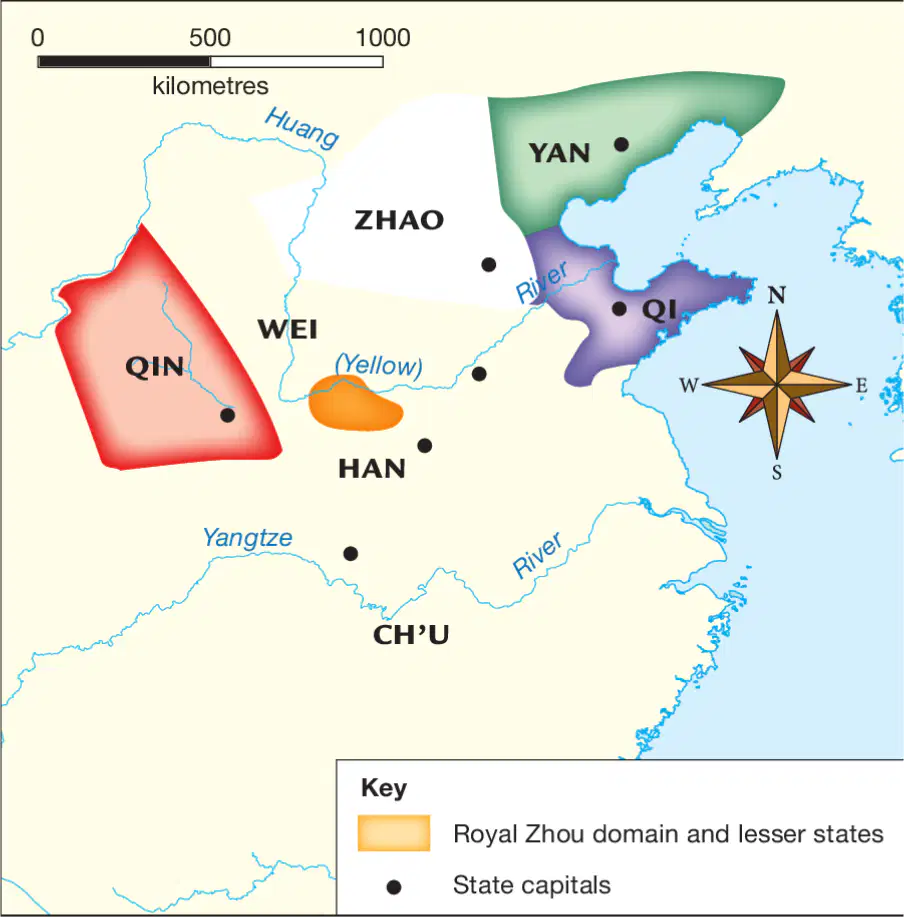
Which state is located to the west of the Wei state during the Warring States period?
a) Yan
b) Qin
c) Han
d) Qi
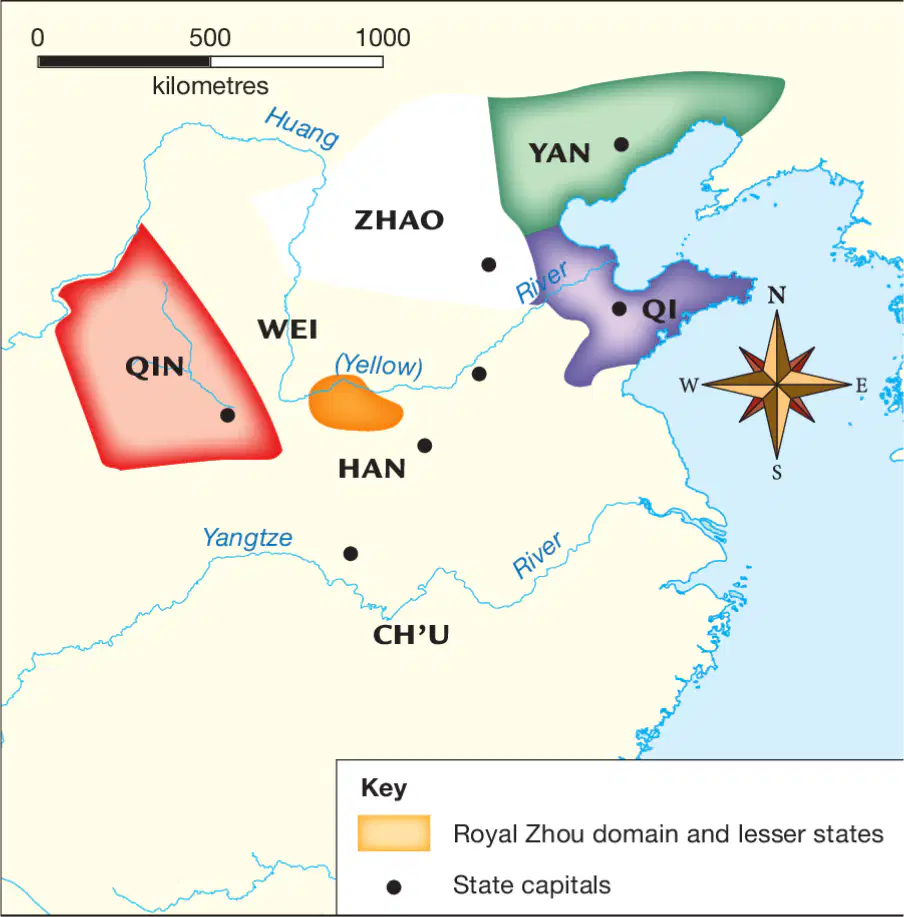
Which state is located to the south of the Zhao state during the Warring States period?
a) Wei
b) Yan
c) Qi
d) Han
Label the major bodies of water.
Huang He (Yellow) River
Chang Jiang (Yangtzee) River

What is the belief that a ruler is chosen by the gods?
Mandate of Heaven

Match the following
philosophy that teaches people to be respectful and responsible
Confucianism
philosophy that teaches that people are evil and need to be punished
Legalism
philosophy that teaches people to be accepting and live in harmony with nature
Daoism

Order these jobs according to the ancient Chinese social structure.
1=top
5=bottom
emperor
civil servants
peasants
artisans
merchants

What is the name of the trade network that started in X'ian, China and extended into Europe?

The knowledge of making this product was a closely guarded secret. Telling others how to make this textile could result in severe punishment by the Chinese government. What is this fabric?

What does China (Zhongguo) actually translate to?
Land of Rising Sun
Central Country
Middle Kingdom
Land of the Dragon
Which of the following was meant to protact Shi Huangdo in death?
the Great Wall of China
Confucian scholars
an army of terra cotta warriors
canals and irrigation systems
China is on which continent?
Asia
Africa
North America
Europe
Which is not one of religions practiced in Ancient China?
Buddhism
Taoism
Christianity
Confucianism


Which of these rivers is NOT located in China? (Multiple Answers)
Euphrates River
Yellow River
Yangzi River
Mississippi River
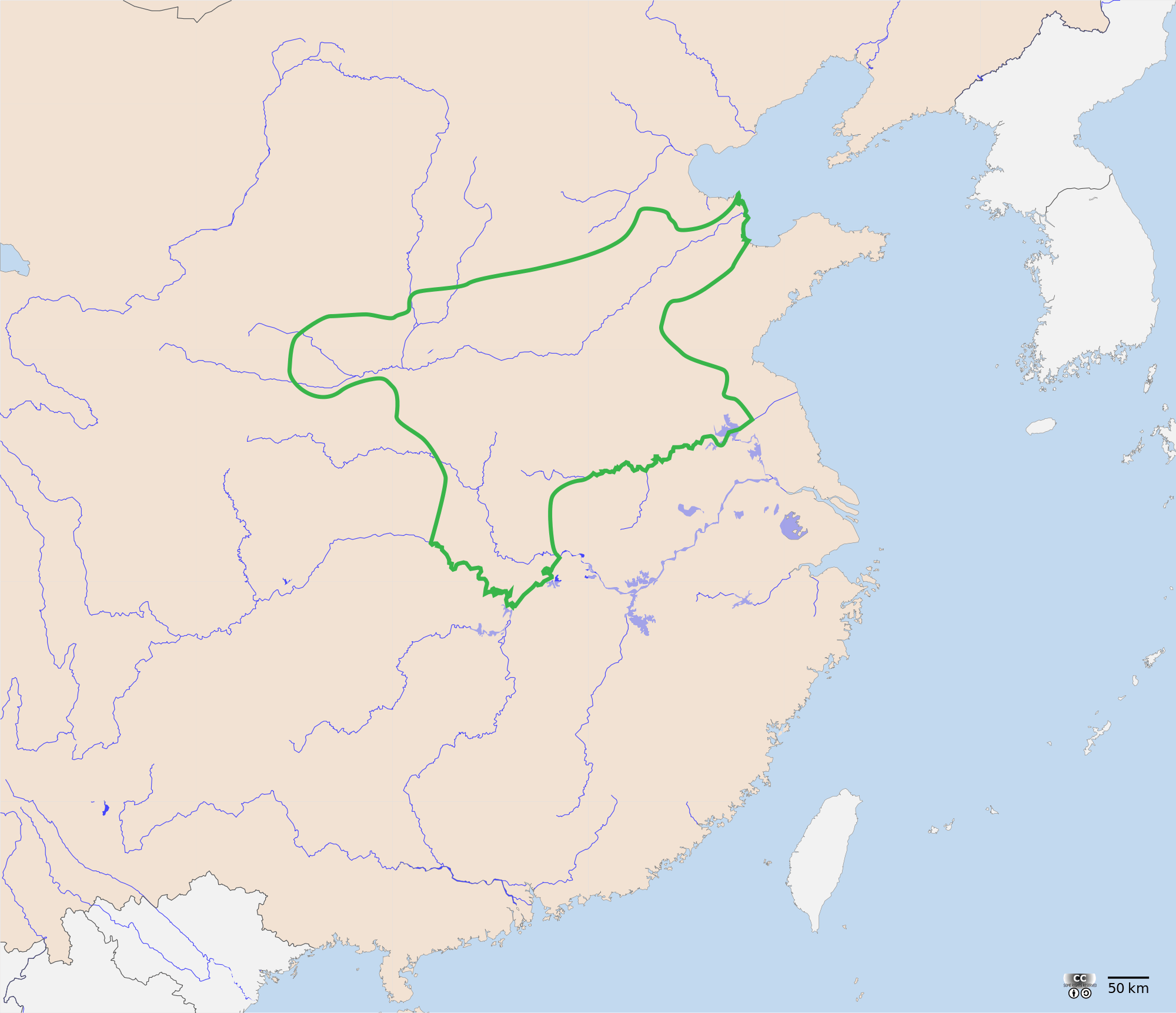

What geographical features isolated Ancient China from much of the rest of the world?
Deserts to the north and west, the Pacific Ocean to the east, and impassable mountains to the south
Deserts to the south and east, the Atlantic Ocean to the west, and impassable mountains to the north
Deserts to the north and east, the Indian Ocean to the west, and impassable mountains to the south
Deserts to the south and west, the Arctic Ocean to the east, and impassable mountains to the north
What geographical features isolated Ancient China from much of the rest of the world?
Deserts to the north and west, the Pacific Ocean to the east, and impassable mountains to the south
Deserts to the south and east, the Atlantic Ocean to the west, and impassable mountains to the north
Deserts to the north and east, the Indian Ocean to the west, and impassable mountains to the south
Deserts to the south and west, the Arctic Ocean to the east, and impassable mountains to the north
Which river is often called the "cradle of Chinese civilization"?
Yangtze River
Yellow River
Nile River
Ganges River
How long is the Yellow River?
3,988 miles
2,500 miles
3,395 miles
4,000 miles
What grain was grown by early Chinese farmers along the Yellow River?
Wheat
Rice
Barley
Millet
Which river is the third longest river in the world?
Yellow River
Yangtze River
Amazon River
Mississippi River
Which river played an important role in the development of the culture and civilization of Ancient China?
Nile River
Amazon River
Yangtze River
Mississippi River
What did farmers along the Yangtze River take advantage of to grow rice?
Fertile soil and dry weather
Warm climate and rainy weather
Cold climate and dry weather
Fertile soil and cold weather
What role did the Yangtze River serve in Ancient China besides agriculture?
It was a major trade route to Europe.
It served as a boundary between northern and southern China.
It was used for mining precious metals.
It was a source of drinking water for the entire country.
Which mountains are located to the south and southeast of China?
Rocky Mountains
Andes Mountains
Himalaya Mountains
Alps Mountains
What was one of the reasons the Great Wall of China was built?
To protect against floods from the Yellow River
To protect the Chinese from northern invaders
To mark the boundary of the Chinese Empire
To facilitate trade with neighboring countries
What is the nickname of the Taklamakan Desert?
The Desert of Despair
The Sea of Sand
The Sea of Death
The Desert of Doom
What is the significance of the Three Gorges Dam on the Yangtze River today?
It is the largest dam in the world.
It serves as the world's largest hydro-electric power source.
It is a major tourist attraction.
It is the oldest dam in China.
Why is the Yellow River also known as "China's Sorrow"?
Because of its yellow-colored water
Because of the terrible floods that have occurred throughout history
Because it is the longest river in China
Because it is difficult to navigate
Which religion is closely associated with the Himalaya Mountains?
Hinduism
Christianity
Buddhism
Islam
Which of these rivers is NOT located in China? (Multiple Answers)
Euphrates River
Yellow River
Yangzi River
Mississippi River
Which is not one of religions practiced in Ancient China?
Buddhism
Taoism
Christianity
Confucianism
The two rivers in Ancient China were the Yellow River and the Yangtze River.
True
False
China is on which continent?
Asia
Africa
North America
Europe
Which of the following was meant to protact Shi Huangdo in death?
the Great Wall of China
Confucian scholars
an army of terra cotta warriors
canals and irrigation systems
What does China (Zhongguo) actually translate to?
Land of Rising Sun
Central Country
Middle Kingdom
Land of the Dragon
Label the major bodies of water.
Huang He (Yellow) River
Chang Jiang (Yangtzee) River
What is the belief that a ruler is chosen by the gods?
Mandate of Heaven
Match the following
philosophy that teaches people to be respectful and responsible
Confucianism
philosophy that teaches that people are evil and need to be punished
Legalism
philosophy that teaches people to be accepting and live in harmony with nature
Daoism
Order these jobs according to the ancient Chinese social structure.
1=top
5=bottom
emperor
civil servants
peasants
artisans
merchants

Emperor Qin Shi Huangdi ruled China using which philosophy?
What is the name of the trade network that started in X'ian, China and extended into Europe?

These people worked in the government during the Han and other dynasties. They were required to pass a test to do this job.
Postal workers

Name the man made feature that connects Huang He (Yellow) River with the Chang Jiang (Yangtzee) River.
Panama Canal
Suez Canal
Darius Canal
The knowledge of making this product was a closely guarded secret. Telling others how to make this textile could result in severe punishment by the Chinese government. What is this fabric?

She is the only female empress to rule China in her own name. She was part of the Tang Dynasty.
Empress Wu Zetian (Zhou)
Empress Liu (Song)
Empress Dowager Cixi (Qing)
Empress Lu Zhi (Han)
Which culture is the world's oldest continuous civilisation?
Egypt
China
Greece
India
How long ago did people settle in farming villages along China’s Huang River?
2000 years ago
4000 years ago
6000 years ago
8000 years ago
According to ancient Chinese legends, what was the 'golden age' known for?
A) Arts of civilisation, morals, and good government
B) Military conquests
C) Trade and commerce
D) Scientific discoveries
What is the name of the legendary dynasty that possibly ruled China from the twenty-first century BCE to the seventeenth century BCE?
A) Han
B) Xia
C) Tang
D) Ming
What provided fertile land for farming in ancient China?
A) River valleys
B) Mountain ranges
C) Deserts
D) Forests
On what basis did Chinese rulers claim their authority?
A) Military strength
B) Wealth
C) Mandate of heaven
D) Popular vote
What is the origin of the name 'China'?
The name of the Chinese state Qin
The name of the Chinese state Zhou
The name of the Chinese state Shang
The name of the Chinese state Han
Which was the first dynasty for which we have evidence in China?
Zhou dynasty
Shang dynasty
Han dynasty
Qin dynasty
When did the Shang dynasty exist?
1045–771 BCE
770–256 BCE
1600–1046 BCE
221–206 BCE
Which dynasty defeated the Shang dynasty?
Qin dynasty
Zhou dynasty
Han dynasty
Tang dynasty
What are the two periods of the Zhou dynasty?
Western Zhou and Eastern Zhou
Northern Zhou and Southern Zhou
Early Zhou and Late Zhou
Central Zhou and Peripheral Zhou
During which period did the Warring States period occur?
a) 475–221 BCE
b) 500–300 BCE
c) 600–400 BCE
d) 300–100 BCE
Label the major bodies of water.
Huang He (Yellow) River
Chang Jiang (Yangtzee) River
Match the following
philosophy that teaches people to be respectful and responsible
Confucianism
philosophy that teaches that people are evil and need to be punished
Legalism
philosophy that teaches people to be accepting and live in harmony with nature
Daoism
Order these jobs according to the ancient Chinese social structure.
1=top
5=bottom
emperor
civil servants
peasants
artisans
merchants
What is the name of the trade network that started in X'ian, China and extended into Europe?
What did the ancient Chinese call China (Zhongguo)?
Land of Rising Sun
Central Country
The Middle Kingdom
Land of the Dragon
dynasty
When did humans first start living in towns during the Agricultural Revolution?
15,000-10,000 BCE
10,000-5,000 BCE
5,000-1,000 BCE
1,000-500 BCE
What does the Agricultural Revolution mean?
People started to build cities
People started to grow food
People started to travel
People started to write
Where were almost all ancient societies developed?
Along mountains
Along rivers
Along deserts
Along forests
Where was Sumer located?
In the Nile Valley
In Mesopotamia
In the Indus Valley
In the Yellow River Valley
Which rivers was Sumer founded on?
Nile and Amazon
Tigris and Euphrates
Ganges and Indus
Yellow and Yangtze
What is Sumer known for?
First use of iron
First city and civilization
First written language
First democracy
When was Egypt founded?
3100 BCE
4500 BCE
753 BCE
1600 BCE
Where is Egypt located?
South America
North East Africa
South East Asia
Western Europe
Which river was Egypt founded on?
Amazon River
Tigris River
Nile River
Yellow River
What is Egypt known for building?
Castles
Pyramids
Skyscrapers
Bridges
When was the Roman Empire founded?
753 BCE
4500 BCE
3100 BCE
1600 BCE
Where was the Roman Empire located?
Asia
Africa
Europe on the Mediterranean Sea
South America
Which river was the Roman Empire founded on?
Nile River
Tiber River
Amazon River
Ganges River
Which ancient civilization was the largest?
Sumer
Egypt
Roman Empire
China
Which river was China founded on?
Nile River
Tigris River
Yellow River
Amazon River

