
 Worksheets
Age Dating of Universe, Earth and Rocks
Total questions: 75
Worksheet time: 1hrs 15mins
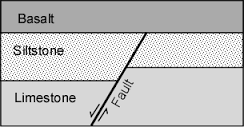


How do most fossils form?
An insect becomes trapped in amber.
An entire organism becomes frozen in ice.
A dead organism becomes buried in sediment.
A dead organism becomes buried in tar.
Relative dating determines the
precise age of fossils
age of rock layers and fossils compared to others
climate fossils survived in
movement of continents
An organism that no longer exists on Earth is called
decayed
evolved
extinct
preserved

What is a fossil?
The remains or physical evidence of an organism preserved by geologic processes
Fossils can be preserved in rock, amber, asphalt, or ice
Any naturally preserved evidence of animal activity
Fossil of an organism that lived during a relatively short period of time
How does absolute age differ from relative age?
Only absolute dating indicates which rock is older than another
Only absolute dating finds the age in years
Only relative dating finds the age in years

What is the correct order of the rock layers from oldest to youngest?
F, E, C, B, A, D
F, E, D, C, B, A
A, B, C, D, E, F
D, F, E, C, B, A
Earth elements decay and change into another element in a process called_____________.
radiation
isotope
radioactive decay
half-life
The __________of rocks is the numerical age and real age of rocks.
relative age
half-life
absolute age
earth age
Geologist use _________ to determine the absolute age of rocks.
absolute age dating
relative age dating
radiation dating
radioactive dating
All organisms contain the element_________, so it is used to find the ages of fossils.
carbon-14
carbon-12
carbon
carbon age
Geologist use the time it takes for a radioactive isotope to decay to half its original mass called a___________.
radioactive decay
isotope
half-life
carbon dating
Radioactive dating shows ___________ rocks are 4.6 billion years old.
Earth rocks
Moon rocks
Earth and Moon rocks
Radioactive rocks
The moon was made from a piece of _________ .
Moon
Earth
radioactive rocks
rock
Life on Earth has existed for more than _____________ years.
3.6 million
3 thousand
3 billion
4.6 billion
A long-lived natually occurring radioactive carbon isotope:
half-life
Isotope
Carbon-12
Carbon-14
The thermal energy transferred by electromagnetic waves is called ____________________
half-life
radiation
radioactive decay
carbon-14

Using the graph, How much Carbon-14 does a 10,000 yr old fossil emit?
10 %
20 %
30 %
40 %

How much Carbon-14 would a foosil that is 6,000 yrs old?
about 40%
about 50%
about 60%
about 70%

Which of these choices is the best definition of absolute dating?
determining the age of a rock layer by studying the fossils present
finding the age of an object compared to other objects
measuring the age of an object in years using any method
determining the amount of a radioactive isotope in an object
What is the method of measuring age that gives the most precise results?
radioactive dating, when scientists measure the levels of an isotopic element inside of an object
rate of sedimentation, which dates layers of Earth based on their thickness
law of superposition, which dates layers of Earth based on their order
B. relative dating, when scientists fill an object with carbon and measure how much will fit
. Which of these statements describes what happens during radioactive decay?
A Stable isotope interacts with an unstable isotope
A stable isotope breaks down and becomes unstable
An unstable isotope breaks down into a more stable isotope.
An unstable isotope interacts with another unstable isotope.
Trilobites are a species of invertebrate fossils commonly found in places such as the Grand Canyon, a large landform made of many rock layers and coastal Florida. Trilobites lived in shallow marine environments and varied widely in size.
Trilobite fossils are in both rocky and marine areas proving that Earth has changed by natural processes.
Trilobite fossils are only in marine areas, showing how Earth has not been changed by natural processes.
Trilobite fossils are found in rock layers that were laid down by natural processes which no longer occurs today.
Trilobite fossils are found in marine areas under the Earth's surface compressed by natural processes over time.
the actual age of an event or object / use radioactive dating
absolute age
radiometric dating
relative age
index fossil
The mostly solid, rocky part of the Earth; extends from the center of the core to the surface of the crust.
Biosphere
Lithoshpere
Geosphere
Hydrosphere
atmosphere
The crust and very top part of the mantle.
Biosphere
Lithoshpere
Geosphere
Hydrosphere
atmosphere
part of Earth in which life exists including land, water, and air or atmosphere
Biosphere
Lithoshpere
Geosphere
Hydrosphere
atmosphere
All the water on earth
Biosphere
Lithoshpere
Geosphere
Hydrosphere
atmosphere
A thin layer of gases surrounding Earth
Biosphere
Lithoshpere
Geosphere
Hydrosphere
atmosphere
Select all 4 major spheres of Earth
Geosphere
Biosphere
Lithosphere
Hydrosphere
Atmosphere
A rock deep within the Earth experiences extreme temperature and pressure. After a long period of time it becomes which rock?
Magma
Igneous
Metamorphic
Sedimentary
In ___________, unstable nuclei spontaneously decay into stable nuclei.
Radiation
Radioactivity
Release
Emission
Those radionuclides that have the same atomic number but different mass number are known as
Isobars
Isotones
Isotopes
Radioisotopes
The characteristics of radioactivity are: -
It is a nuclear phenomenon
Atoms undergo spontaneous, uncontrolled, continuous disintegration
Independent of external factors
No simultaneous emission of α and β, but emission of α and γ or β and γ possible
The original element that undergoes radioactive decay is known as the...
daughter element
half-life
parent element
radioactive decay
The element that is the product of radioactive decay is known as the...
daughter element
half-life
parent element
carbon-14
If the half-life of a radioactive group of atoms is 300 years, then how old is the rock if there have been three half-lives?
37.5 years
100 years
600 years
900 years
If the half-life of a radioactive group of atoms is 500 years, then how many half-lives have passed after 2000 years?
1 half-life
2 half-lives
3 half-lives
4 half-lives
How many half-lives have passed if there 12.5% parent isotope left?
1 half-life
2 half-lives
3 half-lives
4 half-lives
Which hypothesis proposes that a cloud of gas and dust collapsed and flattened due to gravity, leading to the formation of the solar system?
Nebular Hypothesis
Planetesimal Hypothesis
Tidal Theory
Protoplanet Hypothesis
Which hypothesis suggests that a passing star or external perturbation triggers the collapse of a diffuse gas cloud, leading to star and planetary system formation?
Nebular Theory
Planetesimal Hypothesis
Tidal Theory
Protoplanet Hypothesis
What is a major weakness of Tidal Theory?
It fails to explain the role of external influences.
It doesn't address the presence of interstellar gas clouds.
It is too complex to understand.
It lacks a clear mechanism for protostar formation.
Which hypothesis emphasizes the impact of external perturbations on star and planet formation?
Nebular Hypothesis
Planetesimal Hypothesis
Tidal Theory
Protoplanet Hypothesis
What are the most common elements in the universe?
iron and steel
hydrogen and helium
carbon and lead
States that the universe began as a hot and infinitely dense point.
Origins of the Universe theory.
String theory.
Creation theory.
Big Bang theory.

According to the Big Bang theory, the universe has expanded from
a very high-density and low-temperature state
a very high-density and high-temperature state
a very low-density and high-temperature state
none of these
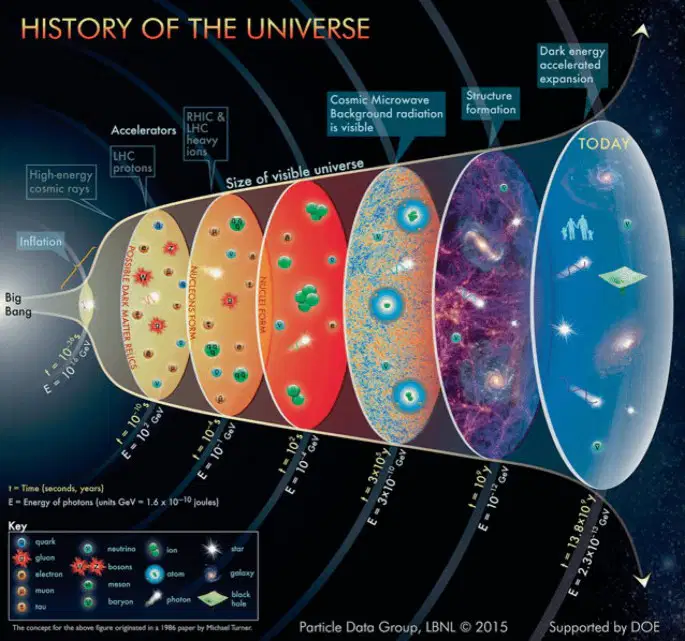
How long ago has the Big Bang happen?
17.799 ± 0.021 billion years
13.799 ± 0.021 billion years
20.799 ± 0.021 billion years
15.799 ± 0.021 billion years
The Cosmic Background Radiation is:
the remaining energy from the big bang.
incredibly hot.
visible to the human eye.
only located in certain places in the universe.
An infinitely small, infinitely dense, and infinitely hot point that is believed to have existed before the big bang.
Singularity
Antimatter
Little bang
condensation nuclei
Who observed galaxies moving away from us?
Hubble
Lemaitre
Penzias
Wilson

The change in wavelength that allows us to determine if an object if moving toward us or away from us
Whiteshift and Blueshift
Redshift and Greenshift
Redshift and Blueshift
The portion of the electromagnetic spectrum that is visible to the human eye 400-700nm
Infrared Light
Microwaves
Ultraviolet Light
Visible Light

Cosmic Microwave Background
the radiation left over from the Big Bang was detected by Penzias and Wilson in 1965. Do microwaves contain high or low energy?
High energy
Low energy
Research proved the universe still expanding; proved galaxies exist outside of the milky way; classification system for galaxies; hubble telescope named after him
Albert Einstein
Edwin Hubble
Fred Hoyle
Penzias and Wilson

