
 Worksheets
PS Science Skills
Total questions: 20
Worksheet time: 10mins
Name
Class
Date
1.
How are science and technology related?
a)
Technology is a branch of natural science.
b)
Science is a branch of technology.
c)
Advances in science may lead to advances in technology and vice versa.
d)
Science and technology are not related.
2.
How does Earth science overlap with life science?
a)
Earth science involves the study of Earth's rocks.
b)
Earth science involves the study of systems that may include living things.
c)
Earth science involves the study of the composition of matter.
d)
Earth science does not overlap with life science.
3.
Which of the following is NOT one of the main ideas of physical science?
a)
The universe is very large and very old.
b)
Forces cause changes in motion.
c)
Energy can be transformed from one form to another, but it can never be destroyed.
d)
One of the main branches of natural science is biology.
4.
What are the building blocks of all matter?
a)
forces
b)
magnetic fields
c)
atoms
d)
kinetic and potential energy
5.
What happens when the data in an investigation do not support the original hypothesis?
a)
The scientists gives up and starts an investigation on a new topic.
b)
The data must be incorrect and thrown out.
c)
The hypothesis will be revised.
d)
The data are altered so that they support the original hypothesis.
6.
Which of the following statements is true about scientific theories?
a)
Scientific theories become scientific laws.
b)
Scientific theories are never proven.
c)
Scientific theories become hypotheses.
d)
Scientific theories summarize patterns found in nature.
7.
What is a statement that summarizes a pattern found in nature?
a)
a scientific law
b)
a fact
c)
a scientific theory
d)
a hypothesis
8.
Why are scientific models important?
a)
They prove scientific theories.
b)
They help visualize things things that are very complex, very large, or very small.
c)
They make it harder to understand things.
d)
They never change.
9.
Which of the following is an example of a safe laboratory procedure?
a)
tying back long hair and loose clothing.
b)
eating or drinking from laboratory glassware.
c)
touching hot objects with your bare hands.
d)
testing an odor by directly inhaling the vapor.
10.
How is 0.00025 written in scientific notation?
a)
25 X 10 (-5)
b)
2.5 X 10 (4)
c)
0.25 X 10 (-3)
d)
2.5 X 10 (-4)
11.
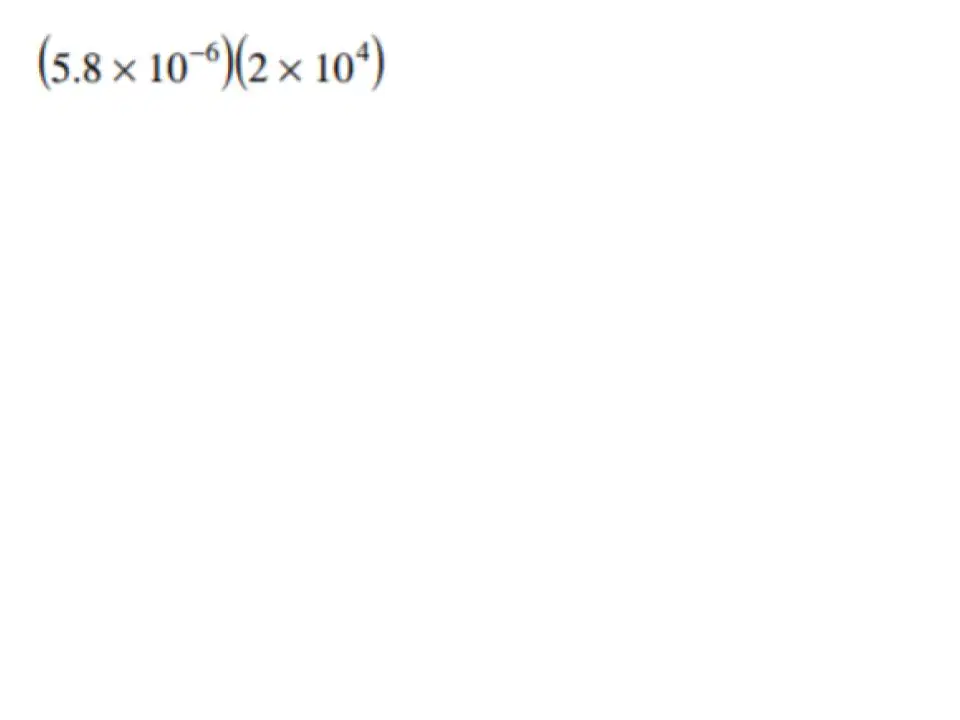
Complete the following question using scientific notation:
a)
11.6 X 10 -2
b)
1.16 X 10 -1
c)
2.9 X10 -10
d)
2.9 X 10 -1
12.
There are 1660 megawatts of wind-generated electricity produced globally every year. This amount is equivalent to
a)
1,660,000 watts
b)
1,660,000 kilowatts
c)
16,600,000 watts
d)
166,000 kilowatts
13.
Which of the following clocks offers the most precision?
a)
a clock that measures time to the nearest hour
b)
a clock that measures time to the nearest minute
c)
a clock that measures time to the nearest second
d)
a clock that measures time to the nearest tenth of a second
14.
Approximately how many kelvins are equal to 60 degrees Fahrenheit?
a)
439
b)
212
c)
902
d)
289
15.
On the Celsius scale, at what temperature does water boil?
a)
0 degrees
b)
212 degrees
c)
100 degrees
d)
32 degrees
16.
The type of graph used to show how part of something relates to the whole is a
a)
circle graph
b)
bar graph
c)
line graph
d)
direct proportion
17.
Which of the following is equal to 1 centimeter?
a)
100 meters
b)
1/100 of a meter
c)
1000 millimeters
d)
100 millimeters
18.
How do scientists that speak different languages make their data understandable to one another?
a)
They all use different systems of measurement.
b)
They all use SI.
c)
They communicate through a universal translator.
d)
They all must speak French.
19.
Why are peer reviews important?
a)
Scientists receive questions and criticism from their peers.
b)
Data are checked for accuracy.
c)
Scientists receive comments and suggestions from other scientists.
d)
all of the above.
20.
If the relationship between the manipulated variable and the responding variable is a direct proportion, what will a line graph of this relationship look like?
a)
a straight line
b)
a curved line
c)
a jagged line
d)
none of the above
100 %

