
 Worksheets
Pretest-Unit 2. Dilations
Total questions: 18
Worksheet time: 15mins
Kayla thinks that the slope of a vertical line is undefined, while Joshua argues that the slope of a vertical line is zero. Who is correct?
Kayla
Joshua
None of them

Find the rate of change shown in the table.
-5
-6
-7

Find the slope of the graph.
½
1
3/2

Which of the following triangles could lie on the line graphed in question #3?
A
B
C
D
A line has a slope of zero. Which of the following points could this line pass through?
(12, 9) and (12, 6)
(3, -6) and (7, -6)
(1, 4) and (2, 5)
(-9, 7) and (9, -7)
Which of the following is true about the graph of the equation y = -5x + 10?
The graph would increase from left to right.
The graph would pass through the origin.
The graph would have a positive y-intercept.
The graph would have a slope of 10.

Write an equation in slope-intercept form to represent the linear relationship on the graph.
y=-3x+10
y=-4x+10
y=-5x+10

Which of the following could be the graph of the equation y = -2x?
Graph A
Graph B
Graph C
Graph D
Which is a true statement about dilations?
A dilation sometimes changes the orientation of the vertices.
A dilation always preserves congruence.
A dilation sometimes enlarges a figure.
A dilation always changes the orientation of a figure.
Which of the following algebraic rules represents a dilation that is an enlargement?
(1/3x, 1/3y)
(0.1x, 0.1y)
(5/6x, 5/6y)
(5/2x, 5/2y)
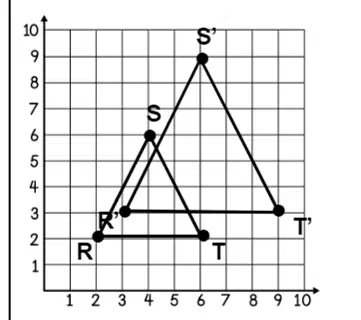
Find the scale factor that was used in the dilation shown.
0.5
1.5
3/2
3

What is the scale factor of the dilation shown?
1/3
1/2
3
2

F
G
H
J
Dilation is described as:
Enlargement or Reduction
Flip
Rotate
Slide

Does the image show a Dilation? If yes, did the image enlarge, reduce or none of the above?
Yes, enlarge
Yes, reduce
No
Which rule would represent a dilation?
(x, y) --> (x - 3, y + 4)
(x, y) --> (3x, 4y)
(x, y) --> (x, -y)
(x, y) --> (3x, 3y)
(x, y) --> (-x, y)
A(3,3) B(6,6) C(9,3)

