wayground logo

Free Printable Worksheets

NEW

Font size

S
M
L
XL
Worksheets

Chemistry: Experimental Design

Total questions: 35

Worksheet time: 1hrs 15mins

Name
Class
Date
1.
What is a factor that is measured for change in an experiment?
a)
control
b)
constant
c)
independent variable
d)
dependent variable
2.
What is the factor that an experimenter changes on purpose?
a)
Dependent Variable
b)
Independent Variable
c)
Constant
d)
Control
3.

A summary of the experiment that includes whether hypothesis was supported or not.

a)

Hypothesis

b)

Results

c)

Conclusion

d)

Independent Variable

4.
The part of the experiment that does not contain the independent variable. Used for comparison.
a)
Control Group
b)
Experimental Group
c)
Results
d)
Data
5.
What are all the things that are kept the same in an experiment?
a)
controls
b)
data
c)
constants
d)
independent variables
6.

What is the affect of salt water on the the height of blades of grass?

The above question is an example of:

a)

Hypothesis

b)

Conclusion

c)

Procedures

d)

Testable Question

7.

What is the affect of salt water on the the height of blades of grass?

What is the independent variable in the above question?

a)

salt water

b)

height

c)

average

d)

affect

8.
What is an if....then statement that predicts the outcome of an experiment or how the Independent variable effects the dependent variable?
a)
Conclusion
b)
Materials
c)
Hypothesis
d)
Problem
9.
Students used various temperatures of water to see which one dissolved candy faster. 
What was the Independent Variable?
a)
Amount of Candy
b)
Amount of Water
c)
Temperature of Water
d)
Time for Candy to Dissolve
10.

Students wanted to see if the type of material affected the temperature after being placed under a heat lamp for 10 minutes.

What is the dependent variable for this investigation?

a)

Type of material (rocks, sand etc)

b)

Temperature after 10 minutes

c)

Time under the lamp

d)

Heat lamp, amount of material

11.
If plants receive more water, the number of leaves will increase. 
This is an example of 
a)
Testable Question
b)
Hypothesis
c)
Variables
d)
None of the above
12.
You will want your experiment to have ____ independent variable(s) in it for the experiment to be valid.
a)
1
b)
2
c)
3
d)
4
13.
In this graph, what is the independent variable? 
a)
Population
b)
Day
c)
Species 5
14.
In this graph, what is the dependent variable? 
a)
Walla Walla Island
b)
Time
c)
Number of Deer
15.
A numbered step by step description that begins with a verb and tells exactly how the experiment is to be done.
a)
reults
Results
b)
Problem
c)
Materials
d)
Procedures
16.
An explanation of why something occurs in the natural world
a)
theory
b)
law
c)
hypothesis
d)
predicition
17.
It is a measure of how close measurements come to each other when they are made in the same way
a)
Accuracy
b)
Precision
c)
Error
d)
Extrapolation
18.

How close a measurement is to the accepted value is called..

a)

Accuracy

b)

Precision

c)

Significant

d)

Estimate

19.
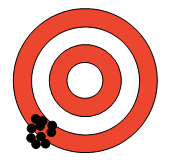
This bullseye demonstrates...
a)
High Accuracy & High Precision
b)
High Accuracy & Low Precision
c)
Low Accuracy & High Precision
d)
Low Accuracy & Low Precision
20.

Which Student is the most Precise?

a)

Alex

b)

Shandra

c)

Luis

21.
a)

evaporating dish

b)

watch glass

c)

mortar and pestle

d)

funnel

22.
a)
glass lens
b)
watch glass
c)
evaporating dish
d)
pestle
23.
Explaining the color of a chemical would be what kind of observation?
a)
Qualitative 
b)
Quanitative
24.

What is the dependent variable on this graph? (you can pinch zoom)

a)

time

b)

distance

c)

marathon runners

d)

males

25.

What type of graphing relationship is shown in this graph?

a)

direct

b)

indirect

c)

cyclical

d)

constant

26.

What kind of graphing relationship is shown?

a)

direct

b)

indirect

c)

constant

d)

cyclical

27.

What graphing relationship is best shown by the diagram?

a)

direct

b)

indirect

c)

constant

d)

cyclical

28.
A claim is ______________________________.
a)
a kind of shellfish often used in chowder. 
b)
a fact.
c)
a statement or conclusion that answers the original question or problem
d)
a bad thing to make about something.
29.
Evidence is ___________________
a)
A statement or conclusion that answers a question
b)
Scientific data that supports the claim
c)
A justification that connects the claim to the evidence
d)
Not vital when using an argument
30.
Reasoning is __________________.
a)
A statement of conclusion that answers the original question/problem
b)
Scientific data that supports the claim
c)
A justification that connects the evidence to the claim
d)
Empirical Evidence
31.
Which of the following is NOT a claim?
a)
California is the best state in the USA.
b)
Twinkies taste better than other snack cakes because of their texture, their creamy filling, and their golden appearance.
c)
The school year began on August 18 and will end on June 4
d)
Christmas is the best holiday of the year.
32.
"Sleepy students are more likely to be tardy, absent, inattentive in the morning and less able to learn" is an example of:
a)
Claim
b)
Reasoning
c)
Evidence
d)
None of these
33.
What is the evidence?
In our experiment, the blocks had different masses, 20 g., 30 g., 44 g., 123 g and 142 g but the time for all five blocks to fall was about the same. It took between 1.5 and 1.8 seconds for them to fall. No, mass does not affect how quickly an object falls. Since the blocks had different masses but took about the same time, I know that mass does not affect how quickly something falls.
a)
In our experiment, the blocks had different masses, 20 g., 30 g., 44 g., 123 g and 142 g but the time for all five blocks to fall was about the same. It took between 1.5 and 1.8 seconds for them to fall. 
b)
No, mass does not affect how quickly an object falls. 
c)
Since the blocks had different masses but took about the same time, I know that mass does not affect how quickly something falls.
34.

The students are running because they are happy

a)

observation

b)

inference

35.

The statement "Oxiclean is the best stain fighter money can buy" is an example of:

a)

Evidence

b)

Claim

c)

Reasoning

d)

Hypothesis