wayground logo

Free Printable Worksheets

Font size

S
M
L
XL
Worksheets

Geometric Proofs: Two-Column

Total questions: 82

Worksheet time: 3hrs 35mins

Name
Class
Date
1.

In a geometric proof, reasons on the _____ side

a)

Left

b)

Right

c)

transative

d)

POE

2.

In a geometric proof, statements go on the ____ side

a)

left

b)

right

c)

transative

d)

POE

3.

AB + BC = AC

a)

Angle addition postulate

b)

Segment addition postulate

c)

Definition of supplementary angles

d)

Transative property

4.

If <1 is a right angle, than m<1 = 90o90^o  

a)

Definition of right angle

b)

Definition of supplementary angles

c)

Definition of angle bisector

d)

Definition of midpoint

5.

If B is the midpoint of AC\overline{AC}  , then ABBC\overline{AB}\cong\overline{BC}  

a)

Definition of midpoint

b)

Definition of angle bisector

c)

Definition of segment bisector

d)

Definition of perpendicular lines

6.

m<AMX + m<XMB = m<AMB

a)

Segment addition postulate

b)

Angle addition postulate

c)

Definition of supplementary angles

d)

Definition of angle bisector

7.

When writing a proof start with ......

a)

The given

b)

Transative property

c)

Supplementary angles

d)

Subtraction POE

8.

The symbol \cong  means..........

a)

Congruent

b)

transitive

c)

equal sign

d)

supplementary

9.
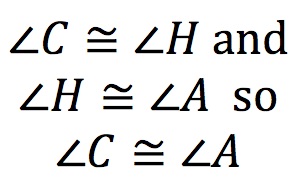
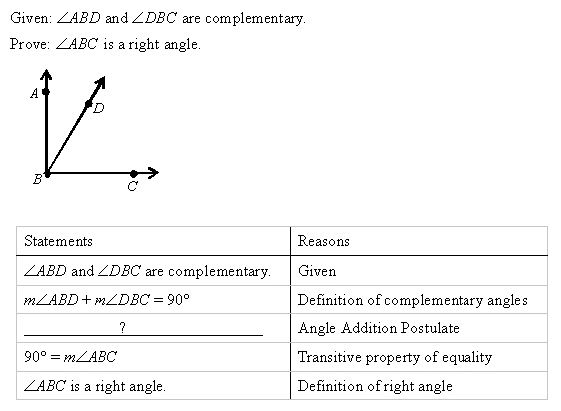
What is the justification?
a)
Symmetric Prop.
b)
Angle addition postulate
c)
Reflexive Prop
d)
Transitive Prop.
10.

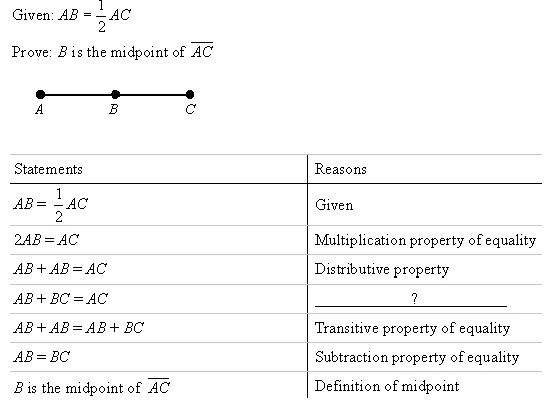
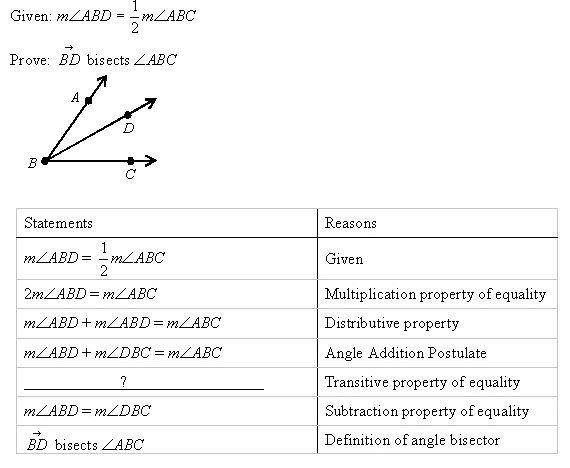
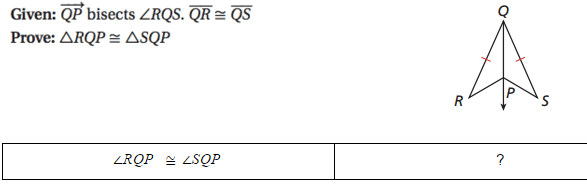
What is the missing statement in the proof?

a)

Addition property

b)

Segment Addition Postulate

c)

Substitution property

d)

Transitive property

11.
If <1 and <2 are complementary, then m<1 + m<2 = 90
a)
Addition POE
b)
Subtraction POE
c)
Def of right angle
d)
Def of Complementary Angles
12.
IF <ABC ≅ <DEF, then m<ABC = m<DEF
a)
Reflexive POE
b)
Addition POE
c)
Def. of congruent angles
d)
Def. of right angles
13.
If X is between R & T on a line,
then RX + XT = RT
a)
Addition POE
b)
Substitution POE
c)
Angle Addition Post.
d)
Segment Addition Post.
14.
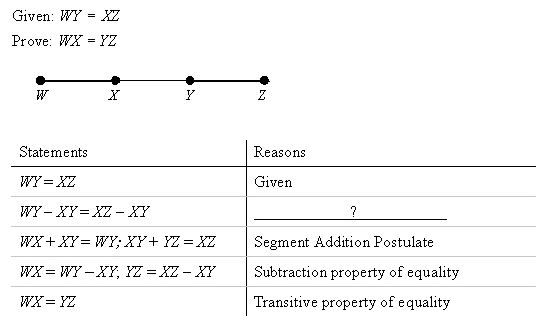
What is the reason?
a)
Definition of Complementary
b)
Definition of 180 
c)
Definition of supplementary
d)
Angle Addition
15.
Which property justifies the next step?
a)
Segment addition postulate
b)
Definition of an angle bisector
c)
Angle addition postulate
d)
Definition of right angles
16.
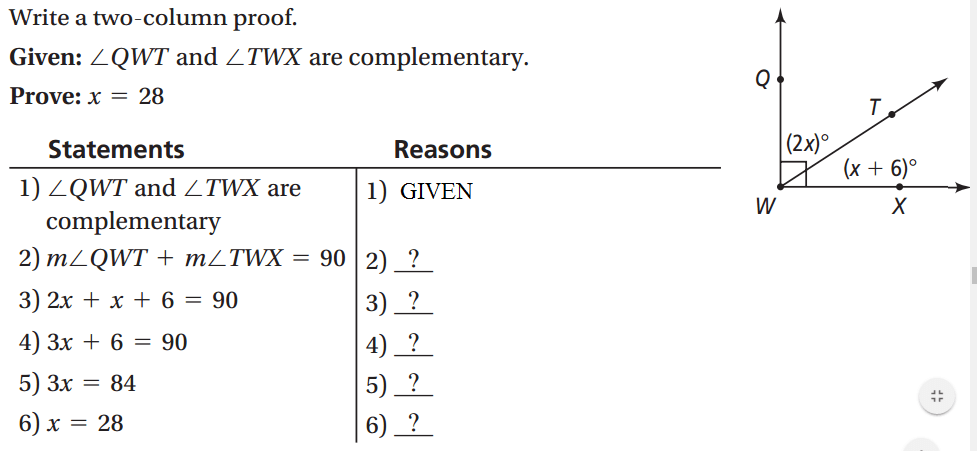
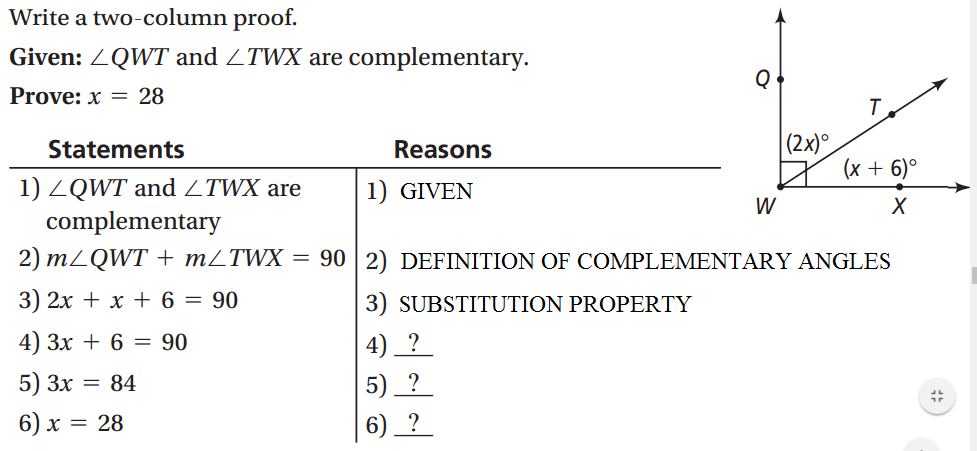
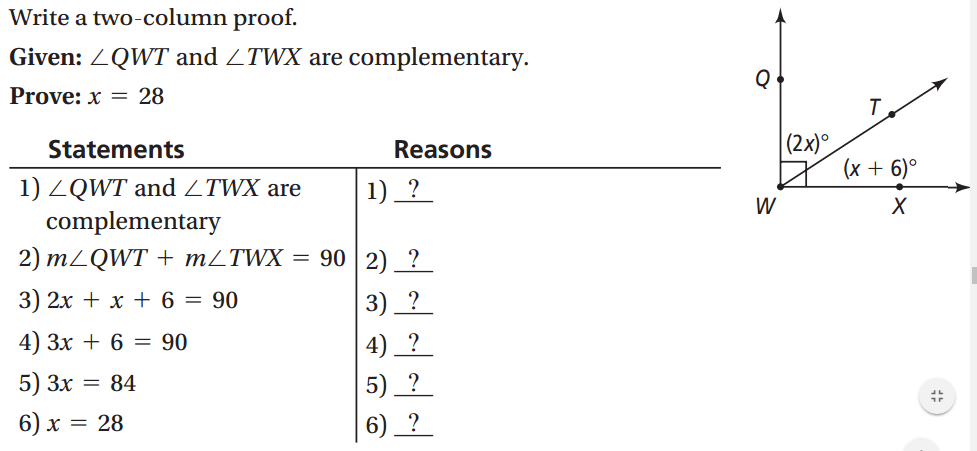
What is the REASON for Statement #2?
a)
Given
b)
Definition of Complementary Angles
c)
Substitution Property
d)
Reflexive Property of Congruence
17.
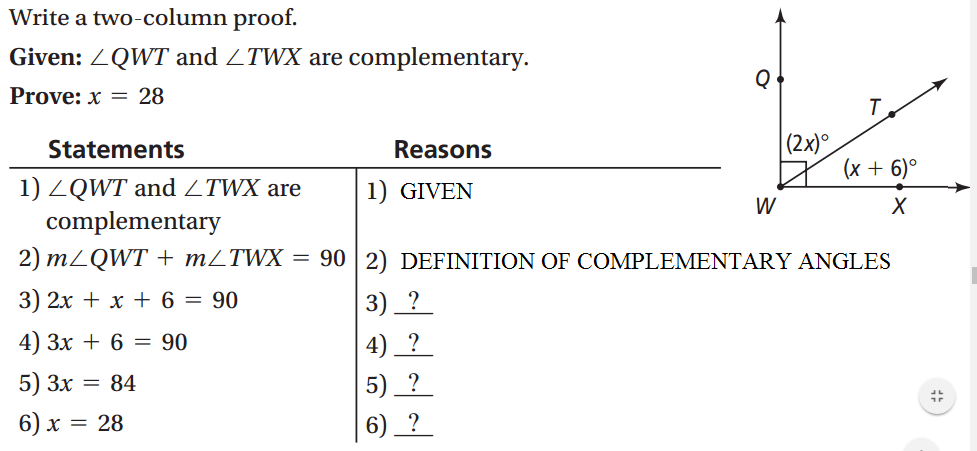
What is the REASON for Statement #3?
a)
Given
b)
Definition of Complementary Angles
c)
Substitution Property
d)
Reflexive Property of Congruence
18.
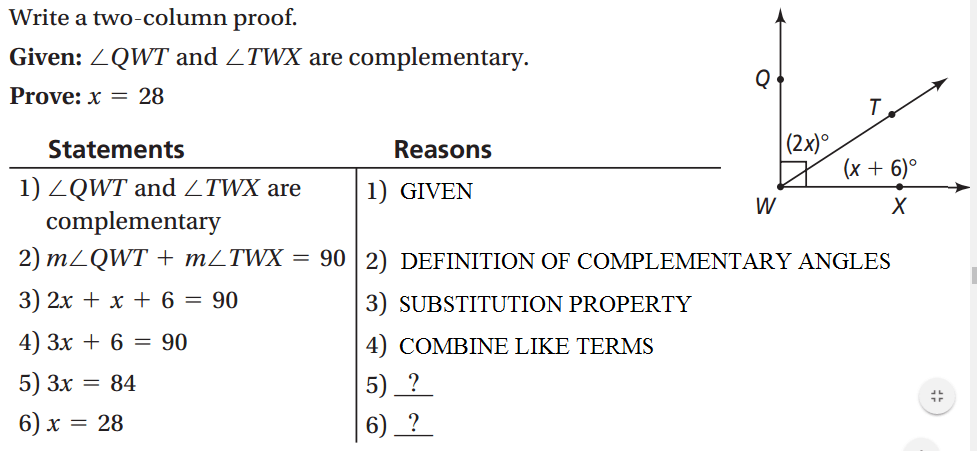
What is the REASON for Statement #4?
a)
Substitution Property
b)
Distributive Property
c)
Transitive Property
d)
Combine Like Terms
19.
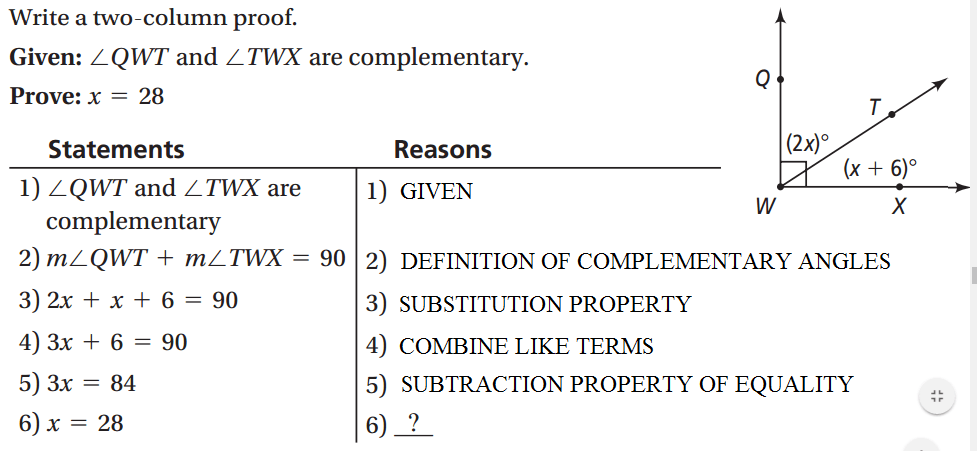
What is the REASON for Statement #5?
a)
Addition Property of Equality
b)
Subtraction Property of Equality
c)
Multiplication Property of Equality
d)
Division Property of Equality
20.
What is the REASON for Statement #6?
a)
Addition Property of Equality
b)
Subtraction Property of Equality
c)
Multiplication Property of Equality
d)
Division Property of Equality
21.
What is the reason?
a)
Definition of perpendicular
b)
Definition of Right angle
c)
Definition of 90 
d)
Definition of angle
22.
What would be the correct "given" statements for this diagram?
a)
T is the midpoint of segment BG and
∡B≅∡G
b)
∡B≅∡G and ∡A≅∡W
c)
T is the midpoint of segment BG and ∡A≅∡W
d)
T is the midpoint of segment AW and ∡A≅∡W
23.
Name the property.
If A is in the interior of <BDC, then m<BDA + m<ADC = m<BDC. 
a)
Reflexive
b)
Transitive
c)
Segment Addition Postulate
d)
Angle Addition Postulate
24.
Identify the  missing statement or reason
a)
Given
b)
Vertical Angles Theorem
c)
Definition of Angle Bisector
d)
Alternate Interior Angles Theorem
25.
Which is the correct reason for statement 1 in the proof?
a)
Definition of Congruent Angles
b)
Substitution
c)
Transitive Property
d)
Given
26.
a)
addition POE
b)
angle addition POE
c)
subtraction POE
d)
substitution POE
27.
Which is the correct reason for statement 2 in the proof?
a)
Given
b)
Transitive Property
c)
Definition of Congruent Angles
d)
Vertical Angles are congruent.
28.
What is the missing statement in the proof?
a)
2m∠ABD=m∠ABD+m∠ABD
b)
m∠ABD=m∠DBC
c)
m∠ABC=m∠ABC
d)
m∠ABD+m∠ABD=m∠ABD+m∠DBC
29.
What is the missing statement in the proof?
a)
m∠ABD+m∠DBC=m∠ABC
b)
m∠ABD=m∠DBC
c)
m∠ABC=m∠ABC
d)
none of the other choices are correct
30.
What is the missing statement in the proof?
a)
Subtraction p.o.e.
b)
Substitution p.o.e.
c)
Transitive p.o.e.
d)
Symmetric p.o.e.
31.

A proof is finished when...

a)

the last reason matches what you are trying to prove

b)

the last statement matches what you are trying to prove

c)

your brain says your finished

d)

you get tired

32.

Which reason justifies the statement below?


s(t +u) = st + su

a)

Multiplication Property

b)

Distributive Property

c)

Reflexive Property

d)

Symmetric Property

33.

Given: BABCGiven:\ \overrightarrow{BA}\perp\overrightarrow{BC}  
Give a conclusion for the given and a reason for the conclusion.

a)

mB=90° m\angle B=90\degree\  Definition of right angle

b)

mB=90°m\angle B=90\degree  Definition of perpendicular

c)

B is a right angle\angle B\ is\ a\ right\ angle  Definition of perpendicular

d)

B is a right angle\angle B\ is\ a\ right\ angle  Definition of right angle

34.
Which property of real numbers justifies the work shown from Step 1 to Step 2?
a)
Distributive Property
b)
Commutative Property
c)
Identity Property
d)
Associative Property
35.
Which property of real numbers was used to get from Step 3 to Step 4?
a)
Addition Property of Equality
b)
Subtraction Property of Equality
c)
Additive Inverse Property
d)
Substitution Property
36.
Which property justifies the work in solving this equation?
a)
Addition Property of Equality
b)
Additive Inverse Property
c)
Identity Property of Addition
d)
Subtraction Property of Equality
37.

Which property of real numbers was used to get from Step 3 to Step 4?

a)

Addition Property of Equality

b)

Subtraction Property of Equality

c)

Symmetric Property

d)

Substitution Property

38.
Which property is shown below?
__________________________
7n = 21 then n = 3
a)
Division Property
b)
Sorcery
c)
Reduction of Multiples
d)
Distributive Property
39.
If AB = CD and CD = EF, then AB = EF
a)
Symmetric Property of Equality
b)
Reflexive Property of Equality
c)
Transitive Property of Equality
d)
CLT or Simplify
40.

Why is it helpful to sketch a diagram when writing certain proofs?

a)

To make the proof look more professional

b)

To waste time

c)

To visualize the problem and understand the relationships between geometric figures

d)

To confuse the reader

41.

What is the purpose of flowchart proofs in geometry?

a)

To make the proof more complicated

b)

To show the flow of a logical argument using boxes and arrows

c)

To confuse the reader

d)

To prove theorems using only words

42.

What is the advantage of using paragraph proofs in geometry?

a)

They are not used in geometry

b)

They are not as effective as other proof formats

c)

They are longer and more confusing

d)

They are easier to understand than other proof formats

43.

In the given proof, what are the reasons for step 1 and 2?

a)

Angles that form a linear pair are supplementary.

b)

Substitution

c)

Reflexive Property of Congruence

d)

Angles of equal measure are congruent.

44.

In the given proof, what is the reason for step 1?

a)

Angles that form a linear pair are supplementary.

b)

Angles of Equal Measure are Congruent

c)

Reflexive Property of Congruence

d)

Definition of a Perpendicular Bisector

45.

In the given proof, what is the statement for step 2?

a)

Angles that form a linear pair are supplementary. m1+m3=180°m∠1+m∠3=180°  

b)

m3+m5=180°m∠3+m∠5=180°  

c)

m1=m3m∠1=m∠3  

d)

35\angle3\cong\angle5  

46.

In the given proof, what is the statement for step 2?

a)

ADDBAD≅DB  

b)

CDCDCD≅CD  

c)

mADC+mBDC=180°m\angle ADC+m\angle BDC=180\degree  

d)

ADCBDC\angle ADC\cong\angle BDC  

47.

In the given proof, what are the reasons for steps 1 and 3?

a)

Alternate Exterior Angle are Congruent

b)

Reflexive Property of Congruence

c)

Angles that form a linear pair are supplementary.

d)

Alternate Interior Angles are Congruent.

48.

In the given proof, what is the reason for step 2?

a)

Alternate Exterior Angle are Congruent

b)

Reflexive Property of Congruence

c)

Angles that form a linear pair are supplementary.

d)

Alternate Interior Angles are Congruent.

49.

In the given proof, what is the statement for step 4?

a)

23\angle2\cong\angle3  

b)

m1+m4 =180°m\angle1+m\angle4\ =180\degree  

c)

14\angle1\cong\angle4  

d)

ΔABCΔACD\Delta ABC\cong\Delta ACD  .

50.

In the given proof, what is the reason for final step?

a)

Reflexive Property of Congruence

b)

Corresponding Parts of Congruent Triangles are Congruent

c)

Angles that form a linear pair are supplementary.

d)

Alternate Interior Angles are Congruent.

51.

A diagram that represents an algorithm, work flow, or process, and uses geometric symbols connected by arrows to show the direction of the flow of action.

a)

Flowchart

b)

Illustration

c)

Data

d)

Information

52.

Which of the following is the best option to fill in for blank #1 in the STATEMENTS section of this geometric proof?

a)

Given

b)

m∠1 + m∠3 = 180°

c)

∠1 ≅ ∠4

d)

∠1 and ∠3 are supplementary

53.

What is reason 2?

a)
b)
c)
d)
54.

What is reason 3?

a)
b)
c)
d)
55.

What is reason 4?

a)
b)
c)
d)
56.

What is reason 5?

a)
b)
c)
d)
57.

What is reason 2?

a)
b)
c)
d)
58.

What is reason 3?

a)
b)
c)
d)
59.

What is reason 4?

a)
b)
c)
d)
60.

What is reason 5?

a)
b)
c)
d)
61.

What is reason 6?

a)
b)
c)
d)
62.
What is the REASON for Statement #1?
a)
Given
b)
Definition of Complementary Angles
c)
Substitution Property
d)
Reflexive Property of Congruence
63.
What is the REASON for Statement #2?
a)
Given
b)
Definition of Complementary Angles
c)
Substitution Property
d)
Reflexive Property of Congruence
64.
What is the REASON for Statement #3?
a)
Given
b)
Definition of Complementary Angles
c)
Substitution Property
d)
Reflexive Property of Congruence
65.
What is the REASON for Statement #4?
a)
Substitution Property
b)
Distributive Property
c)
Transitive Property
d)
Combine Like Terms
66.
What is the REASON for Statement #5?
a)
Addition Property of Equality
b)
Subtraction Property of Equality
c)
Multiplication Property of Equality
d)
Division Property of Equality
67.
What is the REASON for Statement #6?
a)
Addition Property of Equality
b)
Subtraction Property of Equality
c)
Multiplication Property of Equality
d)
Division Property of Equality
68.
Fill in the reason for 5. 
a)
Addition Postulate
b)
Substitution property
c)
Definition of midpoint
d)
Segment Addition Postulate
69.
Fill in the statement for number 4. 
a)
RA=RE +AE
b)
EL = EA + AL
c)
RE +EA= EA +AL
d)
RA = EL
70.
Fill in the reason for number 3. 
a)
Reflexive property
b)
Symmetric Property
c)
Transitive property
d)
Substitution property
71.
Fill in the statement for number 3. 
a)
HA = AY
b)
HA = AP
c)
A is the midpoint of HP
72.
What is the reason?
a)
Transitive 
b)
Substitution
c)
Middle Man
d)
Replacing 
73.

Supply the second reason.

a)

Linear Pair Postulate

b)

Alternate Interior Angles Theorem

c)

Vertical Angles Theorem

d)

Corresponding Angles Postulate

74.

Supply the third reason.

a)

Vertical Angle Theorem

b)

Corresponding Angles Postulate

c)

Alternate Interior Angles Postulate

d)

Same Side Interior Angles Theorem

75.

The last statement is <4 = <6. What is the last reason

a)

Prove

b)

Definition of congruent angles

c)

Transitive Property

d)

Alternate Interior Angles Theorem

76.

2) Which statement represents what you have to prove from the question?

a)
b)
c)
77.

3) What is the reason for statement 2?

a)

Given

b)

Vertical Angle Theorem

c)

Corresponding Angles Postulate

d)

Alternate Interior Angles Theorem

78.
a)

Transitive Property of Equality

b)

Substitution

c)

Reflexive Property of Equality

d)

Transitive Property of Congruence

79.
How can you prove step #5?
a)
Vertical angle theorem
b)
Subtraction property of equality
c)
Transitive property of congruence
d)
Definition of supplementary angles
80.

Fill in the blanks to complete the geometric proof:

a)

A: ∠PQR = 38; B: Definition of Complementary Angles; C: Subtraction

Property of Equality

b)

A: ∠PQR = 38; B: Definition of Supplementary Angles; C: Reflexive Property

c)

A: ∠PQR = 38; B: Definition of Vertical Angles; C: Transitive Property

d)

A: ∠PQR = 38; B: Definition of Complementary Angles; C: Substitution

81.

Which proof is incorrect?

a)
b)
c)
d)
82.

What is the advantage of using paragraph proofs in geometry?

a)

They are not used in geometry

b)

They are not as effective as other proof formats

c)

They are longer and more confusing

d)

They are easier to understand than other proof formats