
 Worksheets
PS Unit 1 Review (Sci. Inv. & Measurement)
Total questions: 26
Worksheet time: 49mins
A student designs an experiment in which they pull a brick across different flat surfaces multiple times. Which of the following questions is the student most likely trying to answer?
How much does the brick weigh?
How much force is needed to move the object across different surfaces?
How are mass and weight related?
Does gravity impact how much force is needed to push a brick a set distance?

A student wants to determine which brand of paper towels holds the most water. The student turns on a faucet and let it drip onto a single piece of each brand of paper towel, and notes how many seconds or minutes it takes for the paper towel to break.
What should the student change about this test to make it more accurate?
Measure the volume of water rather than the time it takes for the paper towel to break.
Use a regular piece of paper as a control.
Increase the types of liquids that are used with each brand of paper towel.
Try different water pressures with each brand of paper towel.
Which of the following is a key step in the scientific method?
Formulating a hypothesis
Ignoring data that doesn't fit
Drawing conclusions without evidence
Skipping the experiment phase
Why is it important to have a control group in an experiment?
To ensure that the experiment is biased
To have a standard for comparison
To increase the number of variables
To make the experiment more complex
Ahmya wants to know if fish swim faster to Broadway music or the Blues. She has two fish tanks, with the same kind and number of fish in each. She plays Broadway music for one hour each day for one tank and the Blues for one hour each day for the other. She puts her findings in a scientific journal.
Name the dependent variable in this experiment.
Length of music exposure
Music type
Type of fish
How fast the fish swim
Sequence the steps of the science method from start to finish. Put the first step at the top, and the last step at the bottom.
Experiment
Conclusion and Share Results
Hypothesis
Observation and Question
Analyze Data
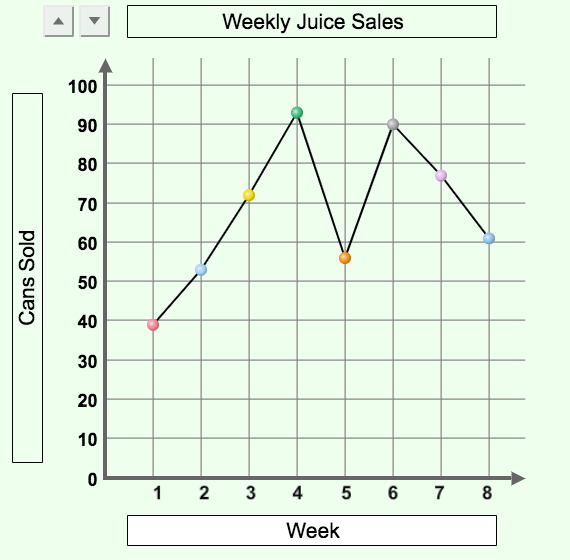
Identify the dependent variable by looking at the graph.
Weeks
Weekly Juice Data
Cans Sold
Indirect Relationship
A student predicts that similar ice cubes will melt faster in a microwave than in a pot on the stove. How should this hypothesis be tested?
Measure and compare the volume of the pot and the microwave.
Determine the volume of liquid water made by each ice cube.
Observe and record the time for each ice cube to completely change to liquid.
Identify and record the temperature of each ice cube before each trial.
After a recent experiment, a scientist noted that the computer simulation varied from the actual experiment. What should the scientist do?
Repeat the experiment several times in order to verify the results.
Ignore the simulation as inaccurate because of a possible computer virus.
Ignore the actual results as inaccurate because computers are always correct.
Adjust the computers program so it matches the actual results.


Priya, Arjun, and Grace conducted an experiment with gummy bears. They submerged gummy bears in different liquids and observed the changes. Based on their observations, which of the following statements is accurate?
There was no change to the gummy bear after 24 hours of being submerged in water.
The gummy bear changed the most in length from being submerged in vinegar.
The gummy bear that has the greatest mass is the one that was submerged in vinegar.
Gummy bears change color when they are submerged in different liquids.

The data table shows the results of an experiment where a model car was modified and rolled down a track.
Which two trials would you compare to show how changing the Wheel Base Width affected the time? (Choose 2)
1
2
3
4
Justin usually blows his nose using Kleenex tissues. His snot keeps leaking through the tissue. He decided he is going to create an experiment to find the best tissue brand. What would be 1 constant?
amount of tissue
type of tissue
kleenex
which one works better

Is the following conclusion correct? A scientist observed a bumble bee in a large field. The bumble bee landed only on pink flowers. The scientist concluded that all bumblebees prefer pink flowers
It is incorrect because there are no pink flowers
it is correct because I know all about bees
It is incorrect because it is not logical to draw conclusions about all butterflies after observing just one.
it is correct because i have done research on bees
What inference would best go with the following experiment?
Students put a stalk of celery in dyed blue water. After a certain amount of time, they cut it open and part of the inside was blue.
students inferred that water moves up the stems of plants
students inferred that putting cut celery in water will make it grow taller
students inferred that water is not good for plants

In this graph, scientists counted how many seeds were made by a fruit depending on how the flower was pollinated. (Self pollinated, by a bee or by the farmer/manual) What is the RESPONDING/dependent variable?
The number of seeds
The type of fruit
How the flower was pollinated (self, bee, manual)
In this graph, scientists counted how many seeds were made by a fruit depending on how the flower was pollinated. (Self pollinated, by a bee or by the farmer/manual) What is the MANIPULATED/Independent variable?
The number of seeds
The type of fruit
How the flower was pollinated (self, bee, manual)

What is something you would have to keep constant in this experiment? (select all that apply)
amount of sunlight all plants get
amount of water all plants get
type of plants
Plastic or Cloth covering


Which of the following claims can be supported by the graph?
roots appear healthier in soil with low amounts of salt
roots appear healthier in soil with high amounts of salt
roots appear healthier in soil with medium amounts of salt
salt concentration in soil has no effect on plant growth
Categorize the Variables
A scientist is conducting an experiment to see if the amount of sleep students get the night before a test affect their performance
Amount of sleep
Test scores of the students
Students who study with no music
Students who get a typical amount of sleep (Aprox. 8 hours)
Test difficulty
Study materials provided
Testing environment
Time the test is given
Age/grade level of the students
Categorize the Variables
A scientist is conducting an experiment to see how much salt is needed be added to water to make an egg float
Amount of salt added to the water
The egg floating or not
Water with NO salt added
Type and size of egg
Amount of water used
Temperature of the water
Type of container used

A scientist wants to learn more about how temperature affects how fast sugar dissolves in water. They stir sugar into cups of water at different temperatures and measure how long it takes for the sugar to dissolve completely.
What question is the scientist trying to answer?
How much sugar is in a sugar cube?
Does sugar dissolve faster in hot or cold water?
What does sugar taste like at different temperatures?
How long does it take to freeze sugar water?
A scientist wants to learn more about how temperature affects how fast sugar dissolves in water. They stir sugar into cups of water at different temperatures and measure how long it takes for the sugar to dissolve completely.
Match each term with the correct information about this experiment:
Water Temperature
Independent Variable
Time for sugar to dissolve
Dependent Variable
Amount of sugar, amount of water, stirring method
Constant(s)
10 Degree Water
Control
Match the Unit to the Measurement
Meters (m)
Length
Grams (g)
Mass
Celcius (C*)
Temperature
Liters (L)
Volume
Pounds (lbs)
Weight
Match the tool to the measurement

Temperature

Mass

Volume

Length

