
 Worksheets
Macromolecules & Enzymes
Total questions: 30
Worksheet time: 16mins
Which type of snack would provide someone with a quick burst of short-term energy, while limiting other biomolecules?


What is the difference between lipids and carbs?
Carbohydrates provide cells with the structures to build & repair cells, while lipids code for the cell's genetic info.
Carbohydrates supply cells with fast, easy to use energy, while lipids supply cells with more, long-term energy.
Lipids supply cells with fast, easy to use energy, while carbohydrates supply cells with more, long-term energy.
Which snack will provide lean protein & long-term energy while limiting calories from other biomolecules?


Researchers observe 3 molecules & conclude they must serve different purposes in cells. What best represents the similarities & differences of the molecules?
Carbs & proteins both contain Carbon, Hydrogen, and Oxygen atoms, while the lipids contain Sulfur in addition to those 3 elements.
Carbs & lipids both contain Carbon, Hydrogen, & Oxygen atoms, while the proteins contain nitrogen in addition to those three elements.
Carbs & proteins both contain Carbon, Hydrogen, & Oxygen atoms, while the lipids contain nitrogen in addition to those three elements.
Which macromolecule can provide insulation?
Which macromolecule carries genetic information?
Nucleic Acids
Carbohydrates
Some are stringy & fibrous & provide support (collagen & keratin)
Carbohydrates
Lipids
Proteins
Nucleic Acids
Which macromolecule is used as a main source of energy for a cell?
Carbohydrates
Help speed up cellular reactions
Carbohydrates
Lipids
Proteins
Nucleic Acid
True or False?
All biomolecules could be called carbon-based molecules.
True
False
True or False
The monomers of DNA are nucleotides.
True
False
True or False.
Cell membranes are made, in part, from phospholipids.
False
Which of the following are nucleic acids? (choose 2)
Starch
DNA
Glucose
RNA
Lipase
Which of these correctly pairs the macromolecule with its monomer?
lipids: nucleic acids
lipids: fatty acids
protein: nucleic acid
Which of these correctly pairs the macromolecule with its monomer?
protein: amino acid
carbohydrate: starch
protein: nucleic acid
Which of these correctly pairs the macromolecule with its monomer?
carbohydrate: monosaccharide
lipid: protein
DNA: RNA
True or False
The monomer for lipids is fatty acid and glycerol.
True
False
A molecule is ring shape, made of carbon, hydrogen, and oxygen atoms in a 1:2:1 ratio. Choose all that apply to this molecule (choose 3).
This molecule is likely a sugar.
This molecule is likely a carbohydrate.
This molecule is produced during photosynthesis.
This molecule comprises the largest component of the cell membrane.
This molecule is an enzyme.
Which macromolecule is made of Carbon, Nitrogen, Oxygen, and Hydrogen.
Which macromolecule can act as a catalysts to help carry out the thousands of chemical reactions that take place in cells?
lipid - hormone
protein - enzyme
carbohydrate - cellulose
nucleic acid - RNA
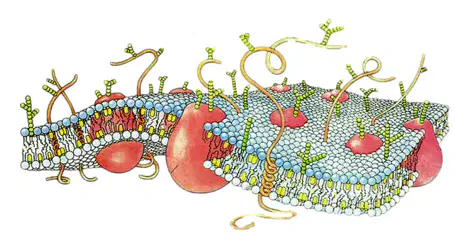
Membrane proteins allow cells to communicate with their environments. What is another function of membrane proteins?
DNA replication and snythesis
Providing a source of energy for the cell
Storing energy for long-term use in the cell
Moving molecules in and out of the cell
Which macromolecule is formed from amino acids joined by peptide bonds?
What would provide the most energy?
glucose
insulin
monosaccharide
triglyceride
Glycogen is a long chain of glucose molecules bonded together, therefore glycogen is a...
lipid
monosaccharide
polysaccharide
protein
Enzymes belong to which macromolecule category?
The ideal temperature to study the effect of proteases on protein is 37 degrees. Why are higher temperatures not advised?
this could result in denaturing of the protein
the substrate will be decomposed
the protein will react with the proteases only at the indicated temperature.
What provides the most energy or kilocalories per gram of food?
Carbs
Lipids (fats)
Protein
Sugars
Excess energy is stored as fat because fats...
its a compact source of energy
break down easily
store twice as much energy per gram
Why are enzymes reusable?
enzymes ensure that the reaction continues without inhibition even if the conditions such as temp and pH change
the products of the reaction are released from the active sites of the enzyme, allowing other substrate molecules to bind with the sites.
In the lock-and-key model of enzyme action, the _______ fits into the active site of the enzyme.
substance
product
substrate

