
 Worksheets
Unit 1 Review
Total questions: 33
Worksheet time: 12mins
Where have archaeologists found the earliest evidence of humans?
Africa
Australia
Mars
South America

Use the map and your knowledge of social studies to answer the question.
Which letter represents the continent of Africa?
A
B
C
D

Use the World History Timeline to answer the question below.
Using the timeline, what CLAIM can be made about early humans?
Early humans never migrated out of Africa.
Early humans migrated before they began using tools.
Early humans began migrating out of Africa around 2.6 million years ago.
Early humans used tools before they began to migrate.

Using the source and your background knowledge, what claim could be made about how early humans migrated?
Early humans migrated to North America by foot on land.
Early humans migrated to North America by boats along the coastline.
Early humans migrated to North America by airplanes.
Early humans migrated to North America by using fire.
How did early humans use fire?
Select the TWO correct answers.
For warmth and light
For making pottery
For cooking and protection
For baking cookies
For migrating from place to place
How do we know things about the prehistoric ancient past?
Archaeologists have found stone tools and other artifacts from prehistoric times.
Geologists have uncovered different types of rocks.
Historians have found written records from prehistoric times.
Early humans passed down their legends and tales to people today.
Why did early human beings migrate to different places around the world?
Select the THREE correct answers.
Africa became drier and hotter due to climate change.
Some nomadic groups became too large, causing them to split up in different directions.
Nomadic groups migrated to where the discovery of fire was.
Hunter-gatherer groups followed herds of animals to different locations.
Early humans migrated due to Africa becoming colder and having too many animals.

Analyze the prehistoric cave painting.
Which statement BEST describes the cave painting?
The painting shows the importance of fire for early humans for cooking and preserving meat.
The painting shows that early humans cooperated and used hand-made weapons to hunt.
The painting shows that early humans did not use weapons to hunt.
The painting shows the importance of using caves for shelter.

Use the source to answer the question.
Which statement BEST explains why early hunter-gatherers banded together
and helped each other?
Early humans wanted to communicate with each other.
Early humans came together so they would be safe and have a better
chance of survival.
Early humans painted cave art together.
Early humans banded together and helped each other to build large
shelters and settlements.
A scientist that studies evidence that humans leave behind is called an ___________.
Paleontologist
Geologist
Biologist
Archaeologist
What made farming easier for people during the Agricultural Revolution?
making tools
studying plants
building settlements
roaming from place to place
What is another name for the Neolithic Revolution?
Scientific revolution
Agricultural revolution
Industrial revolution
Digital revolution
Which of the following are examples of physical geography? Select the THREE correct answers.
forests
oceans
building roads
rivers
planting crops
Planting crops is an example of ________.
physical geography
human geography
resource geography
settlement geography
How did food surpluses affect people during the Agricultural Revolution? Select the THREE correct answers.
People created storage systems for surplus food.
People moved from place to place looking for food surpluses.
People had more food security to to grow their communities.
People needed to stay in one place to be near their storage.
People would have to go hunting, gathering plants, and make temporary houses.
Having more of something than you need is called a _______.
scarcity
artifact
surplus
bonus
Which of the following are examples of life for early nomadic people?
Select the THREE correct answers.
gathering plants, nuts, and berries
growing crops to settle in one place
making simple tools
living in temporary shelters
trading surpluses of crops with other groups
Which of the following are characteristics of civilizations? Select the three correct answers.
tools
nomadic lifestyle
hunting gathering
infrastructure
government
specialization
artifacts
primary sources
pottery
pictures
symbols
stone

What conclusion can be made about the people of Mesopotamia from this image?
They sang many songs as part of their harvest celebrations.
They had complex architecture.
They had a shared language.
They followed the same laws.

This Mesopotapian figure shows a person playing a harp.
What conclusion can be made about the Mesopotamian civilization?
There were distinct social classes.
They bartered for what they needed.
There was a common language.
They had a specialized civilization.

What geographical feature was common to the earliest civilizations?
wood or oil for fuel
level ground for buildings
nearby rivers and floodplains
nearby mountains with caves
What advancement in technology allowed farmers to practice larger-scale agriculture?
public transportation
pottery wheel
irrigation
writing

This carved stone from Mesopotamia records a gift of land from a king.
What were early forms of writing like this used for?
land and other property records
fiction stories
report cards
recipes
What was one effect of settling in one place?
Humans did not need tools for agriculture anymore.
Humans lived in smaller communities.
Humans built permanent homes.
Humans had fewer children.
The Neolithic period, or New Stone Age, lasted from 10,000 BCE to 3000 BCE. This was a period of significant change for the people who lived during these times, as their entire way of life shifted.
How can the changes that happened during the Neolithic period be characterized?
People transitioned from agricultural societies to nomadic life.
People transitioned from nomadic life to agricultural societies.
People transitioned from not having language to having language.
People transitioned from many civilizations to one global civilization.
What was one effect of the domestication of animals?
It led to the extinction of many species.
It had no significant effect on human societies.
It provided humans with reliable milk, food, and labor.
It led to a decrease in human population due to the spread of disease from the animals.
What happened when farmers grew more crops than they could use in a season?
They burned the surplus.
They built ways to store the surplus.
They planted less the following year.
They gave the surplus to their neighbors.
What was the diet of early hunter-gatherers?
crops they planted
small animals
and wild plants
fish, berries, and nuts
any food that could be scavenged
What climate conditions do scientists believe caused
the earliest humans to migrate during the Paleolithic period?
ice ages
warm winters
severe floods
intense storms
What occurred about 60,000 - 90,000 years ago?
Humans began settling in large civilizations.
Humans began migrating from Africa.
Humans created rafts and boats.
Herto Man lived.
Why were early human hunter-gatherers nomadic?
They scavenged.
They were escaping ice storms.
They followed migrating animals
They did not know how to build permanent homes.
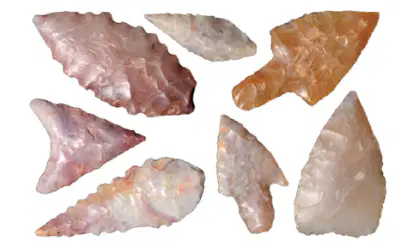
Use the image to answer the question.
How did hunter-gatherers use the tools shown in this image?
to travel long distances
to make cave drawings
to pick wild vegetation
to hunt animals

What does the photo of a Paleolithic cave painting suggest about how early humans lived?
They depended on animals for survival.
They lived in caves with animals.
They had advanced artistic skills.
They spent all their time in caves.

