
 Worksheets
UNIT 2 Review
Total questions: 52
Worksheet time: 56mins
What is the name of the jelly-like substance that is inside the cell?
cytoplasm
ectoplasm
cytokinesis
What cell feature is responsible for powering the cell? (Power house!)
endoplasmic reticulum
Golgi body
mitochondria
Where in the cell is (DNA) found?
ribosomes
mitochondria
nucleus
What cell feature contain digestive enzymes which breaks things down?
lysosomes
mitochondria
chloroplast
nucleus
Which cell feature transports ribosomes?
Golgi body
endoplasmic reticulum
chloroplast
lysosomes
Which cell feature is responsible for storing water?
vacuole
mitochondria
lysosomes
nucleus
Match the following organelles with their correct functions
Ribosomes
Synthesizes proteins
Lysosomes
Cleans the cell of waste
Mitochondria
Provides energy (ATP)
Golgi Complex
ships packages out of the cell
Vacuole
stores water, waste, and nutrients
What type of cell has a nucleus?
eukaryotic
prokaryotic
neither
both
Which type of cells has a chloroplast?
Prokaryote
Plant Cell
Animal Cell
Bacteria
Which do BOTH prokaryotes and eukaryotes contain?
nucleus
mitochondria
ribosomes
cell wall
Bacteria are considered what?
Eukaryotes
Prokaryotes

Plant Cell

Bacteria Cell

Animal Cell
* All cells have
* DNA, Cytoplasm, Ribosomes
* Smaller simple cells no nucleus
* Prokaryote
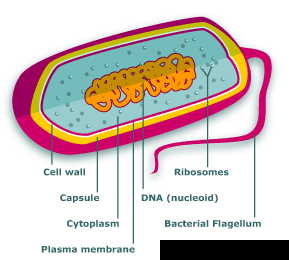

Which type of cell is more complex?
Prokaryote
Eukaryote
Plant and animal cells are examples of
prokaryotic cells
eukaryotic cells
CHALLENGE QUESTION: Which of the following provides evidence for the hypothesis that prokaryotes evolved before eukaryotes.
prokaryotes are more complex
prokaryotes have no nucleus and fewer genes
eukaryotes are multicellular which makes them simpler
prokaryotes grow into eukaryotes
Diffusion & Facilitated Diffusion are both __________ transport.
Passive
Active
Easy
Free
Passive Transport is the movement of particles across the membrane from an area of [ ___ ] to an area of [ ___ ]
high to low
low to high
low to low
high to high
Passive Transport is the movement of particles _________ the concentration gradient.
with
against
opposing
throughout
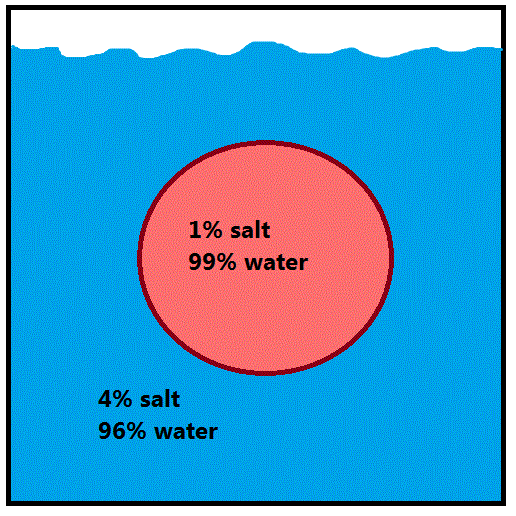


Hypertonic
Isotonic
Hypotonic

Hypertonic
Isotonic
Hypotonic

What type of transport are endocytosis and exocytosis?
Passive Transport
Active Transport

In the cell pictured, which way would water move?
Into the cell, causing the cell to swell
Out of the cell, causing the cell to shrink
In and out of the cell equally, keeping the shape the same

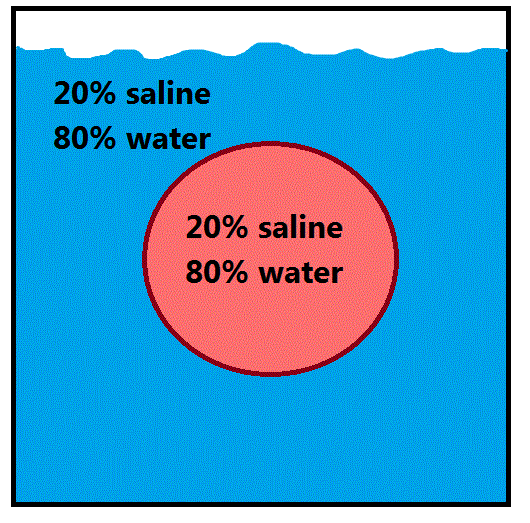
In the cell pictured, which way would water move?
Into the cell, causing the cell to swell
Out of the cell, causing the cell to shrink
In and out of the cell equally, keeping the shape the same


Endocytosis and exocytosis both use energy to engulf substances with the cell membrane. However, _____________ brings substances into the cell, while ____________ takes substances out of the cell.
endocytosis, exocytosis
exocytosis, endocytosis
endocytosis, endocytosis
exocytosis, exocytosis


Which cell type tends to be smaller?
Prokaryote
Eukaryote
there is not a size difference
Bacteria is an example of a(n)
prokaryotic cell.
eukaryotic cell.

F
G
H
J
The Endosymbiotic Theory explains
the origin of prokaryotes
how bacteria lives
the origin of eukaryotes
how species develop

Two students are reading an article about the evidence of the endosymbiotic theory. As they are reading, they have drawn images of what they believe to be occurring on index cards. The two students are engaging in a discussion on how the index cards should be ordered to accurately show the evolution of eukaryotic cells.
Student A claims the order should be B, E, D, A, C. Their reasoning is that since the small circles without lines in the index cards represent chloroplasts, photosynthesizing organisms evolved before aerobic organisms.
Student B claims the order should be B, A, C, E, D. Their reasoning is that since the small ovals with lines in the index cards represent mitochondria, respiratory organisms evolved before photosynthesizing organisms
Use the diagram to answer the question. Which statement below is accurate about the discussion above?
student A has a correct ordering of index cards but incorrect reasoning.
student B has a correct ordering of index cards and correct reasoning.
Student A has a correct ordering of index cards and correct reasoning.
Student B has a correct ordering of index cards but incorrect reasoning.


