
 Worksheets
Gas Exchange in the Lungs
Total questions: 21
Worksheet time: 28mins
Inside the air sacs, (a) from the air goes into the blood.
Carbon dioxide from the blood goes into the (a) .
The process of gases moving between the air and blood is called (a) .
The tiny air sacs in the lungs are called (a) .
The walls of the air sacs are very (a) , allowing gases to move easily.
What comes into the lungs from outside the body?
Carbon dioxide
Oxygen
Nitrogen
Helium
Which gas moves from the air into the blood?
Carbon dioxide
Oxygen
Nitrogen
Hydrogen
What is the name of the process where gases move from an area of high concentration to an area of low concentration?
Respiration
Circulation
Diffusion
Evaporation
In which part of the blood does oxygen combine with hemoglobin?
White blood cells
Plasma
Platelets
Red blood cells
What separates the air in the alveoli from the blood in the capillaries?
A thick membrane
Two very thin cells
A bone
A muscle
What is the primary function of the alveoli in the lungs?
To filter air
To exchange gases
To produce mucus
To regulate temperature
Which gas is a byproduct of cellular respiration?
Oxygen
Carbon dioxide
Hydrogen
Nitrogen
Which of the following is a correct statement about the composition of inhaled and exhaled air?
Inhaled air contains more oxygen than exhaled air
Exhaled air contains more nitrogen than inhaled air
Inhaled air contains more carbon dioxide than exhaled air
Exhaled air contains the same amount of water vapor as inhaled air
What is the correct pathway of air during inhalation?
Nose/mouth → pharynx → larynx → trachea → bronchi → alveoli
Nose/mouth → larynx → pharynx → trachea → bronchi → alveoli
Nose/mouth → trachea → larynx → pharynx → bronchi → alveoli
Nose/mouth → bronchi → trachea → larynx → pharynx → alveoli
Which of the following statements about gas exchange is correct?
Oxygen moves from areas of low concentration to high concentration
Carbon dioxide moves from the blood into the alveoli
Gas exchange occurs in the trachea
Nitrogen is actively transported across the alveolar membrane
Explain why it's important for the walls of the alveoli to be very thin.
Describe how oxygen moves from the air into the blood.
Why does carbon dioxide move from the blood into the air in the alveoli?
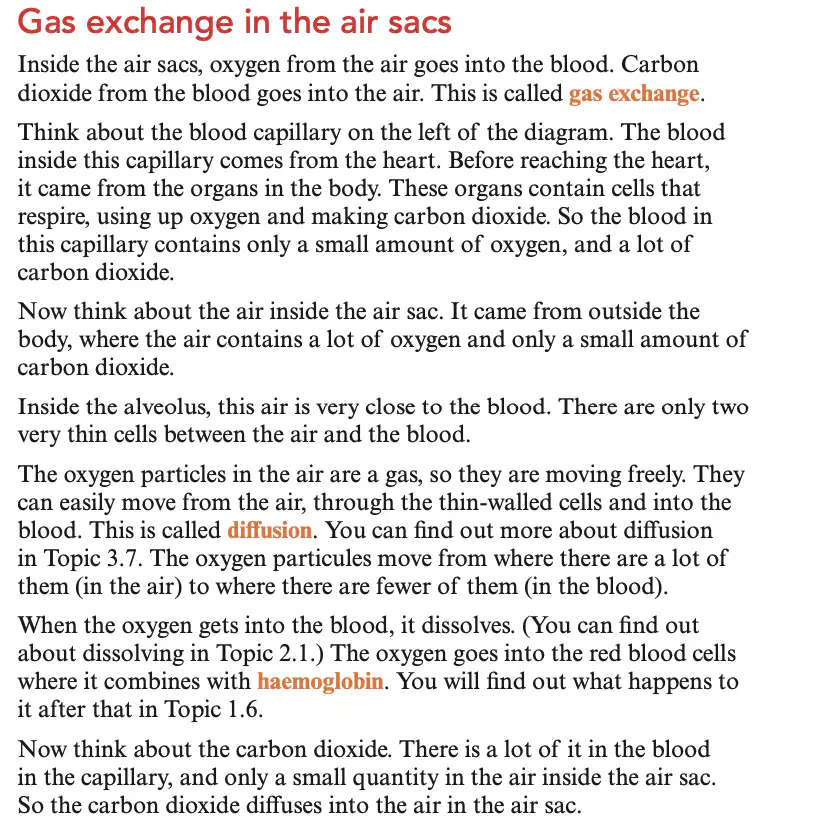
Based on the text, explain the process of gas exchange that occurs inside the air sacs. How does the movement of oxygen and carbon dioxide illustrate the concept of diffusion?
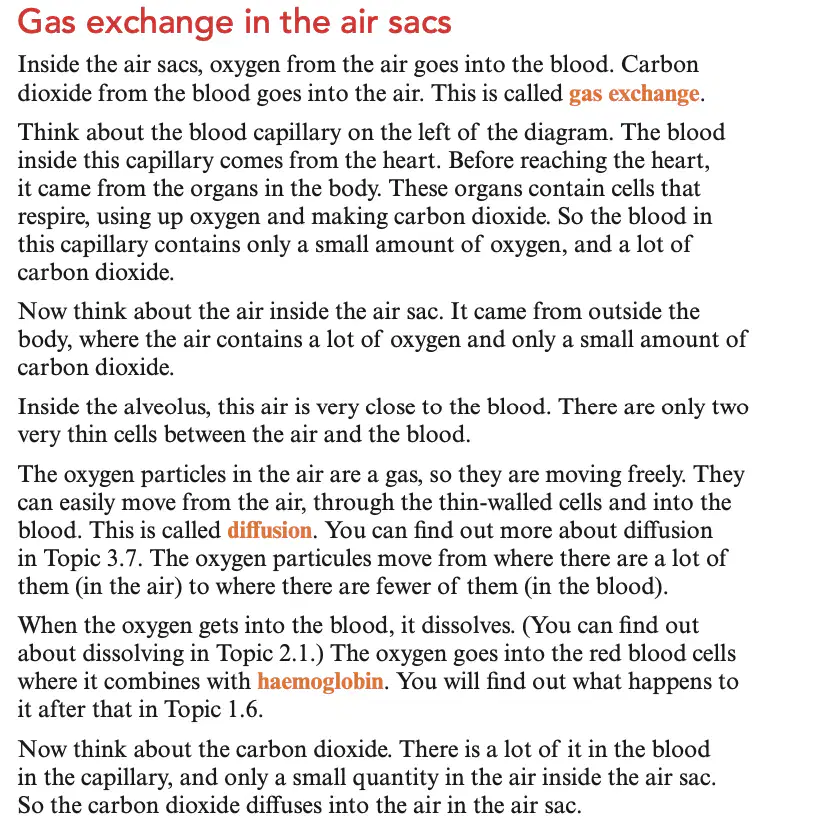
Identify the significance of the thin-walled cells mentioned in the text. How do their properties facilitate the process of gas exchange between the air and the blood?
Identify the parts or the process of diffusion of gas exchange that is happening in the alveoli.

